Search
Proteintech
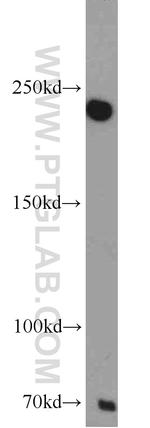
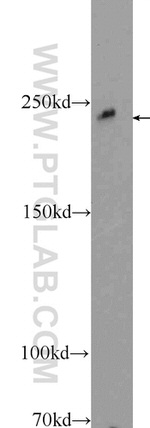
MAPKBP1 Polyclonal Antibody
{{$productOrderCtrl.translations['antibody.pdp.commerceCard.promotion.promotions']}}
{{$productOrderCtrl.translations['antibody.pdp.commerceCard.promotion.viewpromo']}}
{{$productOrderCtrl.translations['antibody.pdp.commerceCard.promotion.promocode']}}: {{promo.promoCode}} {{promo.promoTitle}} {{promo.promoDescription}}. {{$productOrderCtrl.translations['antibody.pdp.commerceCard.promotion.learnmore']}}
Additional Information:
{{banner.description}}
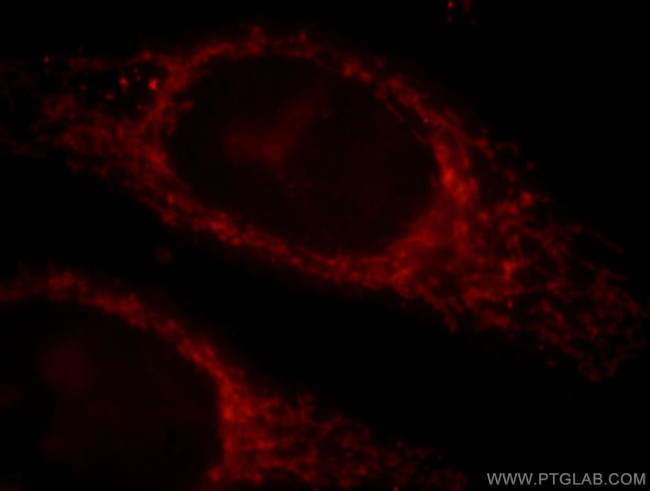


产品信息
17788-1-AP
应用
建议稀释比
已发表文章
产品规格
种属反应
Human,
Mouse,
Rat
宿主/亚型
Rabbit
/ IgG
分类
Polyclonal
类型
Antibody
抗原
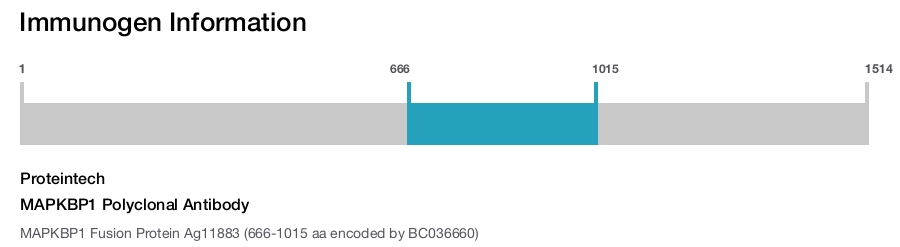
MAPKBP1 Fusion Protein Ag11883 (666-1015 aa encoded by BC036660)
偶联物
Unconjugated
Unconjugated
Unconjugated
形式
Liquid
浓度
0.28 mg/mL
规格
42 µg
纯化类型
Antigen affinity chromatography
保存液
PBS, pH 7.3, with 50% glycerol
内含物
0.02% sodium azide
保存条件
-20°C
运输条件
Wet ice (domestic); Dry ice (international)
产品详细信息
Immunogen sequence: SVLLPRCRL NPDSSWAPKR VATASPFSGL QKAQSVHSLV PQERHEASLQ APSPGALLSR EIEAQDGLGS LPPADGPPSR PHSYQNPTTS SMAKISRSIS VGENLGLVAE PQAHAPIRVS PLSKLALPSR AHLVLDIPKP LPDRPTLAAF SPVTKGRAPG EAEKPGFPVG LGKAHSTTER WACLGEGTTP KPRTECQAHP GPSSPCAQQL PVSSLFQGPE NLQPPPPEKT PNPMECTKPG AALSQDSEPA VSLEQCEQLV AELRGSVRQA VRLYHSVAGC KMPSAEQSRI AQLLRDTFSS VRQELEAVAG AVLSSPGSSP GAVGAEQTQA LLEQYSELLL RAVERRMERK L (666-1015 aa encoded by BC036660)
靶标信息
MAP kinases play a significant role in many biological processes, including cell adhesion and spreading, cell differentiation and apoptosis. MAPKBP-1 (mitogen-activated protein kinase binding protein 1), also known as JNKBP-1, is a 1,514 amino acid protein that contains twelve WD repeats. Induced by TRAF2 (TNF receptor-associated factor 2) and Tak1 (TGF-beta-activated kinase 1), MAPKBP-1 is thought to act an adaptor protein for NFkappaB (nuclear factor kappa-B) activation. MAPKBP-1 interacts with JNK3 and may promote TRAF2 polyubiquitination. MAPKBP-1 exists as six alternatively spliced variants and is encoded by a gene located on human chromosome 15. Human chromosome 15 houses over 700 genes and comprises nearly 3% of the human genome. Angelman syndrome, Prader-Willi syndrome, Tay-Sachs disease and Marfan syndrome are all associated with defects in chromosome 15-localized genes.
仅用于科研。不用于诊断过程。未经明确授权不得转售。
篇参考文献 (0)
您是否在文献中引用过该产品?请点击下方按钮邮件告知我们。
生物信息学
蛋白别名: JNK-binding protein 1; JNKBP-1; Jun N-terminal kinase binding protein 1; Jun N-terminal kinase-binding protein 1; mitogen activated protein kinase binding protein 1; Mitogen-activated protein kinase-binding protein 1; unnamed protein product
基因别名: 2810483F24Rik; AW123212; JNKBP-1; JNKBP1; KIAA0596; MAPKBP1; mKIAA0596; NPHP20
UniProt ID: (Human) O60336, (Mouse) Q6NS57
Entrez Gene ID: (Human) 23005, (Mouse) 26390, (Rat) 362197
Disclaimer

Clicking the images or links will redirect you to a website hosted by BenchSci that provides third-party scientific content. Neither the content nor the BenchSci technology and processes for selection have been evaluated by us; we are providing them as-is and without warranty of any kind, including for use or application of the Thermo Fisher Scientific products presented.

