Search
Invitrogen
MERTK Monoclonal Antibody (A3KCAT), eBioscience™
{{$productOrderCtrl.translations['antibody.pdp.commerceCard.promotion.promotions']}}
{{$productOrderCtrl.translations['antibody.pdp.commerceCard.promotion.promocode']}}: {{promo.promoCode}} {{promo.promoTitle}} {{promo.promoDescription}}. {{$productOrderCtrl.translations['antibody.pdp.commerceCard.promotion.learnmore']}}
{{$ctrl.translations['antibody.pdp.skuNotes.additionalInformation']}}:
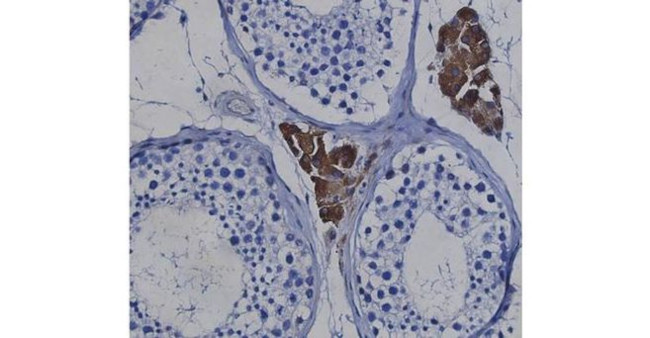
Please note: We are reviewing Western blot images included in the antibody testing data in our catalog, including those provided by third parties. Unless expressly labeled or annotated as “raw-unedited”, Western blot images included in the antibody testing data in our catalog may have been edited, optimized or otherwise adjusted for presentation.

产品信息
14-9053-82
产品规格
种属反应
Human
宿主/亚型
Mouse
/ IgG1, kappa
分类
Monoclonal
类型
Antibody
克隆号
A3KCAT
抗原
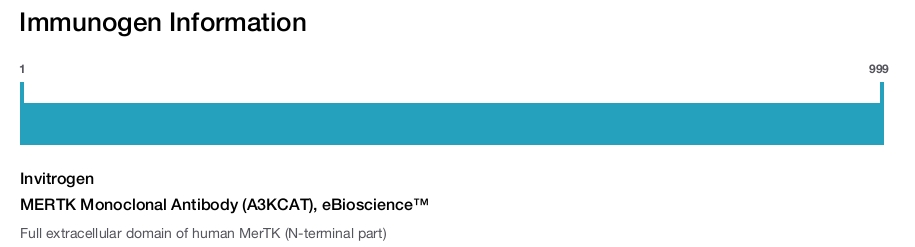
Full extracellular domain of human MerTK (N-terminal part)
偶联物
Unconjugated
Unconjugated
Unconjugated
形式
Liquid
浓度
0.5 mg/mL
规格
100 µg
纯化类型
Affinity chromatography
保存液
PBS
内含物
0.09% sodium azide
保存条件
4°C, do not freeze
运输条件
Ambient (domestic); Wet ice (international)
RRID
产品详细信息
This A3KCAT antibody recognizes human MerTK, known also as MER or c-mer, a 170-210 kDa member of the TAM family of tyrosine kinase receptors that also includes Axl and Tyro3. MerTK is expressed on a subset of anti-inflammatory macrophages and is involved in the removal of apoptotic cells. This process relies on two soluble ligands of MerTK, Protein S and Gas6, that coat the surface of cells undergoing apoptosis. Upon binding these ligands, MerTK undergoes autophosphorylation at multiple tyrosine residues that activate the PI3K and Akt pathways. This results in the phagocytosis of target cells and also the direct inhibition of TLR-induced production of pro-inflammatory cytokines by the phagocytes. MerTK may also function as a putative entry receptor for filoviruses. Deficiency of MerTK causes general autoimmunity, inflammation, and accumulation of apoptotic bodies. MerTK can be released from the cell surface by metalloproteinases, and this process is significantly enhanced when macrophages are stimulated e.g. with LPS. MerTK is often expressed on malignant cells, and may be implicated in immune evasion.
This A3KCAT antibody has been tested by immunohistochemistry of formalin-fixed paraffin embedded tissue using low or high pH antigen retrieval and can be used at less than or equal to 0.5 µg/mL. It is recommended that the antibody be carefully titrated for optimal performance in the assay of interest.
Purity: Greater than 90%, as determined by SDS-PAGE.
Aggregation: Less than 10%, as determined by HPLC.
Filtration: 0.2 µm post-manufacturing filtered.
靶标信息
MERTK (cMER) is a tyrosine kinase proto-oncogene and is involved in the retinal pigment epithelium (RPE) phagocytosis pathway, which is implicated in human retinal disease. Regulates many physiological processes including cell survival, migration, differentiation, and phagocytosis of apoptotic cells (efferocytosis). Ligand binding at the cell surface induces autophosphorylation of MERTK on its intracellular domain that provides docking sites for downstream signaling molecules. Following activation by ligand, interacts with GRB2 or PLCG2 and induces phosphorylation of MAPK1, MAPK2, FAK/PTK2 or RAC1. MERTK signaling plays a role in various processes such as macrophage clearance of apoptotic cells, platelet aggregation, cytoskeleton reorganization and engulfment. Functions in the retinal pigment epithelium (RPE) as a regulator of rod outer segments fragments phagocytosis. Plays also an important role in inhibition of Toll-like receptors (TLRs)-mediated innate immune response by activating STAT1, which selectively induces production of suppressors of cytokine signaling SOCS1 and SOCS3.
仅用于科研。不用于诊断过程。未经明确授权不得转售。
篇参考文献 (0)
您是否在文献中引用过该产品?请点击下方按钮邮件告知我们。
生物信息学
蛋白别名: c-mer proto-oncogene tyrosine kinase; MER receptor tyrosine kinase; MGC133349; novel cellular proto-oncogene; proto-oncogene c-Mer; receptor tyrosine kinase MerTK; sMER; sMERTK; soluble MER; soluble MERTK; STK kinase; unnamed protein product
基因别名: c-Eyk; c-mer; MER; RP38; Tyro12
UniProt ID: (Human) Q12866
Entrez Gene ID: (Human) 10461
Disclaimer

Clicking the images or links will redirect you to a website hosted by BenchSci that provides third-party scientific content. Neither the content nor the BenchSci technology and processes for selection have been evaluated by us; we are providing them as-is and without warranty of any kind, including for use or application of the Thermo Fisher Scientific products presented.

