Search
Invitrogen
MIF Polyclonal Antibody
{{$productOrderCtrl.translations['antibody.pdp.commerceCard.promotion.promotions']}}
{{$productOrderCtrl.translations['antibody.pdp.commerceCard.promotion.promocode']}}: {{promo.promoCode}} {{promo.promoTitle}} {{promo.promoDescription}}. {{$productOrderCtrl.translations['antibody.pdp.commerceCard.promotion.learnmore']}}
{{$ctrl.translations['antibody.pdp.skuNotes.additionalInformation']}}:
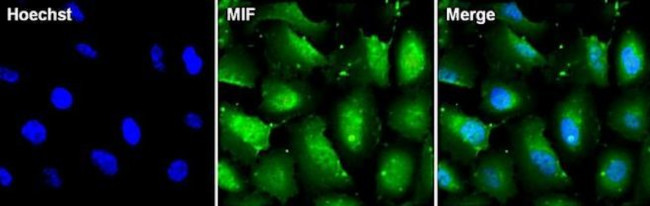
图: 1 / 9
MIF Antibody (36-7401) in ICC/IF
Immunofluorescent analysis of MIF in U2OS cells. The cells were fixed with 4% paraformaldehyde in PBS for 15 minutes, permeabilized with 0.1% Triton X-100 for 15 minutes, and blocked with 3% BSA in PBS for 30 minutes at room temperature. Cells were stained with a MIF mouse monoclonal antibody (Product # 36-7401) at a dilution of 1:100 in blocking buffer for 1 hour at room temperature, and then incubated with Goat anti-Rabbit IgG (H+L) Secondary Antibody, Alexa Fluor® Plus 488 conjugate (Product # A32731) at a dilution of 1:500 for at least... View More
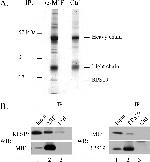
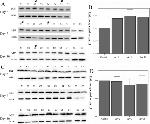
Please note: We are reviewing Western blot images included in the antibody testing data in our catalog, including those provided by third parties. Unless expressly labeled or annotated as “raw-unedited”, Western blot images included in the antibody testing data in our catalog may have been edited, optimized or otherwise adjusted for presentation.


产品信息
36-7401
应用
建议稀释比
已发表文章
产品规格
已发表种属
Chicken,
Human,
Mouse
宿主/亚型
Rabbit
/ IgG
分类
Polyclonal
类型
Antibody
抗原
Recombinant rat MIF fusion protein
偶联物
Unconjugated
Unconjugated
Unconjugated
形式
Liquid
保存条件
-20°C
运输条件
Wet ice
RRID
产品详细信息
36-7401 detects MIF from human, mouse and rat samples.
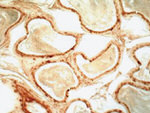
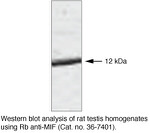
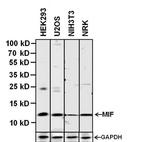
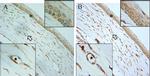
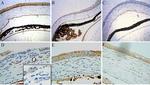
36-7401 has been successfully used in Western blot, immunohistochemical, immunofluorescence and immunoprecipitation procedures. By Western blot, this antibody detects a 12 kDa protein representing MIF. Immunofluorescent staining in U2OS cells and Immunohistochemical staining of MIF in rat epididymis tissue with 36-7401. yields a staining pattern consistent with MIF in nucleus and cytosol.
靶标信息
MIF (macrophage migration inhibitory factor) was one of the first cytokine activities to be discovered and was initially described as a T cell-derived factor that inhibits the random migration of macrophages (Weiser 1989). Recently, MIF was rediscovered as a pituitary hormone that act as the counterregulatory hormone for glucocorticoid action within the immune system (Bernhagen 1993, Mitchell 1995). MIF was released from macrophages and T cells in response to physiological concentrations of glucocorticoids. The secreted MIF counter-regulates the immunosuppressive effects of steroids on immune cell activation and cytokine production (Bucala 1998). MIF plays a critical role in the host control of inflammation and immunity.
仅用于科研。不用于诊断过程。未经明确授权不得转售。
Disclaimer

Clicking the images or links will redirect you to a website hosted by BenchSci that provides third-party scientific content. Neither the content nor the BenchSci technology and processes for selection have been evaluated by us; we are providing them as-is and without warranty of any kind, including for use or application of the Thermo Fisher Scientific products presented.

