Search
Proteintech
MPZL2 Polyclonal Antibody
{{$productOrderCtrl.translations['antibody.pdp.commerceCard.promotion.promotions']}}
{{$productOrderCtrl.translations['antibody.pdp.commerceCard.promotion.viewpromo']}}
{{$productOrderCtrl.translations['antibody.pdp.commerceCard.promotion.promocode']}}: {{promo.promoCode}} {{promo.promoTitle}} {{promo.promoDescription}}. {{$productOrderCtrl.translations['antibody.pdp.commerceCard.promotion.learnmore']}}
Additional Information:
{{banner.description}}


产品信息
11787-1-AP
应用
建议稀释比
已发表文章
产品规格
种属反应
Human,
Mouse,
Rat
已发表种属
Human,
Mouse
宿主/亚型
Rabbit
/ IgG
分类
Polyclonal
类型
Antibody
抗原
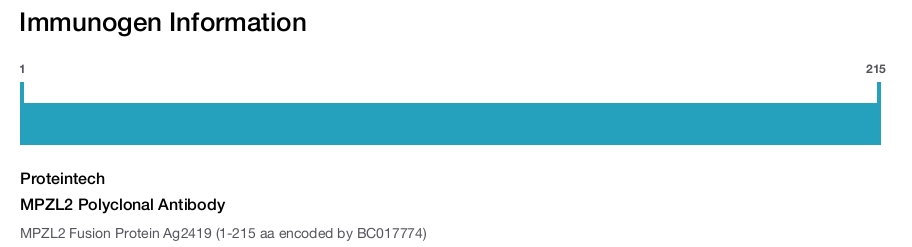
MPZL2 Fusion Protein Ag2419 (1-215 aa encoded by BC017774)
偶联物
形式
Liquid
浓度
0.31 mg/mL
规格
46.5 µg
纯化类型
Antigen affinity chromatography
保存液
PBS, pH 7.3, with 50% glycerol
内含物
0.02% sodium azide
保存条件
-20°C
运输条件
Wet ice (domestic); Dry ice (international)
产品详细信息
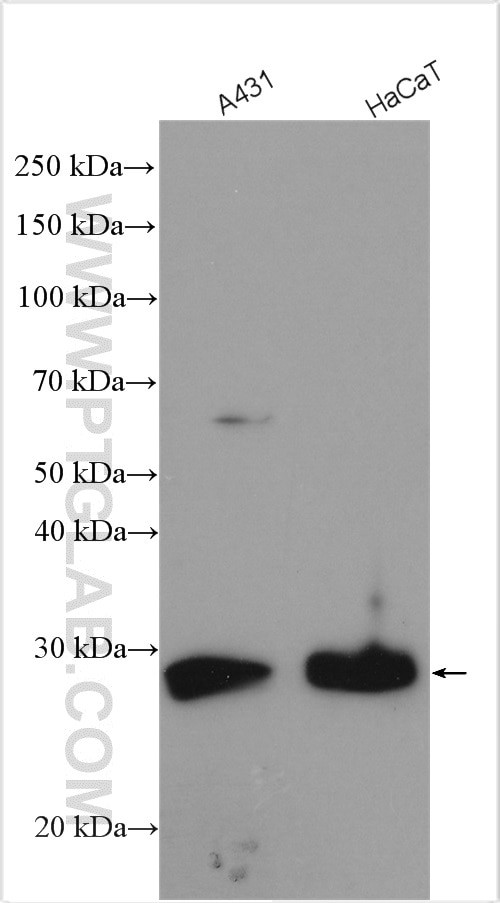
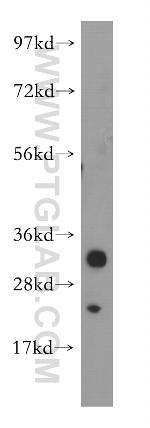
This antibody can be used to detect endogenous MPZL2, however, the reason for the additional band of 32 kDa is still unknown.
Immunogen sequence: MYGKSSTRA VLLLLGIQLT ALWPIAAVEI YTSRVLEAVN GTDARLKCTF SSFAPVGDAL TVTWNFRPLD GGPEQFVFYY HIDPFQPMSG RFKDRVSWDG NPERYDASIL LWKLQFDDNG TYTCQVKNPP DVDGVIGEIR LSVVHTVRFS EIHFLALAIG SACALMIIIV IVVVLFQHYR KKRWAERAHK VVEIKSKEEE RLNQEKKVSV YLEDTD (1-215 aa encoded by B C017774)
靶标信息
Thymus development depends on a complex series of interactions between thymocytes and the stromal component of the organ. Epithelial V-like antigen (EVA) is expressed in thymus epithelium and strongly downregulated by thymocyte developmental progression. This gene is expressed in the thymus and in several epithelial structures early in embryogenesis. It is highly homologous to the myelin protein zero and, in thymus-derived epithelial cell lines, is poorly soluble in nonionic detergents, strongly suggesting an association to the cytoskeleton. Its capacity to mediate cell adhesion through a homophilic interaction and its selective regulation by T cell maturation might imply the participation of EVA in the earliest phases of thymus organogenesis. The protein bears a characteristic V-type domain and two potential N-glycosylation sites in the extracellular domain; a putative serine phosphorylation site for casein kinase 2 is also present in the cytoplasmic tail. Two transcript variants encoding the same protein have been found for this gene.
仅用于科研。不用于诊断过程。未经明确授权不得转售。
生物信息学
蛋白别名: cell adhesion molecule; Epithelial V-like antigen 1; immunoglobulin-like protein; Myelin protein zero-like protein 2; unnamed protein product
基因别名: DFNB111; EVA; EVA1; MPZL2; UNQ606/PRO1192
UniProt ID: (Human) O60487
Entrez Gene ID: (Human) 10205, (Mouse) 14012, (Rat) 300679
Disclaimer

Clicking the images or links will redirect you to a website hosted by BenchSci that provides third-party scientific content. Neither the content nor the BenchSci technology and processes for selection have been evaluated by us; we are providing them as-is and without warranty of any kind, including for use or application of the Thermo Fisher Scientific products presented.

