Search
Bioss
NKG2D Polyclonal Antibody
{{$productOrderCtrl.translations['antibody.pdp.commerceCard.promotion.promotions']}}
{{$productOrderCtrl.translations['antibody.pdp.commerceCard.promotion.viewpromo']}}
{{$productOrderCtrl.translations['antibody.pdp.commerceCard.promotion.promocode']}}: {{promo.promoCode}} {{promo.promoTitle}} {{promo.promoDescription}}. {{$productOrderCtrl.translations['antibody.pdp.commerceCard.promotion.learnmore']}}
Additional Information:
{{banner.description}}
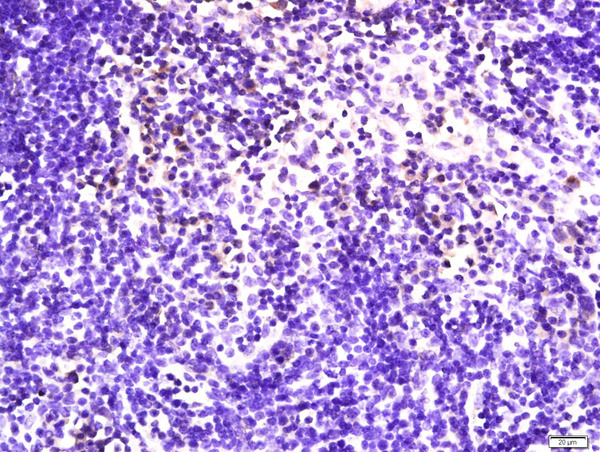
图: 1 / 2
NKG2D Antibody (BS-0938R) in IHC (P)
Paraformaldehyde-fixed, paraffin embedded mouse lymph node tissue; Antigen retrieval by boiling in sodium citrate buffer(pH6) for 15min; Block endogenous peroxidase by 3% hydrogen peroxide for 30 minutes; Blocking buffer (normal goat serum) at 37°C for 20min; Antibody incubation with Rabbit Anti-NKG2D Polyclonal Antibody, Unconjugated (bs-0938R) at 1:400 overnight at 4°C, followed by a conjugated secondary ... View More


产品信息
BS-0938R
应用
建议稀释比
已发表文章
产品规格
种属反应
Mouse,
Rat
宿主/亚型
Rabbit
/ IgG
分类
Polyclonal
类型
Antibody
抗原
KLH conjugated synthetic peptide derived from rat NKG2D, amino acids 121-219.
偶联物
形式
Liquid
浓度
1 mg/mL
规格
100 µg
纯化类型
Protein A
保存液
0.01M TBS, pH 7.4, with 50% glycerol, 1% BSA
内含物
0.02% ProClin 300
保存条件
-20°C
运输条件
Ambient (domestic); Wet ice (international)
产品详细信息
Predicted to react in humans.
靶标信息
Natural killer (NK) cells are lymphocytes that can mediate lysis of certain tumor cells and virus-infected cells without previous activation. NK cells can regulate specific humoral and cell-mediated immunity, and preferentially express several calcium-dependent (C-type) lectins, which have been implicated in the regulation of NK cell function. The NK gene encodes a member of the NKG2 family, and the encoded transmembrane protein is characterized by a type II membrane orientation (extracellular C terminus) and the presence of a C-type lectin domain. The NKG2 gene family is located within the NK complex, a region that contains several C-type lectin genes preferentially expressed in NK cells.
仅用于科研。不用于诊断过程。未经明确授权不得转售。
篇参考文献 (0)
您是否在文献中引用过该产品?请点击下方按钮邮件告知我们。
生物信息学
蛋白别名: CD314; Killer cell lectin-like receptor subfamily K member 1; natural killer cell group 2D; natural killer cell receptor; NK cell receptor D; NK lectin-like receptor; NKG2-D type II integral membrane protein; NKG2-D-activating NK receptor; NKLLR; NKR-P2; NKR-P2, ortholog of human NKG2D
基因别名: D6H12S2489E; Klrk1; NKG2-D; NKG2D; Nkrp2
UniProt ID: (Rat) O70215, (Mouse) O54709
Entrez Gene ID: (Rat) 24934, (Mouse) 27007
stimulatory C-type lectin receptor signaling pathway
positive regulation of natural killer cell mediated cytotoxicity directed against tumor cell target
natural killer cell activation
cell differentiation
positive regulation of myeloid dendritic cell activation
positive regulation of interferon-gamma production
positive regulation of apoptotic process
innate immune response
positive regulation of nitric oxide biosynthetic process
positive regulation of natural killer cell mediated cytotoxicity
defense response to Gram-positive bacterium
cellular response to lipopolysaccharide
immune system process
Disclaimer

Clicking the images or links will redirect you to a website hosted by BenchSci that provides third-party scientific content. Neither the content nor the BenchSci technology and processes for selection have been evaluated by us; we are providing them as-is and without warranty of any kind, including for use or application of the Thermo Fisher Scientific products presented.

