Search
Proteintech
OLFM1 Polyclonal Antibody
{{$productOrderCtrl.translations['antibody.pdp.commerceCard.promotion.promotions']}}
{{$productOrderCtrl.translations['antibody.pdp.commerceCard.promotion.viewpromo']}}
{{$productOrderCtrl.translations['antibody.pdp.commerceCard.promotion.promocode']}}: {{promo.promoCode}} {{promo.promoTitle}} {{promo.promoDescription}}. {{$productOrderCtrl.translations['antibody.pdp.commerceCard.promotion.learnmore']}}
Additional Information:
{{banner.description}}
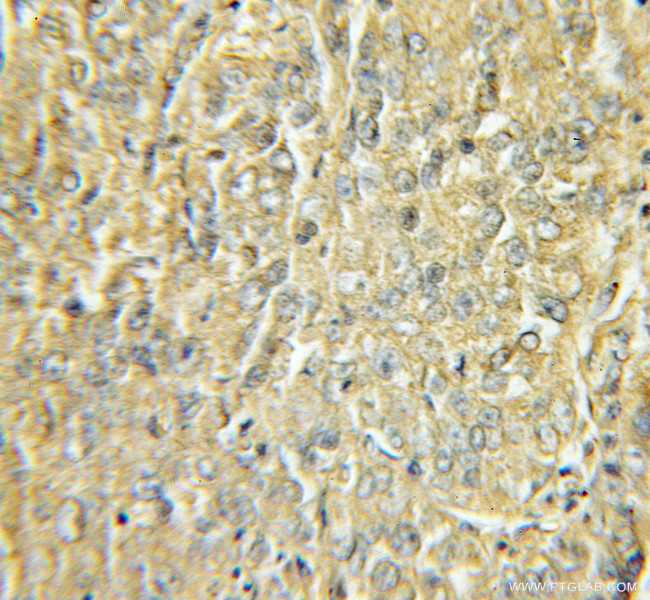

产品信息
10079-1-AP
产品规格
宿主/亚型
Rabbit
/ IgG
分类
Polyclonal
类型
Antibody
抗原
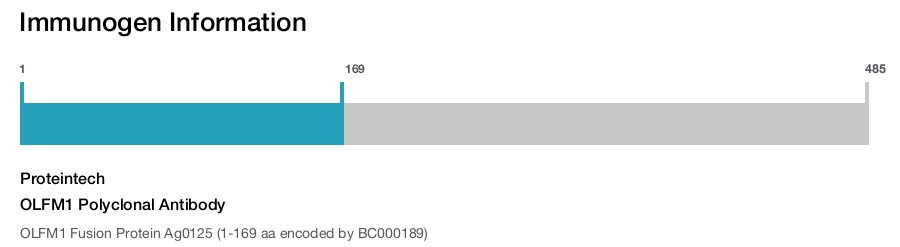
OLFM1 Fusion Protein Ag0125 (1-169 aa encoded by BC000189)
偶联物
形式
Liquid
浓度
0.13 mg/mL
规格
19.5 µg
保存条件
-20°C
运输条件
Wet ice (domestic); Dry ice (international)
产品详细信息
This antibody is specific for isoform 3 and isoform 4 (AMY) of Olfm1 with native molecular weights of 54 kDa and 16 kDa respectively. AMY may have an essential role in nerve tissue.
Immunogen sequence: MPGRWRWQR DMHPARKLLS LLFLILMGTE LTQNKRENKA EKMGGPESER KTTGEKTLNE LPLFCLEAHA GSLALPRMCS PNPNPAVGLC RPAYPQSPSP GAAQTISQSL LERFCMASRR EVFLAPGRPG GGWWLCTVAG QMHSFMCTHT HTHAHTGEQI PAEKSQPGPD (1-169 aa encoded by BC000189)
靶标信息
The Olfactomedin family comprises a diverse group of secreted glycoproteins, which includes OLFM1 (Noelin-1), OLFM2 (Noelin-2), OLFM3 (Noelin-3), OLFM4 (Noelin-4), tiarin, pancortin, gliomedin and mycocilin. These proteins are implicated in the development of the nervous system. Specifically, OLFM1 and OLFM2 expression is observed in the neural plate and neural crest, as well as in the cranial ganglia in mouse at E8-10, and later in brain tissue and in the zone of polarizing activity in the limb. Overexpression of OLFM1 causes an excess of neural crest emigrations and prolonged neural crest production. OLFM2 participates in the regulation of the development of the anterior nervous system. An Arg144Gln mutation in OLFM2 has been implicated as a possible cause for open-angle glaucoma (OAG).
仅用于科研。不用于诊断过程。未经明确授权不得转售。
篇参考文献 (0)
您是否在文献中引用过该产品?请点击下方按钮邮件告知我们。
Disclaimer

Clicking the images or links will redirect you to a website hosted by BenchSci that provides third-party scientific content. Neither the content nor the BenchSci technology and processes for selection have been evaluated by us; we are providing them as-is and without warranty of any kind, including for use or application of the Thermo Fisher Scientific products presented.

