Search
GenScript
Omalizumab Monoclonal Antibody (10G3)
{{$productOrderCtrl.translations['antibody.pdp.commerceCard.promotion.promotions']}}
{{$productOrderCtrl.translations['antibody.pdp.commerceCard.promotion.viewpromo']}}
{{$productOrderCtrl.translations['antibody.pdp.commerceCard.promotion.promocode']}}: {{promo.promoCode}} {{promo.promoTitle}} {{promo.promoDescription}}. {{$productOrderCtrl.translations['antibody.pdp.commerceCard.promotion.learnmore']}}
Additional Information:
{{banner.description}}
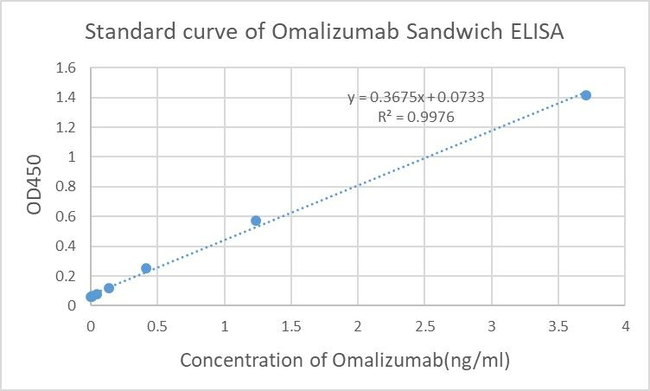
图: 1 / 2
Omalizumab Antibody (A02095-40) in ELISA
Standard curve of Omalizumab Sandwich ELISA. The Omalizumab Sandwich ELISA assay is developed by using Anti-Omalizumab Antibody (10G3), mAb, Mouse (GenScript, A02095-40) and Anti-Omalizumab Antibody (15B12), mAb, Mouse (GenScript, A02094-40) as the capture and detection antibodies, respectively. In this ELISA assay, Anti-Omalizumab Antibody (15B12), mAb, Mouse (GenScript, A02094-40) was labeled with Biotin. GenScript can provide customized conjugation services for this product per the customers request. The sensitivity of detecting Omalizu... View More


产品信息
A02095-40
产品规格
种属反应
Human
宿主/亚型
Mouse
/ IgG1, kappa
分类
Monoclonal
类型
Antibody
克隆号
10G3
抗原
Omalizumab
偶联物
Unconjugated
Unconjugated
Unconjugated
形式
Lyophilized
浓度
0.5 mg/mL
规格
40 µg
纯化类型
Protein A
保存液
PBS, pH 7.2
内含物
0.02% sodium azide
保存条件
-20°C, Avoid Freeze/Thaw Cycles
运输条件
Ambient (domestic); Wet ice (international)
产品详细信息
Reconstitute the lyophilized powder with deionized water (or equivalent) to a final concentration of 0.5 mg/mL.
The lyophilized product remains stable up to 1 year at -20 °C from date of receipt. Upon reconstitution, it can be stored for 2-3 weeks at 2-8 °C or for up to 12 months at -20 °C or below. Avoid repeated freezing and thawing cycles.
靶标信息
IgE is one of the five classes of immunoglobulins found in mammals, characterized by its monomeric structure consisting of two heavy (epsilon) chains with four Ig-like constant domains and two light chains. Although IgE comprises only a small portion of the total immunoglobulin in serum, it plays a crucial role in type I hypersensitivity reactions, such as hay fever, asthma, hives, and anaphylactic shock. IgE is produced by terminally differentiated plasma B cells and basophils. It binds to Fc epsilon receptors on mast cells and basophils, leading to the release of histamine and other molecules that promote allergic responses. Crosslinking of IgE bound to these receptors induces degranulation of mast cells and basophils, resulting in allergic manifestations. In addition to its role in allergic responses, IgE is functionally important for immunity against parasites, highlighting its dual role in both protective and pathological immune processes.
仅用于科研。不用于诊断过程。未经明确授权不得转售。
篇参考文献 (0)
您是否在文献中引用过该产品?请点击下方按钮邮件告知我们。
生物信息学
蛋白别名: Immunoglobulin E; ImmunoglobulinE
Disclaimer

Clicking the images or links will redirect you to a website hosted by BenchSci that provides third-party scientific content. Neither the content nor the BenchSci technology and processes for selection have been evaluated by us; we are providing them as-is and without warranty of any kind, including for use or application of the Thermo Fisher Scientific products presented.

