Search
Agrisera
PAB/protein in chloroplast atpase biogenesis Polyclonal Antibody
{{$productOrderCtrl.translations['antibody.pdp.commerceCard.promotion.promotions']}}
{{$productOrderCtrl.translations['antibody.pdp.commerceCard.promotion.viewpromo']}}
{{$productOrderCtrl.translations['antibody.pdp.commerceCard.promotion.promocode']}}: {{promo.promoCode}} {{promo.promoTitle}} {{promo.promoDescription}}. {{$productOrderCtrl.translations['antibody.pdp.commerceCard.promotion.learnmore']}}
Additional Information:
{{banner.description}}
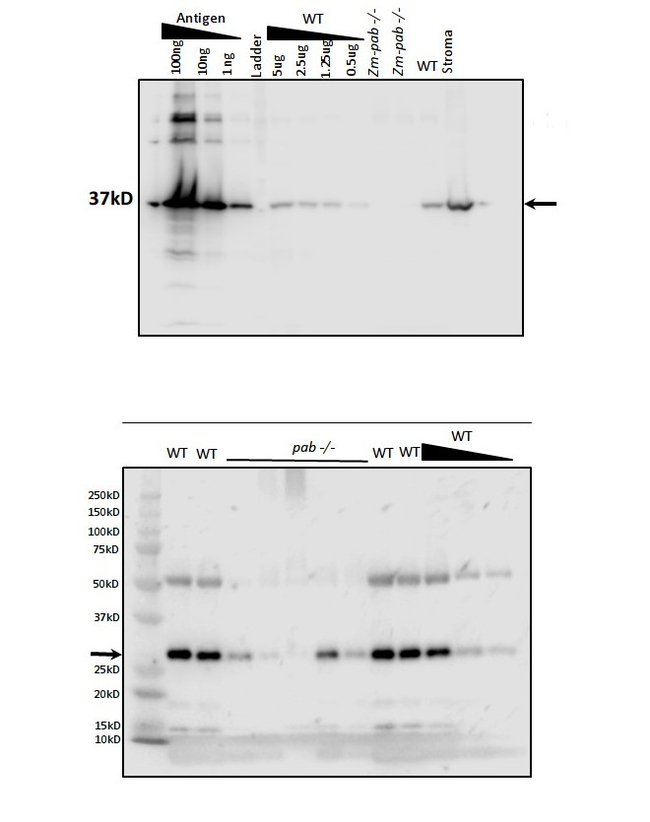
图: 1 / 1
PAB/protein in chloroplast atpase biogenesis Antibody (AS15-2833) in WB
Lanes contain ~5 µg of total protein from Zea mays seedling leaves (upper image), Arabidopsis thaliana seedling leaves (lower image), or isolated chloroplast stroma. Leaf extract from homozygous pab mutants (hylomorphic alleles), and purified recombinant antigen were analyzed as controls. Proteins were separated on 12% SDS-PAGE and blotted overnight to nitrocellulose using tank transfer. Blots were blocked ... View More

产品信息
AS15-2833
产品规格
种属反应
Plant
宿主/亚型
Rabbit
分类
Polyclonal
类型
Antibody
抗原
Recombinant PAB from Zea mays.
偶联物
Unconjugated
Unconjugated
Unconjugated
形式
Lyophilized
保存液
whole serum
内含物
no preservative
保存条件
-20°C, Avoid Freeze/Thaw Cycles
运输条件
Ambient (domestic); Wet ice (international)
产品详细信息
Store lyophilized/reconstituted at -20°C; once reconstituted make aliquots to avoid repeated freeze-thaw cycles. Please remember to spin the tubes briefly prior to opening them to avoid any losses that might occur from material adhering to the cap or sides of the tube.
For reconstitution add 50 µL of sterile water.
Specific Species Reactivity: Arabidiopsis thaliana, Zea mays
靶标信息
PAB usually refers to poly A binding proteins in plants that bind the 3 prime polyadenylated tail of messenger RNAs to enhance translation initiation, stabilize transcripts, and coordinate mRNA turnover. Cytosolic PABs interact with eIF4G and other initiation factors to promote ribosome recruitment and circularization of mRNAs, while nuclear PABs participate in polyadenylation, export, and quality control. PAB proteins influence development, stress responses, and hormone signaling by shaping the translational landscape and selective mRNA stability, and their activity adjusts with environmental cues such as heat, drought, and pathogen challenge. Multiple PAB isoforms show tissue specific and condition dependent expression, enabling fine tuning of gene expression, and perturbation impacts growth, fertility, and resilience by altering protein synthesis and mRNA dynamics.
仅用于科研。不用于诊断过程。未经明确授权不得转售。
篇参考文献 (0)
您是否在文献中引用过该产品?请点击下方按钮邮件告知我们。
生物信息学
蛋白别名: AT4G34090; F28A23.150; F28A23_150; PAB; PROTEIN IN CHLOROPLAST ATPASE BIOGENESIS
Disclaimer

Clicking the images or links will redirect you to a website hosted by BenchSci that provides third-party scientific content. Neither the content nor the BenchSci technology and processes for selection have been evaluated by us; we are providing them as-is and without warranty of any kind, including for use or application of the Thermo Fisher Scientific products presented.

