Search
Bioss
PAPOL A+B+G Polyclonal Antibody
{{$productOrderCtrl.translations['antibody.pdp.commerceCard.promotion.promotions']}}
{{$productOrderCtrl.translations['antibody.pdp.commerceCard.promotion.promocode']}}: {{promo.promoCode}} {{promo.promoTitle}} {{promo.promoDescription}}. {{$productOrderCtrl.translations['antibody.pdp.commerceCard.promotion.learnmore']}}
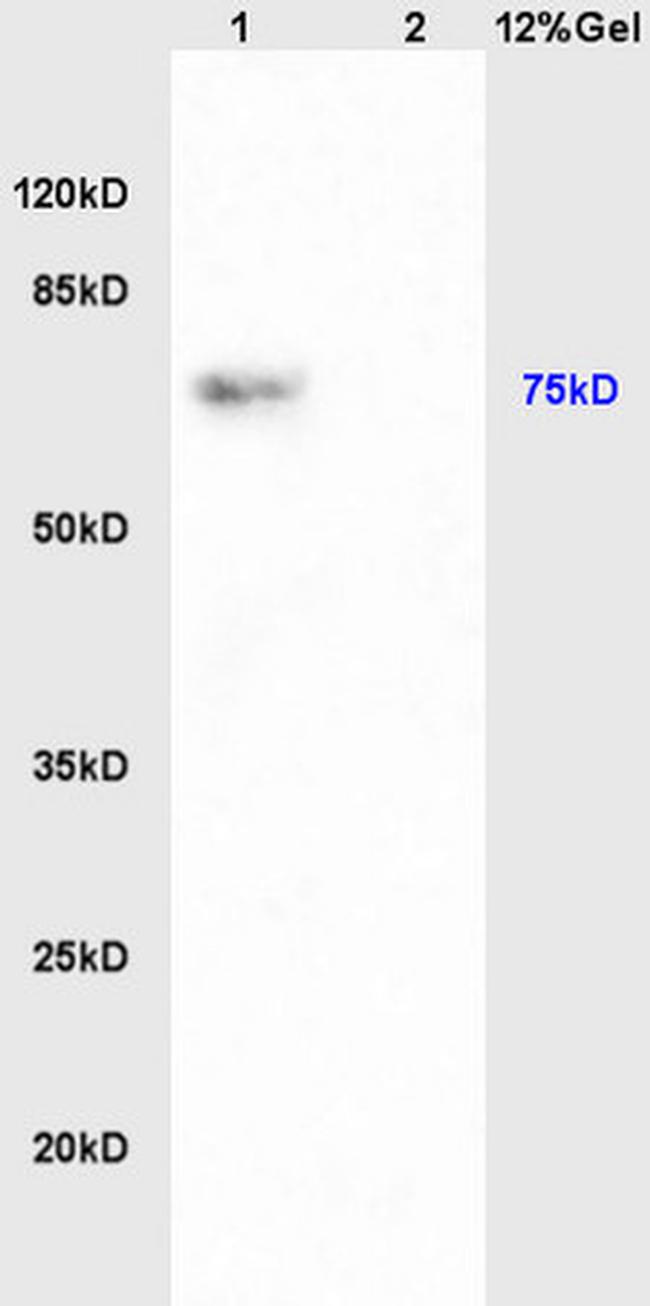
图: 1 / 1
PAPOL A+B+G Antibody (BS-9435R) in WB
Lane 1: rat kidney lysates Lane 2: rat brain lysates probed with Anti PAP-alpha/beta/gamma Polyclonal Antibody, Unconjugated (bs-9435R) at 1:200 in 4°C. Followed by conjugation to secondary antibody (bs-0295G-HRP) at 1:3,000 90 min in 37°C. Predicted band 70-82 kD. Observed band size: 75 kDa.
Please note: We are reviewing Western blot images included in the antibody testing data in our catalog, including those provided by third parties. Unless expressly labeled or annotated as “raw-unedited”, Western blot images included in the antibody testing data in our catalog may have been edited, optimized or otherwise adjusted for presentation.

产品信息
BS-9435R
产品规格
种属反应
Human,
Mouse,
Rat
宿主/亚型
Rabbit
/ IgG
分类
Polyclonal
类型
Antibody
抗原
KLH conjugated synthetic peptide derived from human PAPOLA/PAPOLB/PAPOLG.
偶联物
Unconjugated
Unconjugated
Unconjugated
形式
Liquid
浓度
1 mg/mL
规格
100 µg
纯化类型
Protein A
保存液
0.01M TBS, pH 7.4, with 50% glycerol, 1% BSA
内含物
0.02% ProClin 300
保存条件
-20°C
运输条件
Ambient (domestic); Wet ice (international)
靶标信息
Polyadenylation of the 3-prime ends of eukaryotic mRNAs is a key event that takes place in the nucleus during maturation of mRNA. The reaction includes endoribonucleolytic cleavage of the pre-RNA at the poly(A) site that leads to synthesis of the poly(A) tail at the 3-prime end of the upstream cleavage product. The poly(A) polymerase (PAP) is required The adenosine addition reaction depends on poly(A) polymerase (PAP) activity. The testis express PAP-beta (TPAP) in the cytoplasm of spermatogenic cells. The adenosine addition function of PAP-beta plays a critical role in male germ cell production. PAP-beta-deficient transgenic mice display impaired expression of haploid-specific genes that are necessary for spermatogenesis. The intronless gene encoding human PAP-beta maps to chromosome 7p22.3.
仅用于科研。不用于诊断过程。未经明确授权不得转售。
篇参考文献 (0)
您是否在文献中引用过该产品?请点击下方按钮邮件告知我们。
生物信息学
蛋白别名: mPAP-B; neo-PAP; neo-poly(A) polymerase; nuclear poly(A) polymerase gamma; nucleotidyl transferase; PAP-alpha; PAP-beta; PAP-gamma; poly (A) polymerase beta (testis specific); poly(A) polymerase beta (testis specific); polynucleotide adenylyltransferase; polynucleotide adenylyltransferase alpha; polynucleotide adenylyltransferase beta; polynucleotide adenylyltransferase gamma; signal recognition particle RNA-adenylating enzyme; SRP 3'-adenylating protein; SRP RNA 3' adenylating enzyme/pap2; SRP RNA 3'-adenylating enzyme; SRP RNA-adenylating enzyme; testis-specific poly(A) polymerase; unnamed protein product
基因别名: 9630006B20Rik; PAP; PAP-alpha; PapIII; Paplob; Papola-ps; PAPT; Plap; Plap-ps; TPAP
UniProt ID: (Human) P51003, (Human) Q9NRJ5, (Human) Q9BWT3, (Mouse) Q61183, (Mouse) Q9WVP6, (Mouse) Q6PCL9
Entrez Gene ID: (Human) 10914, (Human) 56903, (Human) 64895, (Rat) 314417, (Mouse) 18789, (Rat) 304300, (Mouse) 56522, (Mouse) 216578, (Rat) 305586
Disclaimer

Clicking the images or links will redirect you to a website hosted by BenchSci that provides third-party scientific content. Neither the content nor the BenchSci technology and processes for selection have been evaluated by us; we are providing them as-is and without warranty of any kind, including for use or application of the Thermo Fisher Scientific products presented.

