Search
Invitrogen
PAX6 Monoclonal Antibody (13B10-1A10)
{{$productOrderCtrl.translations['antibody.pdp.commerceCard.promotion.promotions']}}
{{$productOrderCtrl.translations['antibody.pdp.commerceCard.promotion.promocode']}}: {{promo.promoCode}} {{promo.promoTitle}} {{promo.promoDescription}}. {{$productOrderCtrl.translations['antibody.pdp.commerceCard.promotion.learnmore']}}
{{$ctrl.translations['antibody.pdp.skuNotes.additionalInformation']}}:
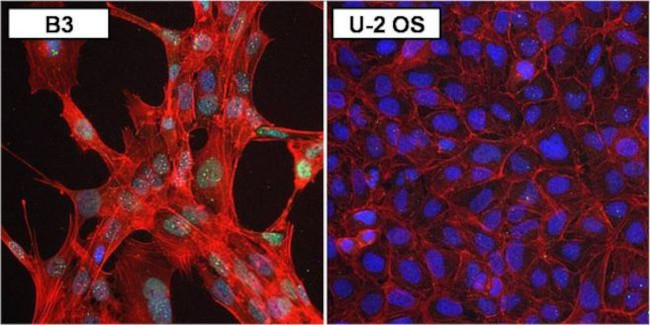
图: 1 / 20
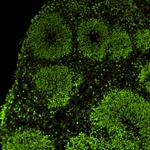
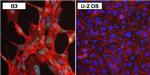
PAX6 Antibody (MA1-109) in ICC/IF
Immunofluorescent analysis of PAX6 (green) in human B3 lens epithelial cells (left panel) and negative control U-2 OS cells (right panel). The cells were fixed with formaldehyde for 15 minutes, permeabilized with 0.1% Triton X-100 in TBS for 10 minutes, and blocked with 1% Blocker BSA in PBS (Product # 37525) for 15 minutes, all at room temperature. Cells were stained with a PAX6 monoclonal antibody (Product # MA1-109) in 1% Blocker BSA in PBS (Product # 37525) at a dilution of 1:100 for 1 hour at room temperature, and then incubated with ... View More
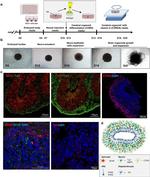
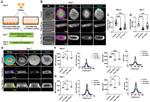
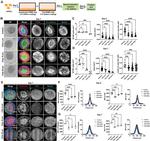
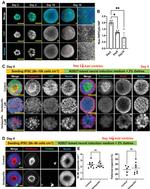
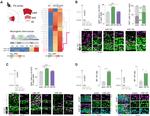
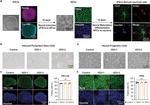
Please note: We are reviewing Western blot images included in the antibody testing data in our catalog, including those provided by third parties. Unless expressly labeled or annotated as “raw-unedited”, Western blot images included in the antibody testing data in our catalog may have been edited, optimized or otherwise adjusted for presentation.


产品信息
MA1-109
应用
建议稀释比
已发表文章
产品规格
种属反应
Human,
Mouse
已发表种属
Human,
Mouse
宿主/亚型
Mouse
/ IgG1
分类
Monoclonal
类型
Antibody
克隆号
13B10-1A10
抗原
Purified internal fragment of human recombinant PAX6 expressed in E. coli.
偶联物
Unconjugated
Unconjugated
Unconjugated
形式
Liquid
浓度
1 mg/mL
规格
100 µg
纯化类型
Protein A
保存液
PBS with 1mg/mL BSA, 30% glycerol
内含物
0.05% sodium azide
保存条件
-20°C
运输条件
Ambient (domestic); Wet ice (international)
RRID
产品详细信息
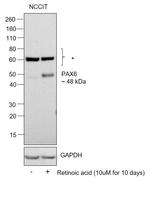
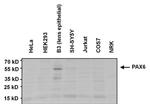
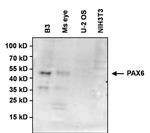
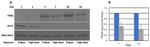
Western blot analysis of MA1-109 detects an ~47 kDa protein in whole cell lysates from early passage human B3 lens epithelial cells and in mouse eye lysate. An additional unknown band at ~36 kDa is also detected in B3 cell lysates. This antibody will detect additional nonspecific bands in lysates with very low basal PAX6 expression. Specificity of the antibody was confirmed in B3 and mouse eye lysates (positive controls) compared to U-2 OS human osteosarcoma and NIH/3T3 mouse embryonic fibroblasts (negative controls).
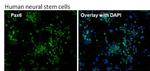
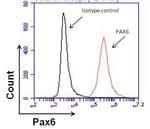
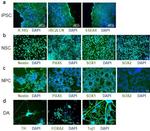
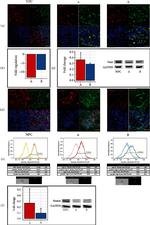
MA1-109- can be used for immunofluoresence and flow cytometry analysis of Pax6 in human neural stem cells.
靶标信息
This gene encodes paired box gene 6, one of many human homologs of the Drosophila melanogaster gene prd. In addition to the hallmark feature of this gene family, a conserved paired box domain, the encoded protein also contains a homeo box domain. Both domains are known to bind DNA, and function as regulators of gene transcription. This gene is expressed in the developing nervous system, and in developing eyes. Mutations in this gene are known to cause ocular disorders such as aniridia and Peter's anomaly. Alternatively spliced transcript variants encoding either the same or different isoform have been found for this gene.
仅用于科研。不用于诊断过程。未经明确授权不得转售。
生物信息学
蛋白别名: alternative protein PAX6; Aniridia; Aniridia 1; Aniridia 2; aniridia type II protein; Dickie's small eye; driven by P1 promotor; Keratitis; MGC17209; oculorhombin; paired box 6 PAX6-12a isoform; paired box 6 PAX6A-ASdel6 isoform; paired box 6 PAX6A-ASdel6-AS7 isoform; paired box 6 PAX6A-del6 isoform; paired box 6 PAX6B-ASdel6 isoform; paired box 6 PAX6D isoform; paired box gene 6; Paired Box Gene-6; paired box homeotic gene-6; Pax-6 (paired box containing gene); Pax6; Pax6(S); encoded by transcript variant 4; unnamed protein product
基因别名: 1500038E17Rik; AEY11; AN; AN1; AN2; ASGD5; D11S812E; Dey; FVH1; Gsfaey11; MGDA; Pax-6; Sey; WAGR
UniProt ID: (Human) P26367, (Mouse) P63015
Entrez Gene ID: (Human) 5080, (Mouse) 18508
transcription regulatory region sequence-specific DNA binding
RNA polymerase II core promoter proximal region sequence-specific DNA binding
RNA polymerase II core promoter sequence-specific DNA binding
RNA polymerase II transcription factor activity, sequence-specific DNA binding
transcription cofactor binding
transcriptional repressor activity, RNA polymerase II transcription regulatory region sequence-specific binding
transcriptional activator activity, RNA polymerase II transcription regulatory region sequence-specific binding
DNA binding
chromatin binding
transcription factor activity, sequence-specific DNA binding
RNA binding
protein binding
protein kinase binding
chromatin DNA binding
ubiquitin protein ligase binding
histone acetyltransferase binding
sequence-specific DNA binding
co-SMAD binding
R-SMAD binding
HMG box domain binding
sequence-specific double-stranded DNA binding
AT DNA binding
double-stranded DNA binding
negative regulation of transcription from RNA polymerase II promoter
blood vessel development
eye development
type B pancreatic cell differentiation
pancreatic A cell development
chromatin remodeling
regulation of transcription, DNA-templated
regulation of transcription from RNA polymerase II promoter
nervous system development
central nervous system development
brain development
sensory organ development
visual perception
response to wounding
anatomical structure morphogenesis
organ morphogenesis
positive regulation of gene expression
ventral spinal cord development
cerebral cortex development
neuron differentiation
forebrain development
glucose homeostasis
camera-type eye development
positive regulation of transcription, DNA-templated
positive regulation of transcription from RNA polymerase II promoter
neuron fate commitment
negative regulation of neurogenesis
neurological system process
retina development in camera-type eye
iris morphogenesis
cornea development in camera-type eye
positive regulation of pri-miRNA transcription from RNA polymerase II promoter
establishment of mitotic spindle orientation
cell fate determination
neural crest cell migration
neuron migration
negative regulation of protein phosphorylation
positive regulation of neuroblast proliferation
epithelial cell development
lens development in camera-type eye
regionalization
pancreatic A cell differentiation
smoothened signaling pathway
axonogenesis
axon guidance
salivary gland morphogenesis
negative regulation of cell proliferation
regulation of asymmetric cell division
dorsal/ventral axis specification
anterior/posterior pattern specification
dorsal/ventral pattern formation
gene expression
regulation of gene expression
regulation of neuron projection development
spinal cord development
telencephalon development
pallium development
rhombomere morphogenesis
olfactory bulb development
oligodendrocyte cell fate specification
cerebral cortex regionalization
forebrain dorsal/ventral pattern formation
commitment of neuronal cell to specific neuron type in forebrain
forebrain-midbrain boundary formation
telencephalon regionalization
pituitary gland development
habenula development
interkinetic nuclear migration
signal transduction involved in regulation of gene expression
cell differentiation
keratinocyte differentiation
regulation of cell migration
positive regulation of epithelial cell differentiation
hindbrain development
lacrimal gland development
eye photoreceptor cell development
positive regulation of cell fate specification
cell fate commitment
positive regulation of cell differentiation
regulation of neuron differentiation
negative regulation of neuron differentiation
regulation of timing of cell differentiation
embryonic camera-type eye morphogenesis
astrocyte differentiation
negative regulation of epithelial cell proliferation
regulation of neurogenesis
establishment of organelle localization
olfactory bulb mitral cell layer development
neural precursor cell proliferation
learned vocalization behavior or vocal learning
positive regulation of glutamatergic neuron differentiation
insulin metabolic process
sensory neuron migration
cellular response to leukemia inhibitory factor
negative regulation of neural precursor cell proliferation
positive regulation of neuron migration
Disclaimer

Clicking the images or links will redirect you to a website hosted by BenchSci that provides third-party scientific content. Neither the content nor the BenchSci technology and processes for selection have been evaluated by us; we are providing them as-is and without warranty of any kind, including for use or application of the Thermo Fisher Scientific products presented.

