Search
Proteintech
PCDHGC5 Polyclonal Antibody
{{$productOrderCtrl.translations['antibody.pdp.commerceCard.promotion.promotions']}}
{{$productOrderCtrl.translations['antibody.pdp.commerceCard.promotion.promocode']}}: {{promo.promoCode}} {{promo.promoTitle}} {{promo.promoDescription}}. {{$productOrderCtrl.translations['antibody.pdp.commerceCard.promotion.learnmore']}}
{{$ctrl.translations['antibody.pdp.skuNotes.additionalInformation']}}:
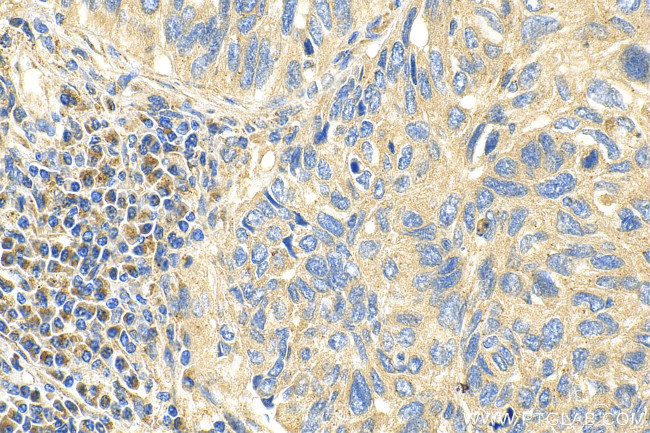
Please note: We are reviewing Western blot images included in the antibody testing data in our catalog, including those provided by third parties. Unless expressly labeled or annotated as “raw-unedited”, Western blot images included in the antibody testing data in our catalog may have been edited, optimized or otherwise adjusted for presentation.

产品信息
23848-1-AP
产品规格
种属反应
Human
宿主/亚型
Rabbit
/ IgG
分类
Polyclonal
类型
Antibody
抗原
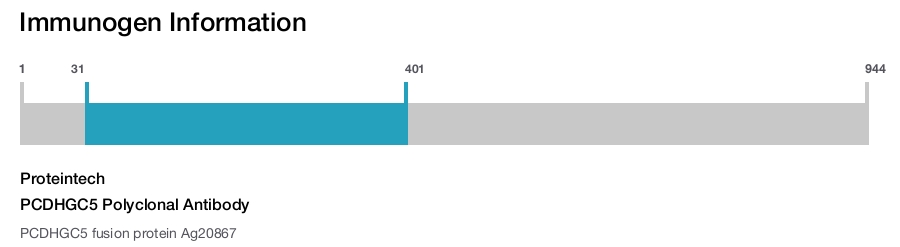
PCDHGC5 fusion protein Ag20867
偶联物
Unconjugated
Unconjugated
Unconjugated
形式
Liquid
浓度
450 µg/mL
规格
67.5 µg
纯化类型
Affinity chromatography
保存液
PBS, pH 7.3, with 50% glycerol
内含物
0.02% sodium azide
保存条件
-20°C
运输条件
Wet ice
产品详细信息
Sequence of this protein is as follows: LRYSVVEESE PGTLVGNVAQ DLGLKMTDLL SRRLQLGSEE NGRYFSLSLM SGALAVNQKI DRESLCGAST SCLLPVQVVT EHPLELIRVE VEILDLNDNS PSFATPEREM RISESAASGA RFPLDSAQDP DVGTNTVSFY TLSPNSHFSL NVKTLKDGKP FPELVLEQQL DREAQARHQL VLTAVDGGTP ARSGTTLISV IVLDINDNAP TFQSSVLRVG IPENAPIGTL LLRLNATDPD EGTNGQLDYS FGDHTSEAVR NLFGLDPSSG AIHVLGPIDF EESRFYEIHA RARDQGQPAM EGHCVIQVDV GDVNDNAPEV LLASLANPVL ESTPVGTVVG LFNVRDRDSG RNGEVSLDIS PDLPFQIKPS E
靶标信息
This gene is a member of the protocadherin gamma gene cluster, one of three related clusters tandemly linked on chromosome five. These gene clusters have an immunoglobulin-like organization, suggesting that a novel mechanism may be involved in their regulation and expression. The gamma gene cluster includes 22 genes divided into 3 subfamilies. Subfamily A contains 12 genes, subfamily B contains 7 genes and 2 pseudogenes, and the more distantly related subfamily C contains 3 genes. The tandem array of 22 large, variable region exons are followed by a constant region, containing 3 exons shared by all genes in the cluster. Each variable region exon encodes the extracellular region, which includes 6 cadherin ectodomains and a transmembrane region. The constant region exons encode the common cytoplasmic region. These neural cadherin-like cell adhesion proteins most likely play a critical role in the establishment and function of specific cell-cell connections in the brain. Alternative splicing has been described for the gamma cluster genes.
仅用于科研。不用于诊断过程。未经明确授权不得转售。
篇参考文献 (0)
您是否在文献中引用过该产品?请点击下方按钮邮件告知我们。
生物信息学
Disclaimer

Clicking the images or links will redirect you to a website hosted by BenchSci that provides third-party scientific content. Neither the content nor the BenchSci technology and processes for selection have been evaluated by us; we are providing them as-is and without warranty of any kind, including for use or application of the Thermo Fisher Scientific products presented.

