Search
Invitrogen
PDGF-B Polyclonal Antibody
{{$productOrderCtrl.translations['antibody.pdp.commerceCard.promotion.promotions']}}
{{$productOrderCtrl.translations['antibody.pdp.commerceCard.promotion.viewpromo']}}
{{$productOrderCtrl.translations['antibody.pdp.commerceCard.promotion.promocode']}}: {{promo.promoCode}} {{promo.promoTitle}} {{promo.promoDescription}}. {{$productOrderCtrl.translations['antibody.pdp.commerceCard.promotion.learnmore']}}
Additional Information:
{{banner.description}}

产品信息
PA1-27394
产品规格
宿主/亚型
Rabbit
/ IgG
分类
Polyclonal
类型
Antibody
抗原
Synthetic peptide corresponding to residues T(101) E V F E I S R R L I D R T N A(116) of human PDGF beta.
偶联物
Unconjugated
Unconjugated
Unconjugated
形式
Liquid
保存条件
4°C, do not freeze
运输条件
Wet ice
RRID
产品详细信息
PA1-27394 detects PDGF beta from human, mouse, rat, bovine, feline, canine, golden hamster, and ovine samples.
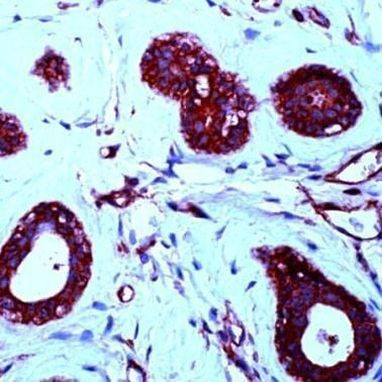
PA1-27394 has been successfully used in immunohistochemistry (paraffin) procedures. Perform heat mediated antigen retrieval with 10 mM citrate buffer pH 6.0 before commencing with IHC staining protocol. A suggested positive control for this product is angiosarcoma.
The PA1-27394 immunogen is a synthetic peptide corresponding to residues T(101) E V F E I S R R L I D R T N A(116) of human PDGF beta.
靶标信息
This gene encodes a member of the protein family comprised of both platelet-derived growth factors (PDGF) and vascular endothelial growth factors (VEGF). The encoded preproprotein is proteolytically processed to generate platelet-derived growth factor subunit B, which can homodimerize, or alternatively, heterodimerize with the related platelet-derived growth factor subunit A. These proteins bind and activate PDGF receptor tyrosine kinases, which play a role in a wide range of developmental processes. Mutations in this gene are associated with meningioma. Reciprocal translocations between chromosomes 22 and 17, at sites where this gene and that for collagen type 1, alpha 1 are located, are associated with dermatofibrosarcoma protuberans, a rare skin tumor. Alternative splicing results in multiple transcript variants.
仅用于科研。不用于诊断过程。未经明确授权不得转售。
篇参考文献 (0)
您是否在文献中引用过该产品?请点击下方按钮邮件告知我们。
Disclaimer

Clicking the images or links will redirect you to a website hosted by BenchSci that provides third-party scientific content. Neither the content nor the BenchSci technology and processes for selection have been evaluated by us; we are providing them as-is and without warranty of any kind, including for use or application of the Thermo Fisher Scientific products presented.

