Search
Agrisera
PEC1/Plastid Envelope Channel 1 Polyclonal Antibody
{{$productOrderCtrl.translations['antibody.pdp.commerceCard.promotion.promotions']}}
{{$productOrderCtrl.translations['antibody.pdp.commerceCard.promotion.viewpromo']}}
{{$productOrderCtrl.translations['antibody.pdp.commerceCard.promotion.promocode']}}: {{promo.promoCode}} {{promo.promoTitle}} {{promo.promoDescription}}. {{$productOrderCtrl.translations['antibody.pdp.commerceCard.promotion.learnmore']}}
Additional Information:
{{banner.description}}
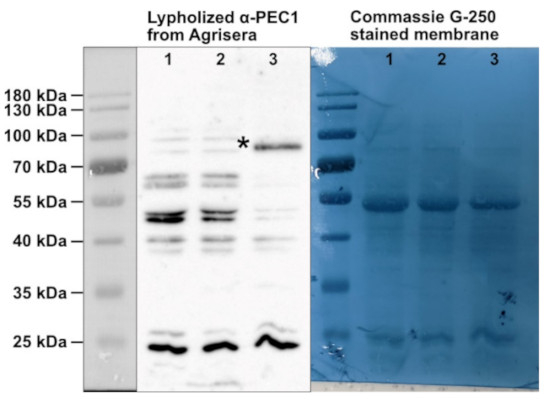
图: 1 / 1
PEC1/Plastid Envelope Channel 1 Antibody (AS21-4528) in WB
Samples: 1 – 2,5 µg of Arabidopsis thaliana mutant pec 1-1 pec 2-1 2 – 2,5 µg of Arabidopsis thaliana mutant pec 1-2 pec 2-2 3 – 2,5 µg of Arabidopsis thaliana whole leaf extract Arabidopsis thaliana tissue was frozen with liquid nitrogen and ground to a fine powder with mortar and pestle. Protein was extracted by mixing with extraction buffer (200 m M tris p H 8.0,4% (w/v) sodium dodecyl sulfate) to 0.5 g ... View More

产品信息
AS21-4528
产品规格
种属反应
Plant
宿主/亚型
Rabbit
分类
Polyclonal
类型
Antibody
抗原
The soluble domain 466 (M244 until stop codon, 64 kDa) was cloned into pET16b and transformed into BLR 21 for 467 expression in Escherichia coli.
偶联物
形式
Lyophilized
保存液
whole serum
内含物
no preservative
保存条件
-20°C, Avoid Freeze/Thaw Cycles
运输条件
Ambient (domestic); Wet ice (international)
产品详细信息
Store lyophilized/reconstituted at -20°C; once reconstituted make aliquots to avoid repeated freeze-thaw cycles. Please remember to spin the tubes briefly prior to opening them to avoid any losses that might occur from material adhering to the cap or sides of the tube.
For reconstitution add 50 µL of sterile water.
Specific Species Reactivity: Arabidopsis thaliana
靶标信息
PEC1, also called Plastid Envelope Channel 1, is a plant outer plastid envelope membrane protein that forms a cation selective channel facilitating metabolite and ion exchange between the cytosol and plastid intermembrane space. It contributes to maintaining plastid membrane potential, redox balance, and import export of small solutes that support biosynthetic pathways, including fatty acid and carbohydrate metabolism. PEC1 helps integrate plastid function with cellular signaling by adjusting permeability under developmental and stress conditions, and works alongside porins and specific transporters to coordinate envelope transport. Expression aligns with plastid biogenesis and photosynthetic demand, and perturbation affects metabolite flux, plastid homeostasis, and growth due to altered envelope conductance and communication with the cytosol.
仅用于科研。不用于诊断过程。未经明确授权不得转售。
篇参考文献 (0)
您是否在文献中引用过该产品?请点击下方按钮邮件告知我们。
生物信息学
蛋白别名: ABCG32; AtABCG32; ATP-binding cassette G32; ATPDR4; F12C20.5; F12C20_5; PDR4; PERMEABLE CUTICLE 1; pleiotropic drug resistance 4
Disclaimer

Clicking the images or links will redirect you to a website hosted by BenchSci that provides third-party scientific content. Neither the content nor the BenchSci technology and processes for selection have been evaluated by us; we are providing them as-is and without warranty of any kind, including for use or application of the Thermo Fisher Scientific products presented.

