Search
Invitrogen
PPY Polyclonal Antibody
{{$productOrderCtrl.translations['antibody.pdp.commerceCard.promotion.promotions']}}
{{$productOrderCtrl.translations['antibody.pdp.commerceCard.promotion.promocode']}}: {{promo.promoCode}} {{promo.promoTitle}} {{promo.promoDescription}}. {{$productOrderCtrl.translations['antibody.pdp.commerceCard.promotion.learnmore']}}
{{$ctrl.translations['antibody.pdp.skuNotes.additionalInformation']}}:
Please note: We are reviewing Western blot images included in the antibody testing data in our catalog, including those provided by third parties. Unless expressly labeled or annotated as “raw-unedited”, Western blot images included in the antibody testing data in our catalog may have been edited, optimized or otherwise adjusted for presentation.

产品信息
PA1-36141
产品规格
宿主/亚型
Rabbit
/ IgG
分类
Polyclonal
类型
Antibody
抗原
Pure bovine pancreatic polypeptide.
偶联物
Unconjugated
Unconjugated
Unconjugated
形式
Lyophilized
保存条件
4°C
运输条件
Wet ice
产品详细信息
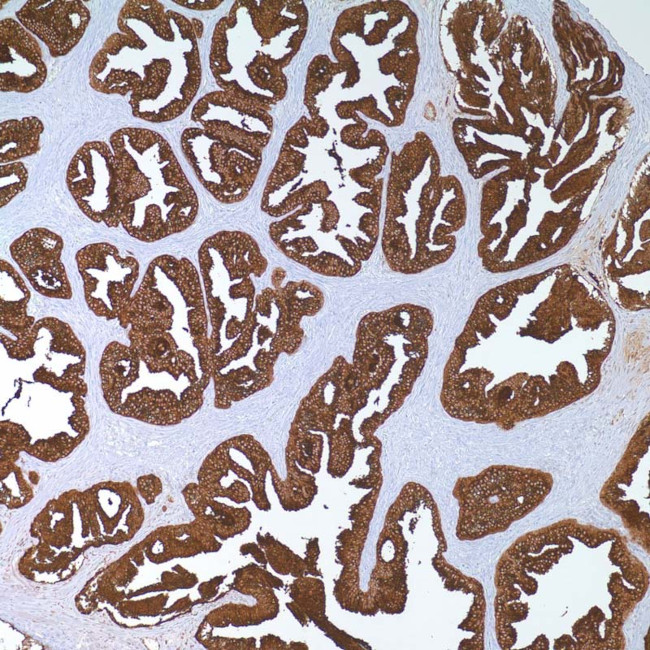
Suggested positive controls for IHC include paraffin sections of pig duodenal pancreas and frozen sections of rat pancreas.
Reconstitute with 50-100 ul of distilled water, and dilute further in 0.1M PBS with 1% BSA and 0.1% sodium azide. For long-term storage, aliquot and store at -20°C.
靶标信息
The PPY gene encodes pancreatic polypeptide, a peptide hormone involved in the regulation of appetite and energy balance. The origin of the PPY gene is linked to a tandem duplication of the PYY gene, occurring concomitantly with the emergence of tetrapods, leading to the distinct PPY function within the neuropeptide Y family. In primates and ungulates, a gene duplication event resulted in the formation of a PYY2-PPY2 gene cluster, highlighting the evolutionary complexity of these genes. The PPY gene product is secreted by gamma-cells in the pancreas, localized primarily in the islet periphery, and plays a crucial role in metabolic homeostasis by interacting with receptors in the central nervous system to modulate satiety signals postprandially. PPY's function is linked to its inhibition of AGRP/NPY neurons which decreases their suppressive effect on POMC neurons, enhancing POMC activity and contributing to appetite suppression. This intricate regulation underscores the importance of PPY in dietary intake and metabolic disorders, with ongoing research exploring its potential therapeutic applications.
仅用于科研。不用于诊断过程。未经明确授权不得转售。
篇参考文献 (0)
您是否在文献中引用过该产品?请点击下方按钮邮件告知我们。
Disclaimer

Clicking the images or links will redirect you to a website hosted by BenchSci that provides third-party scientific content. Neither the content nor the BenchSci technology and processes for selection have been evaluated by us; we are providing them as-is and without warranty of any kind, including for use or application of the Thermo Fisher Scientific products presented.

