Search
Invitrogen
PRAS40 Recombinant Superclonal™ Antibody (4HCLC)
{{$productOrderCtrl.translations['antibody.pdp.commerceCard.promotion.promotions']}}
{{$productOrderCtrl.translations['antibody.pdp.commerceCard.promotion.viewpromo']}}
{{$productOrderCtrl.translations['antibody.pdp.commerceCard.promotion.promocode']}}: {{promo.promoCode}} {{promo.promoTitle}} {{promo.promoDescription}}. {{$productOrderCtrl.translations['antibody.pdp.commerceCard.promotion.learnmore']}}
Additional Information:
{{banner.description}}
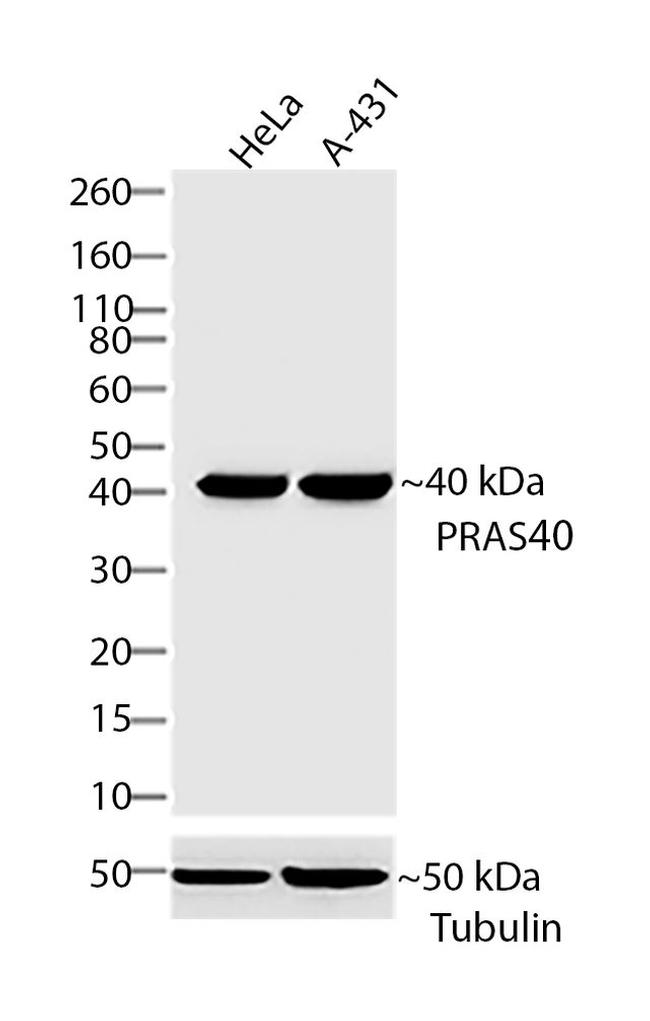
图: 1 / 2
PRAS40 Antibody (710079) in WB
Western blot analysis of PRAS40 was performed by loading 30 µg of HeLa and A431 cell lysates using Novex®NuPAGE® 4-12% Bis-Tris gel (Product # NP0321BOX), XCell SureLock Electrophoresis System (Product # EI0002), Novex® Sharp Pre-Stained Protein Standard (Product # LC5800), and iBlot® Dry Blotting System (Product # IB21001). Proteins were transferred to a nitrocellulose membrane and blocked with 5% skim milk for 1 hour at room temperature. PRAS40 was detected at ~40 kDa using PRAS40 Recombinant Rabbit Polyclonal Antibody (Product # 710079)... View More


产品信息
710079
产品规格
宿主/亚型
Rabbit
/ IgG
分类
Recombinant Superclonal
类型
Antibody
克隆号
4HCLC
抗原
Recombinant protein corresponding to amino acids 2-256 of PRAS40
偶联物
Unconjugated
Unconjugated
Unconjugated
形式
Liquid
浓度
0.5 mg/mL
规格
100 µg
保存条件
Store at 4°C short term. For long term storage, store at -20°C, avoiding freeze/thaw cycles.
运输条件
Wet ice (domestic); Wet or Dry ice (international)
RRID
产品详细信息
Recombinant rabbit polyclonal antibodies are unique offerings from Thermo Fisher Scientific. They are comprised of a selection of multiple different recombinant monoclonal antibodies, providing the best of both worlds - the sensitivity of polyclonal antibodies with the specificity of monoclonal antibodies - all delivered with the consistency only found in a recombinant antibody. While functionally the same as a polyclonal antibody - recognizing multiple epitope sites on the target and producing higher detection sensitivity for low abundance targets - a recombinant rabbit polyclonal antibody has a known mixture of light and heavy chains. The exact population can be produced in every lot, circumventing the biological variability typically associated with polyclonal antibody production.
靶标信息
The Akt signaling pathway contributes to the regulation of apoptosis after a variety of cell death signals. AKT1S1, also known as PRAS40, is a proline-rich substrate of the kinase AKT1 and is thought to play a role in neuroprotection mediated by nerve growth factor (NGF) after transient focal cerebral ischemia. AKT1S1 is also a substrate and potential regulator of mammalian target of rapamycin (mTOR), a serine/threonine kinase that regulates cell growth and cell cycle, and a negative regulator of autophagy. Treatment with the insulin-like growth factor-1 (IGF1) can induce the phosphorylation of AKT1S1 via the PI3K/AKT signaling pathway in PC12 cells.
仅用于科研。不用于诊断过程。未经明确授权不得转售。
篇参考文献 (0)
您是否在文献中引用过该产品?请点击下方按钮邮件告知我们。
Disclaimer

Clicking the images or links will redirect you to a website hosted by BenchSci that provides third-party scientific content. Neither the content nor the BenchSci technology and processes for selection have been evaluated by us; we are providing them as-is and without warranty of any kind, including for use or application of the Thermo Fisher Scientific products presented.

