Search
Proteintech
PSAP Polyclonal Antibody, CoraLite® Plus 488
{{$productOrderCtrl.translations['antibody.pdp.commerceCard.promotion.promotions']}}
{{$productOrderCtrl.translations['antibody.pdp.commerceCard.promotion.promocode']}}: {{promo.promoCode}} {{promo.promoTitle}} {{promo.promoDescription}}. {{$productOrderCtrl.translations['antibody.pdp.commerceCard.promotion.learnmore']}}
{{$ctrl.translations['antibody.pdp.skuNotes.additionalInformation']}}:
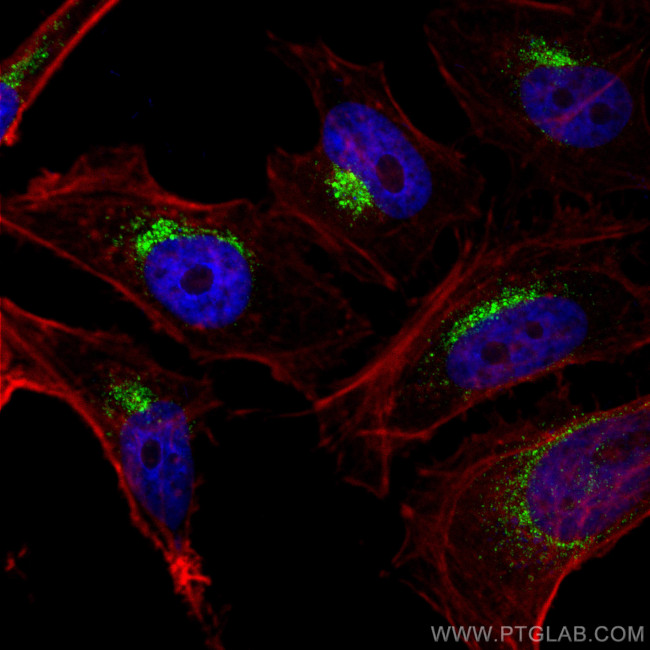
Please note: We are reviewing Western blot images included in the antibody testing data in our catalog, including those provided by third parties. Unless expressly labeled or annotated as “raw-unedited”, Western blot images included in the antibody testing data in our catalog may have been edited, optimized or otherwise adjusted for presentation.


产品信息
CL488-10801
应用
建议稀释比
已发表文章
产品规格
种属反应
Human
宿主/亚型
Rabbit
/ IgG
分类
Polyclonal
类型
Antibody
抗原
PSAP fusion protein Ag1194
偶联物
CoraLite® Plus 488
CoraLite® Plus 488
CoraLite® Plus 488
激发/发射光谱
493/522 nm
形式
Liquid
浓度
1 mg/mL
规格
100 µg
纯化类型
Antigen affinity chromatography
保存液
PBS, pH 7.3, with 0.5% BSA, 50% glycerol
内含物
0.05% ProClin 300
保存条件
-20°C, store in dark
运输条件
Wet ice
产品详细信息
Immunogen sequence: MYALFLLAS LLGAALAGPV LGLKECTRGS AVWCQNVKTA SDCGAVKHCL QTVWNKPTVK SLPCDICKDV VTAAGDMLKD NATEEEILVY LEKTCDWLPK PNMSASCKEI VDSYLPVILD IIKGEMSRPG EVCSALNLCE SLQKHLAELN HQKQLESNKI PELDMTEVVA PFMANIPLLL YPQDGPRSKP QPKDNGDVCQ DCIQMVTDIQ TAVRTNSTFV QALVEHVKEE CDRLGPGMAD ICKNYISQYS EIAIQMMMHM QPKEICALVG FCDEVKEMPM QTLVPAKVAS KNVIPALELV EPIKKHEVPA KSDVYCEVCE F
靶标信息
PSAP is a highly conserved glycoprotein which is a precursor for 4 cleavage products: saposins A, B, C, and D. Each domain of the precursor protein is approximately 80 amino acid residues long with nearly identical placement of cysteine residues and glycosylation sites. Saposins A-D localize primarily to the lysosomal compartment where they facilitate the catabolism of glycosphingolipids with short oligosaccharide groups. The precursor protein exists both as a secretory protein and as an integral membrane protein and has neurotrophic activities.
仅用于科研。不用于诊断过程。未经明确授权不得转售。
篇参考文献 (0)
您是否在文献中引用过该产品?请点击下方按钮邮件告知我们。
生物信息学
蛋白别名: co-beta glucosidase precursor; precursor of saposins; proactivator polypeptide; prosaposin; PSAP; saposin-A; saposin-B; saposin-C; saposin-D; sphingolipid activator protein-1; sphingolipid activator protein-2; unnamed protein product
基因别名: GLBA; PARK24; PSAPD; SAP1; SAP2
UniProt ID: (Human) P07602
Entrez Gene ID: (Human) 5660
protease binding
protein binding
phospholipid binding
lipid binding
sphingolipid activator protein activity
identical protein binding
protein homodimerization activity
scaffold protein binding
ganglioside GM1 binding
ganglioside GM2 binding
ganglioside GM3 binding
ganglioside GT1b binding
ganglioside GP1c binding
lipid chaperone activity
lipid metabolic process
sphingolipid metabolic process
sphingomyelin catabolic process
lysosomal transport
adenylate cyclase-inhibiting G-protein coupled receptor signaling pathway
gene expression
regulation of autophagy
regulation of lipid metabolic process
sphingolipid catabolic process
prostate gland growth
epithelial cell differentiation involved in prostate gland development
ganglioside GM1 transport to membrane
Disclaimer

Clicking the images or links will redirect you to a website hosted by BenchSci that provides third-party scientific content. Neither the content nor the BenchSci technology and processes for selection have been evaluated by us; we are providing them as-is and without warranty of any kind, including for use or application of the Thermo Fisher Scientific products presented.

