Search
Disclaimer

Clicking the images or links will redirect you to a website hosted by BenchSci that provides third-party scientific content. Neither the content nor the BenchSci technology and processes for selection have been evaluated by us; we are providing them as-is and without warranty of any kind, including for use or application of the Thermo Fisher Scientific products presented.
Proteintech
PYGL Monoclonal Antibody (1G12D8)
{{$productOrderCtrl.translations['antibody.pdp.commerceCard.promotion.promotions']}}
{{$productOrderCtrl.translations['antibody.pdp.commerceCard.promotion.viewpromo']}}
{{$productOrderCtrl.translations['antibody.pdp.commerceCard.promotion.promocode']}}: {{promo.promoCode}} {{promo.promoTitle}} {{promo.promoDescription}}. {{$productOrderCtrl.translations['antibody.pdp.commerceCard.promotion.learnmore']}}
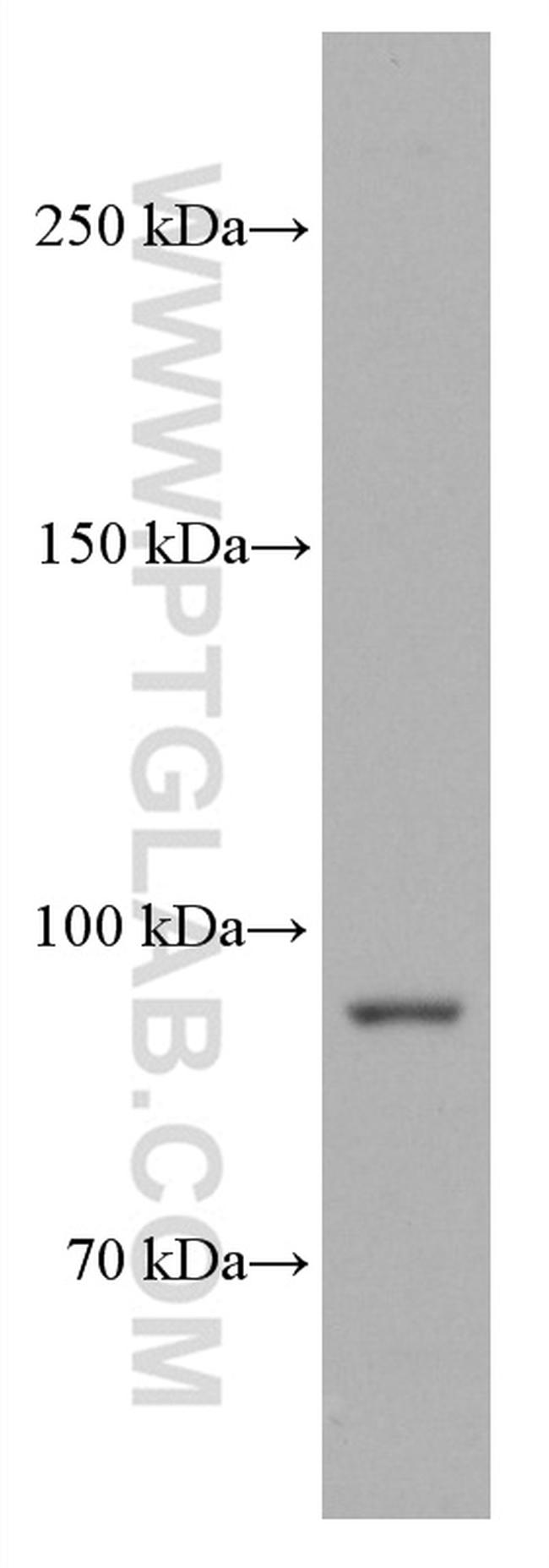
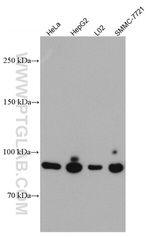


产品信息
66769-1-IG
产品规格
种属反应
Human
宿主/亚型
Mouse
/ IgG1
分类
Monoclonal
类型
Antibody
克隆号
1G12D8
抗原
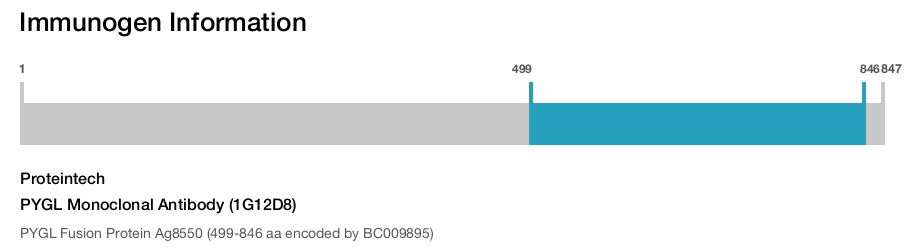
PYGL Fusion Protein Ag8550 (499-846 aa encoded by BC009895)
偶联物
形式
Liquid
浓度
1 mg/mL
纯化类型
Protein G
保存液
PBS, pH 7.3, with 50% glycerol
内含物
0.02% sodium azide
保存条件
-20°C
运输条件
Wet ice (domestic); Dry ice (international)
产品详细信息
Immunogen sequence: GLAELIAEK IGEDYVKDLS QLTKLHSFLG DDVFLRELAK VKQENKLKFS QFLETEYKVK INPSSMFDVQ VKRIHEYKRQ LLNCLHVITM YNRIKKDPKK LFVPRTVIIG GKAAPGYHMA KMIIKLITSV ADVVNNDPMV GSKLKVIFLE NYRVSLAEKV IPATDLSEQI STAGTEASGT GNMKFLNGAL TIGTMDGANV EMAEEAGEEN LFIFGMRIDD VAALDKKGYE AKEYYEALPE LKLVIDQIDN GFFSPKQPDL FKDIINMLFY HDRFKVFADY EAYVKCQDKV SQLYMNPKAW NTMVLKNIAA SGKFSSDRTI KEYAQNIWNV EPSDLKISLS NESNKVNGN (499-846 aa encoded by BC009895)
靶标信息
This gene encodes a homodimeric protein that catalyses the cleavage of alpha-1,4-glucosidic bonds to release glucose-1-phosphate from liver glycogen stores. This protein switches from inactive phosphorylase B to active phosphorylase A by phosphorylation of serine residue 15. Activity of this enzyme is further regulated by multiple allosteric effectors and hormonal controls. Humans have three glycogen phosphorylase genes that encode distinct isozymes that are primarily expressed in liver, brain and muscle, respectively. The liver isozyme serves the glycemic demands of the body in general while the brain and muscle isozymes supply just those tissues. In glycogen storage disease type VI, also known as Hers disease, mutations in liver glycogen phosphorylase inhibit the conversion of glycogen to glucose and results in moderate hypoglycemia, mild ketosis, growth retardation and hepatomegaly. Alternative splicing results in multiple transcript variants encoding different isoforms.
仅用于科研。不用于诊断过程。未经明确授权不得转售。
篇参考文献 (0)
您是否在文献中引用过该产品?请点击下方按钮邮件告知我们。
生物信息学
蛋白别名: glycogen liver; Glycogen phosphorylase, liver form; GPLL
基因别名: GSD6; PYGL
UniProt ID: (Human) P06737
Entrez Gene ID: (Human) 5836

