Search
Disclaimer

Clicking the images or links will redirect you to a website hosted by BenchSci that provides third-party scientific content. Neither the content nor the BenchSci technology and processes for selection have been evaluated by us; we are providing them as-is and without warranty of any kind, including for use or application of the Thermo Fisher Scientific products presented.
OriGene
Pancreatic Polypeptide (PPY) Monoclonal Antibody (OTI1G7)
{{$productOrderCtrl.translations['antibody.pdp.commerceCard.promotion.promotions']}}
{{$productOrderCtrl.translations['antibody.pdp.commerceCard.promotion.viewpromo']}}
{{$productOrderCtrl.translations['antibody.pdp.commerceCard.promotion.promocode']}}: {{promo.promoCode}} {{promo.promoTitle}} {{promo.promoDescription}}. {{$productOrderCtrl.translations['antibody.pdp.commerceCard.promotion.learnmore']}}
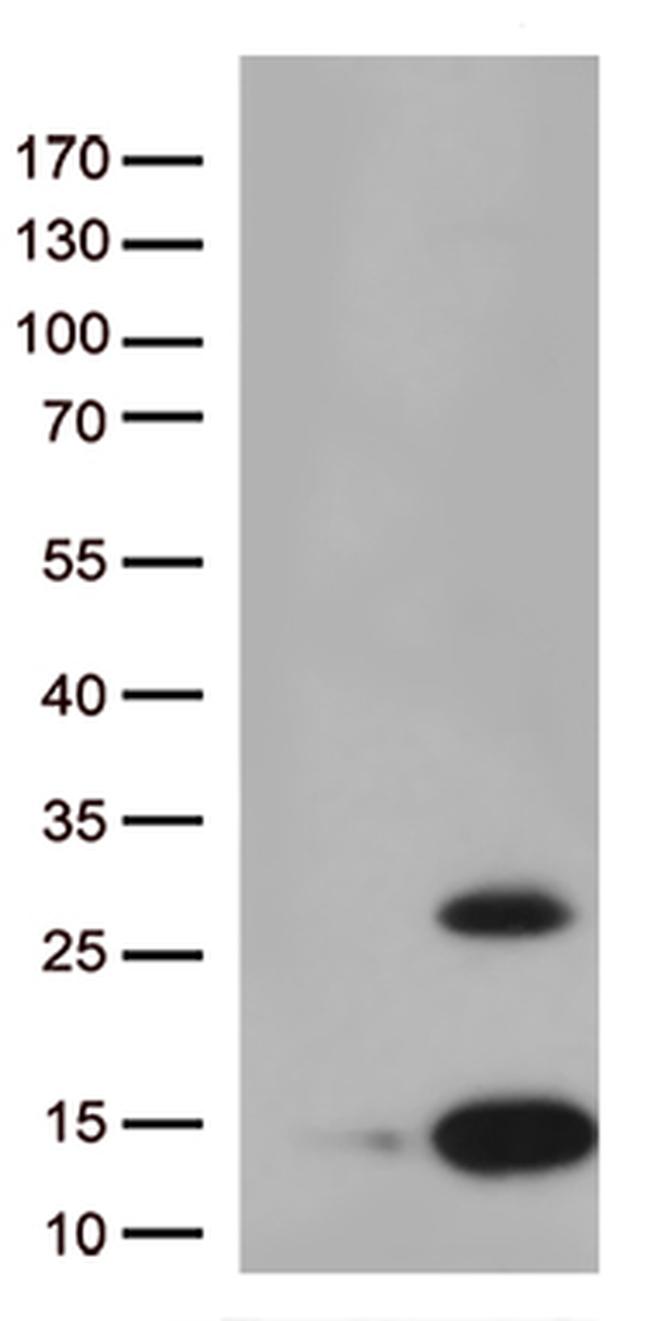
图: 1 / 1
Pancreatic Polypeptide (PPY) Antibody (CF813059) in WB
HEK293T cells were transfected with the pCMV6-ENTRY control (Left lane) or pCMV6-ENTRY PPY (RC206584, Right lane) cDNA for 48 hrs and lysed. Equivalent amounts of cell lysates (5 ug per lane) were separated by SDS-PAGE and immunoblotted with anti-PPY (1:500).

产品信息
CF813059
产品规格
种属反应
Human
宿主/亚型
Mouse
/ IgG1
分类
Monoclonal
类型
Antibody
克隆号
OTI1G7
抗原
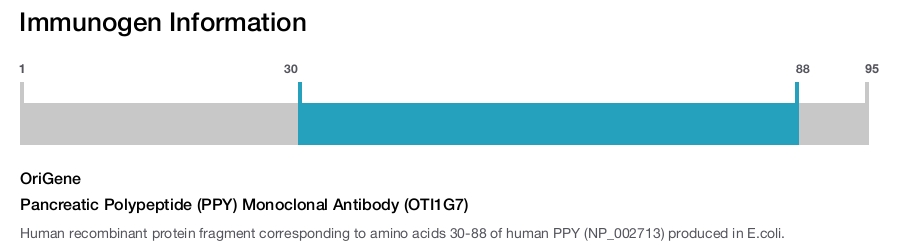
Human recombinant protein fragment corresponding to amino acids 30-88 of human PPY (NP_002713) produced in E.coli.
偶联物
形式
Lyophilized
浓度
1 mg/mL
纯化类型
Affinity chromatography
保存液
PBS with 8% trehalose
内含物
no preservative
保存条件
-20°C
运输条件
Ambient (domestic); Wet ice (international)
产品详细信息
For reconstitution, we recommend adding 100 µL distilled water to a final antibody concentration of about 1 mg/mL. To use this carrier-free antibody for conjugation experiments, we strongly recommend performing another round of desalting. (Zeba Spin Desalting Columns, 7KMWCO, 0.5 mL, Product # 89882)
靶标信息
The PPY gene encodes pancreatic polypeptide, a peptide hormone involved in the regulation of appetite and energy balance. The origin of the PPY gene is linked to a tandem duplication of the PYY gene, occurring concomitantly with the emergence of tetrapods, leading to the distinct PPY function within the neuropeptide Y family. In primates and ungulates, a gene duplication event resulted in the formation of a PYY2-PPY2 gene cluster, highlighting the evolutionary complexity of these genes. The PPY gene product is secreted by gamma-cells in the pancreas, localized primarily in the islet periphery, and plays a crucial role in metabolic homeostasis by interacting with receptors in the central nervous system to modulate satiety signals postprandially. PPY's function is linked to its inhibition of AGRP/NPY neurons which decreases their suppressive effect on POMC neurons, enhancing POMC activity and contributing to appetite suppression. This intricate regulation underscores the importance of PPY in dietary intake and metabolic disorders, with ongoing research exploring its potential therapeutic applications.
仅用于科研。不用于诊断过程。未经明确授权不得转售。
篇参考文献 (0)
您是否在文献中引用过该产品?请点击下方按钮邮件告知我们。
生物信息学
蛋白别名: HGNC:9327; IOPPP; Pancreatic polypeptide prohormone; Pancreatic polypeptide Y; PH; PP1; PPA1; PPase; prepro-PP (prepropancreatic polypeptide); SID6-8061
基因别名: PNP; PP; PPY
UniProt ID: (Human) P01298
Entrez Gene ID: (Human) 5539

