Search
Invitrogen
Phospho-4E-BP1 (Thr36) Polyclonal Antibody
{{$productOrderCtrl.translations['antibody.pdp.commerceCard.promotion.promotions']}}
{{$productOrderCtrl.translations['antibody.pdp.commerceCard.promotion.viewpromo']}}
{{$productOrderCtrl.translations['antibody.pdp.commerceCard.promotion.promocode']}}: {{promo.promoCode}} {{promo.promoTitle}} {{promo.promoDescription}}. {{$productOrderCtrl.translations['antibody.pdp.commerceCard.promotion.learnmore']}}
Additional Information:
{{banner.description}}

产品信息
PA5-35567
产品规格
宿主/亚型
Rabbit
/ IgG
分类
Polyclonal
类型
Antibody
抗原
Synthetic peptide derived from human 4E-BP1 around the phosphorylation site of Threonine 36
偶联物
Unconjugated
Unconjugated
Unconjugated
形式
Liquid
浓度
Lot-Specific
保存条件
-20°C
运输条件
Ambient
RRID
产品详细信息
Concentration is lot-specific and will vary from 0.5-0.6 mg/ml
靶标信息
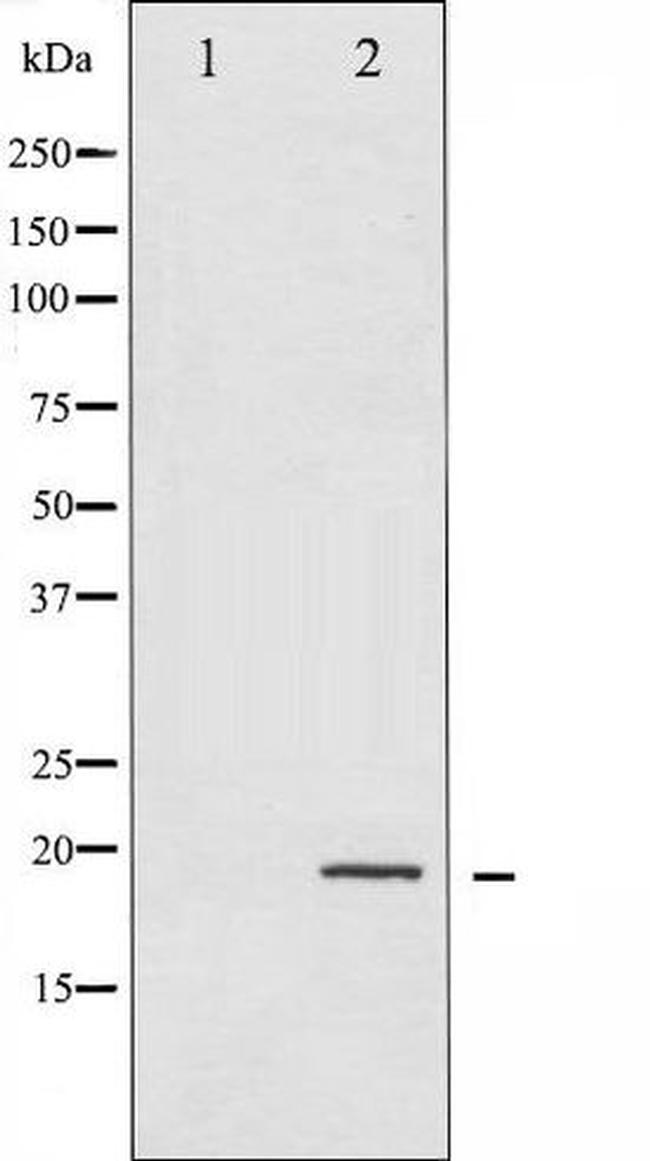
4E-BP1 (Eukaryotic initiation factor 4E binding protein 1, PHAS) is a 20 kDa translation repressor protein, and directly interacts with eukaryotic translation initiation factor 4E (eIF4E), which is a limiting component of the multi-subunit complex that recruits 40S ribosomal subunits to the 5' end of mRNAs. 4E-BP1 inhibits cap-dependent translation by binding to eIF4E on the same site that overlaps the binding site for eIF4G, preventing its binding to the latter and leading to an increase in mRNA translation. The phosphorylation of 4E-BP1 is critical in determining cell fate by controlling translation initiation and apoptotic potency. 4E-BP1 is hyper-phosphorylated in response to several external stimuli including hormones, growth factors, mitogens, cytokines and G-protein-coupled receptors and in response to stress conditions including nutrient deprivation. The phosphorylation of these sites is believed to occur in an orderly fashion where phosphorylation of threonine 37 and 46 by FRAP/mTOR is a priming step for subsequent phosphorylation of 4E-BP1 at the carboxy-terminal sites. Under normoxic conditions, increased VEGF expression, resulting from inhibition of 4E-BP1, contributes to efficient angiogenesis and metastatic brain growth through activated integrin alpha-v beta3. 4E-BP1 is phosphorylated in response to various signals including UV irradiation and insulin signaling, resulting in its dissociation from eIF4E and activation of mRNA translation.
仅用于科研。不用于诊断过程。未经明确授权不得转售。
篇参考文献 (0)
您是否在文献中引用过该产品?请点击下方按钮邮件告知我们。
Disclaimer

Clicking the images or links will redirect you to a website hosted by BenchSci that provides third-party scientific content. Neither the content nor the BenchSci technology and processes for selection have been evaluated by us; we are providing them as-is and without warranty of any kind, including for use or application of the Thermo Fisher Scientific products presented.

