Search
Disclaimer

Clicking the images or links will redirect you to a website hosted by BenchSci that provides third-party scientific content. Neither the content nor the BenchSci technology and processes for selection have been evaluated by us; we are providing them as-is and without warranty of any kind, including for use or application of the Thermo Fisher Scientific products presented.
Invitrogen
Phospho-GSK3 alpha/beta (Tyr279, Tyr216) Polyclonal Antibody
{{$productOrderCtrl.translations['antibody.pdp.commerceCard.promotion.promotions']}}
{{$productOrderCtrl.translations['antibody.pdp.commerceCard.promotion.viewpromo']}}
{{$productOrderCtrl.translations['antibody.pdp.commerceCard.promotion.promocode']}}: {{promo.promoCode}} {{promo.promoTitle}} {{promo.promoDescription}}. {{$productOrderCtrl.translations['antibody.pdp.commerceCard.promotion.learnmore']}}
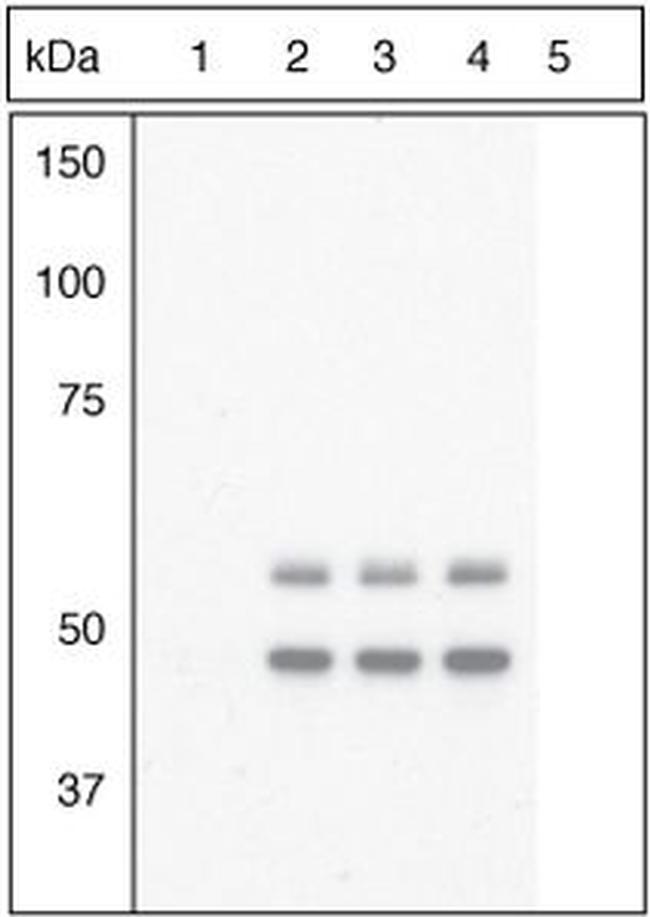
图: 1 / 1
Phospho-GSK3 alpha/beta (Tyr279, Tyr216) Antibody (OPA1-03083) in WB
Up-regulation and Antibody-Peptide Competition: Peptide Competition. Extracts of 3T3L1 cells stimulated with 100 nM insulin for 10 minutes were resolved by SDS-PAGE on a 10% Tris-glycine gel and transferred to PVDF. The membrane was blocked with a 5% BSA-TBST buffer for one hour at room temperature and either left untreated (1-4) or treated with lambda phosphatase (5), and then incubated with the GSK-3a (pY... View More

产品信息
OPA1-03083
应用
建议稀释比
已发表文章
产品规格
已发表种属
Human,
Mouse
宿主/亚型
Rabbit
/ IgG
分类
Polyclonal
类型
Antibody
抗原
Synthetic phosphopeptide derived from regions of human GSK3alpha/beta that contain tyrosine 279/216.
偶联物
形式
Liquid
保存条件
-20°C, Avoid Freeze/Thaw Cycles
运输条件
Wet ice
RRID
产品详细信息
OPA1-03083 detects the alpha and beta isoforms of phospho-GSK3 from human and mouse tissues. This antibody is expected to cross-react with rat, frog, and zebra fish GSK-3 due to 100% sequence homology.
OPA1-03083 has been successfully used in Western blot procedures. By Western blot, this antibody detects an ~51 kDa protein and an ~47 kDa protein from stimulated 3T3-L1 cells representing tyrosine 279 phosphorylated GSK3alpha and tyrosine 216 phosphorylated GSK3beta, respectively. Positive control: serum starved mouse 3T3-L1 cells +/- insulin (100 nM, 10 minutes), or background extracts +/- human recombinant GSK-3â.
OPA1-03083 immunizing phosphopeptide was derived from a regions of human GSK3alpha/beta that contain tyrosine 279/216.
靶标信息
Glycogen synthase kinase-3 (GSK3) is a protein kinase that was originally identified as a regulator of glycogen synthase, a key enzyme in glycogen metabolism. Since then, it has been shown to be involved in the regulation of a diverse array of cellular functions, including protein synthesis, cell proliferation, cell differentiation, microtubule assembly/disassembly, and apoptosis. GSK3's substrate specificity is unique in that phosphorylation of the substrate only occurs if a phosphoserine or phosphotyrosine is present - four residues C-terminal to the site of GSK phosphorylation. There exists two isoforms of GSK3, GSK3 alpha and GSK3 beta, and they are strictly regulated via phosphorylation. Phosphorylation of GSK3 beta on Ser9 (Ser21 in GSK3alpha) by protein kinase B (PKB) causes its inactivation and is the primary mechanism responsible for growth factor inhibition of this kinase. Activation of GSK3 beta is dependent upon the phosphorylation of Tyr216 (Tyr279 in GSK3 alpha). Upon activation, it has been shown to phosphorylate a number of different cellular proteins, including p53, c-Myc, c-Jun, heat shock factor-1 (HSF-1), and cyclin D1. GSK3 beta also has been shown to phosphorylate aberrant sites on the microtubule associated protein tau, which is critical for the progression of Alzheimer's disease.
仅用于科研。不用于诊断过程。未经明确授权不得转售。

