Search
Invitrogen
Phospho-HSP27 (Ser85) Polyclonal Antibody
{{$productOrderCtrl.translations['antibody.pdp.commerceCard.promotion.promotions']}}
{{$productOrderCtrl.translations['antibody.pdp.commerceCard.promotion.viewpromo']}}
{{$productOrderCtrl.translations['antibody.pdp.commerceCard.promotion.promocode']}}: {{promo.promoCode}} {{promo.promoTitle}} {{promo.promoDescription}}. {{$productOrderCtrl.translations['antibody.pdp.commerceCard.promotion.learnmore']}}
Additional Information:
{{banner.description}}
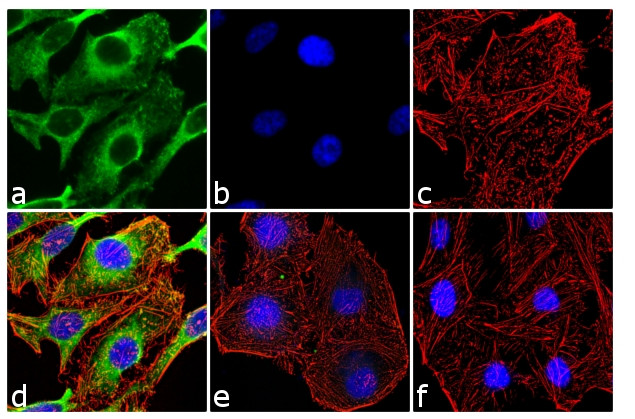
图: 1 / 11
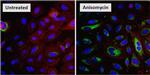
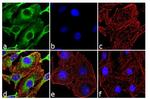
Phospho-HSP27 (Ser85) Antibody (PA1-005) in ICC/IF
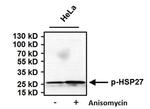
Immunofluorescence analysis of Phospho-HSP27 pSer85 was done on 70% confluent log phase HeLa cells. The cells were treated with 25 µg of Anisomycin for 30 minutes and cell were fixed with 4% paraformaldehyde for 10 minutes, permeabilized with 0.1% Triton™ X-100 for 10 minutes, and blocked with 1% BSA for 1 hour at room temperature. The cells were labeled with of Phospho-HSP27 pSer85 Rabbit Polyclonal Antibo... View More



产品信息
PA1-005
应用
建议稀释比
已发表文章
产品规格
已发表种属
Human,
Rat
宿主/亚型
Rabbit
/ IgG
分类
Polyclonal
类型
Antibody
抗原
Synthetic phosphopeptide corresponding to residues R(82) Q L S(p) S G V S E I R(92) C of rat HSP27.
偶联物
形式
Lyophilized
浓度
1 mg/mL
规格
100 µg
保存条件
-20°C, Avoid Freeze/Thaw Cycles
运输条件
Wet ice
RRID
产品详细信息
PA1-005 detects phosphorylated heat shock protein 27 (HSP27) from human and rat tissue samples. This antibody does not detect the unphosphorylated form of the protein.
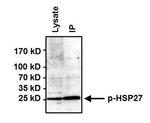
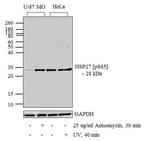
PA1-005 has been successfully used in Western blot, immunoprecipitation, and immunofluorescence procedures. By Western blot, this antibody detects an ~27 kDa protein representing phosphorylated HSP27(Ser85) from rat skeletal muscle extracts.
The PA1-005 immunogen is a synthetic phosphopeptide corresponding to residues R(82) Q L S(p) S G V S E I R(92) C of rat HSP27. This sequence is completely conserved in mouse.
Reconstitute with 100 µL for a 1 mg/mL solution.
靶标信息
In response to adverse changes in their environment, cells from many organisms increase the expression of a class of proteins referred to as heat shock or stress proteins. HSPB1 (heat shock protein beta-1 or HSP27) is a small heat shock protein which functions as a molecular chaperone that maintains denatured proteins in a folding-competent state. It plays a role in stress resistance and actin organization. Through its molecular chaperone activity, HSP27 regulates numerous biological processes including the phosphorylation and the axonal transport of neurofilament proteins. Mutations in the gene can result in Charcot-Marie-Tooth disease 2F and Neuronopathy distal hereditary motor 2B.
仅用于科研。不用于诊断过程。未经明确授权不得转售。
Disclaimer

Clicking the images or links will redirect you to a website hosted by BenchSci that provides third-party scientific content. Neither the content nor the BenchSci technology and processes for selection have been evaluated by us; we are providing them as-is and without warranty of any kind, including for use or application of the Thermo Fisher Scientific products presented.

