Search
Invitrogen
Phospho-PKC zeta/gamma (Thr410, Thr412) Recombinant Rabbit Monoclonal Antibody (K01_2L07)
{{$productOrderCtrl.translations['antibody.pdp.commerceCard.promotion.promotions']}}
{{$productOrderCtrl.translations['antibody.pdp.commerceCard.promotion.promocode']}}: {{promo.promoCode}} {{promo.promoTitle}} {{promo.promoDescription}}. {{$productOrderCtrl.translations['antibody.pdp.commerceCard.promotion.learnmore']}}
{{$ctrl.translations['antibody.pdp.skuNotes.additionalInformation']}}:
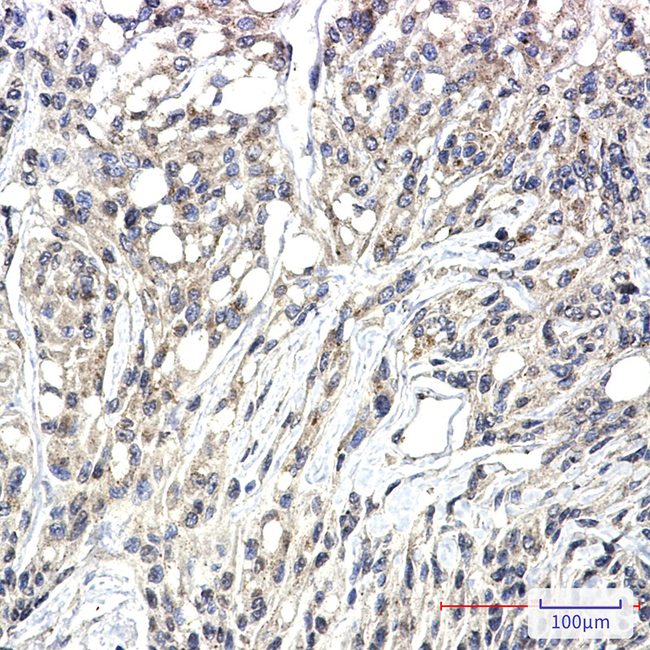
图: 1 / 3
Phospho-PKC zeta/gamma (Thr410, Thr412) Antibody (MA567870) in IHC (P)
Immunohistochemical (Paraffin) analysis of Phospho-PKC zeta/gamma (Thr410, Thr412) in Human Brain using Phospho-PKC zeta/gamma (Thr410, Thr412) Recombinant Monoclonal Antibody (Product # MA567870). High-pressure and temperature Sodium Citrate pH 6.0 was used for antigen retrieval.
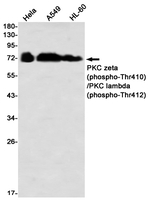
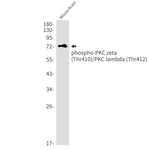
Please note: We are reviewing Western blot images included in the antibody testing data in our catalog, including those provided by third parties. Unless expressly labeled or annotated as “raw-unedited”, Western blot images included in the antibody testing data in our catalog may have been edited, optimized or otherwise adjusted for presentation.


产品信息
MA567870
产品规格
种属反应
Human,
Mouse
宿主/亚型
Rabbit
/ IgG
Expression System
HEK293F
分类
Recombinant Monoclonal
类型
Antibody
克隆号
K01_2L07
抗原
A synthetic phosphopeptide corresponding to residues surrounding Thr410 of human PKC zeta.
偶联物
Unconjugated
Unconjugated
Unconjugated
形式
Liquid
浓度
1 mg/mL
规格
100 µg
纯化类型
Protein A/G
保存液
50mM tris glycine, pH 7.4, with 40% glycerol, 0.05% BSA, 150mM NaCl
内含物
0.01% sodium azide
保存条件
Store at 4°C short term. For long term storage, store at -20°C, avoiding freeze/thaw cycles.
运输条件
Ambient (domestic); Wet ice (international)
靶标信息
Protein kinase C zeta and protein kinase C gamma are members of the PKC family of serine threonine kinases that regulate diverse signaling pathways. PKC zeta, encoded by PRKCZ, is an atypical isoform that does not require calcium or diacylglycerol and functions downstream of PI3K and PDK1, often within PAR polarity complexes and NF kappa B signaling, to control cell survival, polarity, migration, and metabolic responses. PKC gamma, encoded by PRKCG, is a conventional isoform that requires calcium, diacylglycerol, and phosphatidylserine for activation, is highly expressed in neurons, and contributes to synaptic plasticity, nociception, and cerebellar function. Germline mutations in PRKCG cause spinocerebellar ataxia type 14, while PRKCZ dysregulation has been linked to cancer signaling, insulin resistance, and inflammatory responses. Both isoforms are studied using phospho specific antibodies, kinase activity assays, genetic perturbation, and small molecule modulators; therapeutically, PKC pathway inhibitors and isoform selective probes are being explored to modulate neurological and oncogenic processes.
仅用于科研。不用于诊断过程。未经明确授权不得转售。
篇参考文献 (0)
您是否在文献中引用过该产品?请点击下方按钮邮件告知我们。
生物信息学
蛋白别名: atypical protein kinase C; nPKC-y; nPKC-zeta; PKC gamma; PKC-gamma; PKC-y; PKC-Z; protein kinase C zeta subspecies; unnamed protein product
基因别名: aPKCzeta; nPKC-zeta; PKC-gamma; PKC-ZETA; PKC2; PKCC; PKCG; PKCgamma; PKCI(3); Pkcz; Prkcc; SCA14; zetaPKC
UniProt ID: (Human) P05129, (Human) Q05513, (Mouse) P63318, (Mouse) Q02956
Entrez Gene ID: (Human) 5582, (Human) 5590, (Mouse) 18752, (Mouse) 18762
protein kinase activity
protein serine/threonine kinase activity
protein kinase C activity
calcium-dependent protein kinase C activity
protein serine/threonine/tyrosine kinase activity
protein binding
ATP binding
zinc ion binding
protein serine kinase activity
insulin receptor substrate binding
potassium channel regulator activity
protein kinase binding
phospholipase binding
macromolecular complex binding
14-3-3 protein binding
microtubule cytoskeleton organization
positive regulation of cell-matrix adhesion
protein phosphorylation
cell surface receptor signaling pathway
long-term memory
positive regulation of cell proliferation
cell migration
peptidyl-serine phosphorylation
establishment of cell polarity
negative regulation of protein complex assembly
activation of protein kinase B activity
positive regulation of interleukin-10 production
positive regulation of interleukin-13 production
positive regulation of interleukin-4 production
positive regulation of interleukin-5 production
cellular response to insulin stimulus
intracellular signal transduction
positive regulation of phosphorylation
negative regulation of apoptotic process
positive regulation of T-helper 2 cell differentiation
negative regulation of insulin receptor signaling pathway
positive regulation of insulin receptor signaling pathway
vesicle transport along microtubule
positive regulation of synaptic transmission
positive regulation of protein transport
negative regulation of hydrolase activity
membrane depolarization
membrane hyperpolarization
long-term synaptic potentiation
positive regulation of ERK1 and ERK2 cascade
protein localization to plasma membrane
regulation of neurotransmitter receptor localization to postsynaptic specialization membrane
positive regulation of smooth muscle cell-matrix adhesion
neuron projection extension
positive regulation of excitatory postsynaptic potential
positive regulation of T-helper 2 cell cytokine production
signal transduction
phospholipase C-activating G-protein coupled receptor signaling pathway
chemical synaptic transmission
learning or memory
response to toxic substance
negative regulation of protein ubiquitination
regulation of response to food
positive regulation of mismatch repair
negative regulation of protein catabolic process
regulation of circadian rhythm
response to morphine
negative regulation of neuron apoptotic process
response to pain
innervation
negative regulation of proteasomal protein catabolic process
response to angiotensin
response to psychosocial stress
regulation of synaptic vesicle exocytosis
chemosensory behavior
protein autophosphorylation
regulation of phagocytosis
synaptic signaling via neuropeptide
Disclaimer

Clicking the images or links will redirect you to a website hosted by BenchSci that provides third-party scientific content. Neither the content nor the BenchSci technology and processes for selection have been evaluated by us; we are providing them as-is and without warranty of any kind, including for use or application of the Thermo Fisher Scientific products presented.

