Search
Disclaimer

Clicking the images or links will redirect you to a website hosted by BenchSci that provides third-party scientific content. Neither the content nor the BenchSci technology and processes for selection have been evaluated by us; we are providing them as-is and without warranty of any kind, including for use or application of the Thermo Fisher Scientific products presented.
Invitrogen
Phospho-PSG1 (Thr278) Polyclonal Antibody
{{$productOrderCtrl.translations['antibody.pdp.commerceCard.promotion.promotions']}}
{{$productOrderCtrl.translations['antibody.pdp.commerceCard.promotion.viewpromo']}}
{{$productOrderCtrl.translations['antibody.pdp.commerceCard.promotion.promocode']}}: {{promo.promoCode}} {{promo.promoTitle}} {{promo.promoDescription}}. {{$productOrderCtrl.translations['antibody.pdp.commerceCard.promotion.learnmore']}}
产品信息
PA5-64713
产品规格
宿主/亚型
Rabbit
/ IgG
分类
Polyclonal
类型
Antibody
抗原
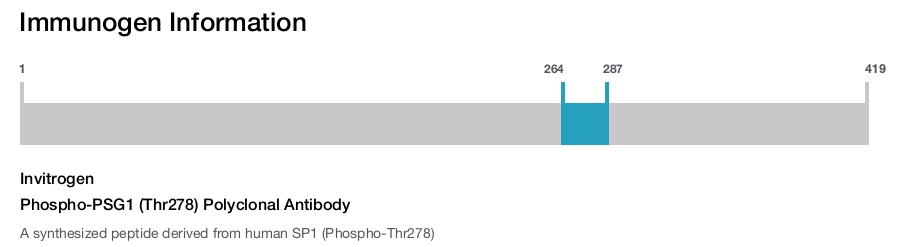
A synthesized peptide derived from human SP1 (Phospho-Thr278)
偶联物
形式
Liquid
浓度
1 mg/mL
保存条件
-20°C
运输条件
Wet ice
RRID
产品详细信息
Phospho-PSG1 (Thr278) Polyclonal Antibody detects endogenous levels of PSG1 only when phosphorylated at Thr278.
靶标信息
Human pregnancy-specific glycoproteins (PSG), are a group of closely related secreted glycoproteins which are highly expressed in placental syncytiotrophoblast cells of fetal origin. PSG are commonly expressed in tumors of trophoblast origin (hydatidiform mole, choriocarcinoma). They represent the most abundant fetal protein in the maternal blood at term. The eleven human PSG genes (PSG1-PSG11) form together with the carcinoembryonic antigen (CEA)-related cell adhesion molecule (CEACAM) genes the CEACAM gene family. PSG stimulates secretion of TH2-type cytokines from monocytes. CD9 was shown to represent the monocyte receptor for murine PSG17. PSG are thought to modulate the maternal immune system during pregnancy thus protecting the semiallotypic fetus from rejection.
仅用于科研。不用于诊断过程。未经明确授权不得转售。
篇参考文献 (0)
您是否在文献中引用过该产品?请点击下方按钮邮件告知我们。

