Search
Invitrogen
Phospho-SHP-1 (Tyr564) Polyclonal Antibody
{{$productOrderCtrl.translations['antibody.pdp.commerceCard.promotion.promotions']}}
{{$productOrderCtrl.translations['antibody.pdp.commerceCard.promotion.promocode']}}: {{promo.promoCode}} {{promo.promoTitle}} {{promo.promoDescription}}. {{$productOrderCtrl.translations['antibody.pdp.commerceCard.promotion.learnmore']}}
{{$ctrl.translations['antibody.pdp.skuNotes.additionalInformation']}}:
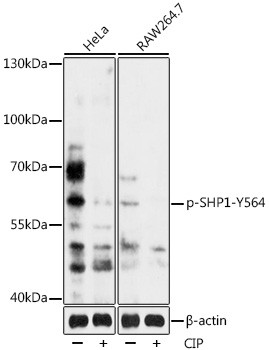
图: 1 / 1
Phospho-SHP-1 (Tyr564) Antibody (PA5-97397) in WB
Western blot analysis of Phospho-SHP-1 (Tyr564) in extracts of HeLa and RAW 264.7 cells. Samples were incubated with Phospho-SHP-1 (Tyr564) Polyclonal antibody (Product # PA5-97397) using a dilution of 1:2,000, followed by HRP Goat Anti-Rabbit IgG (H+L) secondary antibody at a dilution of 1:10,000. HeLa cell lysates were treated by CIP at 37°C for 1 hour. RAW 264.7 cell lysates were treated by CIP at 37°C f... View More
Please note: We are reviewing Western blot images included in the antibody testing data in our catalog, including those provided by third parties. Unless expressly labeled or annotated as “raw-unedited”, Western blot images included in the antibody testing data in our catalog may have been edited, optimized or otherwise adjusted for presentation.

产品信息
PA5-97397
产品规格
种属反应
Human,
Mouse
宿主/亚型
Rabbit
/ IgG
分类
Polyclonal
类型
Antibody
抗原
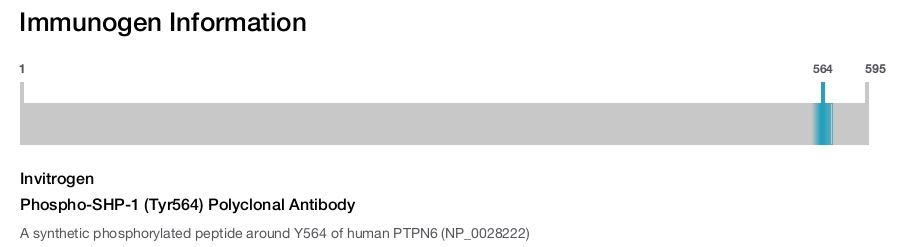
A synthetic phosphorylated peptide around Y564 of human PTPN6 (NP_0028222)
偶联物
Unconjugated
Unconjugated
Unconjugated
形式
Liquid
浓度
1.14 mg/mL
规格
114 µg
纯化类型
Affinity Chromatography
保存液
PBS, pH 7.3, with 50% glycerol
内含物
0.01% thimerosal
保存条件
-20°C, Avoid Freeze/Thaw Cycles
运输条件
Ambient (domestic); Wet ice (international)
RRID
产品详细信息
Immunogen sequence: DVYEN; Positive Samples: HeLa, RAW 264.7; Cellular Location: Cytoplasm, Nucleus
靶标信息
SHP-1 (PTPN6) is a non-receptor protein tyrosine phosphatase that is expressed primarily in hematopoietic cells. The enzyme is composed of two SH2 domains, a tyrosine phosphatase catalytic domain, and a carboxy-terminal regulatory domain. SHP-1 removes phosphates from target proteins to downregulate several tyrosine kinase-regulated pathways. In hematopoietic cells, the amino-terminal SH2 domain of SHP-1 binds to tyrosine phosphorylated erythropoietin receptors (EpoR) to negatively regulate hematopoietic growth. Overexpression of SHP-1 in epithelial cells results in dephosphorylation of the Ros receptor tyrosine kinase and subsequent downregulation of Ros-dependent cell proliferation and transformation. Following ligand binding in myeloid cells, SHP-1 associates with the IL-3R beta chain and downregulates IL-3-induced tyrosine phosphorylation and cell proliferation.
⚠WARNING: This product can expose you to chemicals including mercury, which is known to the State of California to cause birth defects or other reproductive harm. For more information go to www.P65Warnings.ca.gov.
仅用于科研。不用于诊断过程。未经明确授权不得转售。
篇参考文献 (0)
您是否在文献中引用过该产品?请点击下方按钮邮件告知我们。
生物信息学
蛋白别名: EC 3.1.3.48; hematopoietic cell phosphatase; hematopoietic cell protein-tyrosine phosphatase; motheaten; protein-tyrosine phosphatase 1C; protein-tyrosine phosphatase SHP-1; PTN6; SH2 phosphatase 1; unnamed protein product
基因别名: 70Z-SHP; HCP; HCPH; HPTP1C; me; PTP-1C; Ptp1C; PTPTY-42; SH-PTP1; SHP-1; SHP-1L; SHP1
UniProt ID: (Human) P29350, (Mouse) P29351
Entrez Gene ID: (Human) 5777, (Mouse) 15170
phosphotyrosine binding
protein tyrosine phosphatase activity
non-membrane spanning protein tyrosine phosphatase activity
transmembrane receptor protein tyrosine phosphatase activity
protein binding
SH3 domain binding
protein kinase binding
SH2 domain binding
cell adhesion molecule binding
phosphorylation-dependent protein binding
cytokine receptor binding
natural killer cell lectin-like receptor binding
mitotic cell cycle
protein dephosphorylation
G-protein coupled receptor signaling pathway
positive regulation of cell proliferation
negative regulation of cell proliferation
negative regulation of angiogenesis
peptidyl-tyrosine phosphorylation
cytokine-mediated signaling pathway
cell differentiation
T cell costimulation
negative regulation of lipopolysaccharide-mediated signaling pathway
negative regulation of interleukin-6 production
negative regulation of tumor necrosis factor production
negative regulation of mast cell activation involved in immune response
peptidyl-tyrosine dephosphorylation
T cell activation
negative regulation of innate immune response
negative regulation of inflammatory response
negative regulation of antigen receptor-mediated signaling pathway
negative regulation of B cell receptor signaling pathway
positive regulation of protein kinase B signaling
regulation of type I interferon-mediated signaling pathway
regulation of ERK1 and ERK2 cascade
negative regulation of inflammatory response to wounding
CD27 signaling pathway
negative regulation of neutrophil activation
epididymis development
regulation of G1/S transition of mitotic cell cycle
pattern recognition receptor signaling pathway
hematopoietic progenitor cell differentiation
cytoplasmic pattern recognition receptor signaling pathway
negative regulation of humoral immune response mediated by circulating immunoglobulin
platelet formation
regulation of lipopolysaccharide-mediated signaling pathway
regulation of tumor necrosis factor production
positive regulation of cell adhesion mediated by integrin
intracellular signal transduction
megakaryocyte development
negative regulation of T cell proliferation
natural killer cell mediated cytotoxicity
negative regulation of MAP kinase activity
negative regulation of MAPK cascade
regulation of B cell differentiation
positive regulation of angiogenesis
negative regulation of peptidyl-tyrosine phosphorylation
B cell receptor signaling pathway
negative regulation of T cell receptor signaling pathway
regulation of release of sequestered calcium ion into cytosol
platelet aggregation
inflammatory response to wounding
positive regulation of cytokine production involved in inflammatory response
Disclaimer

Clicking the images or links will redirect you to a website hosted by BenchSci that provides third-party scientific content. Neither the content nor the BenchSci technology and processes for selection have been evaluated by us; we are providing them as-is and without warranty of any kind, including for use or application of the Thermo Fisher Scientific products presented.

