Search
Bioss
Polycystin 2 Polyclonal Antibody
{{$productOrderCtrl.translations['antibody.pdp.commerceCard.promotion.promotions']}}
{{$productOrderCtrl.translations['antibody.pdp.commerceCard.promotion.viewpromo']}}
{{$productOrderCtrl.translations['antibody.pdp.commerceCard.promotion.promocode']}}: {{promo.promoCode}} {{promo.promoTitle}} {{promo.promoDescription}}. {{$productOrderCtrl.translations['antibody.pdp.commerceCard.promotion.learnmore']}}
Additional Information:
{{banner.description}}
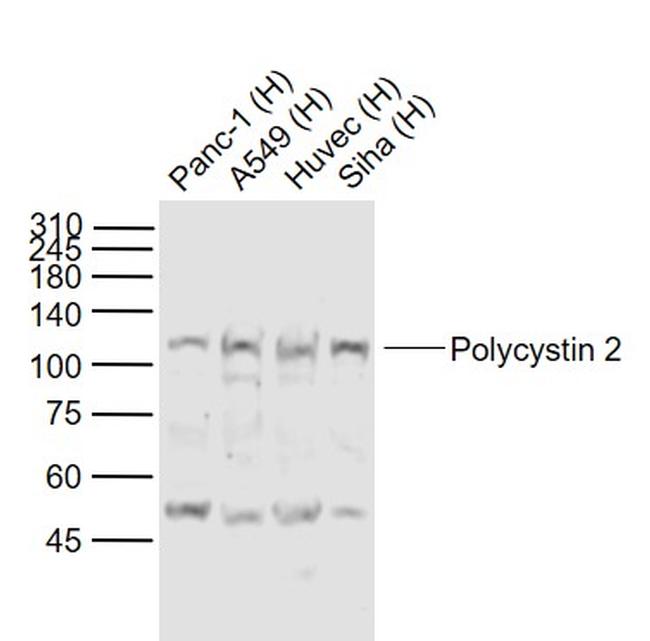
图: 1 / 1
Polycystin 2 Antibody (BS-24450R) in WB
Lane 1:Human Panc-1 cell lysates; Lane 2: Human A549 cell lysates; Lane 3: Human Huvec cell lysates; Lane 4: Human Siha cell lysates probed with Polycystin 2 Polyclonal Antibody, Unconjugated (bs-24450R) at 1:1000 dilution and 4°C overnight incubation. Followed by conjugated secondary antibody incubation at 1:20000 for 60 min at 37°C.

产品信息
BS-24450R
产品规格
种属反应
Human
宿主/亚型
Rabbit
/ IgG
分类
Polyclonal
类型
Antibody
抗原
KLH conjugated synthetic peptide derived from human Polycystin 2
偶联物
Unconjugated
Unconjugated
Unconjugated
形式
Liquid
浓度
1 mg/mL
规格
100 µg
纯化类型
Protein A
保存液
TBS, pH 7.4, with 1% BSA, 50% glycerol
内含物
0.03% ProClin 300
保存条件
-20°C, Avoid Freeze/Thaw Cycles
运输条件
Ambient (domestic); Wet ice (international)
靶标信息
Polycystin-2 (PC2), encoded by the PKD2 gene, is a multi-pass membrane protein that functions as a nonselective calcium-permeable cation channel, primarily localized to the primary cilium and endoplasmic reticulum. It plays a key role in calcium signaling and mechanosensation, often forming a complex with polycystin-1 to regulate cellular responses to fluid flow. Mutations in PKD2 disrupt these processes and lead to autosomal dominant polycystic kidney disease (ADPKD).
仅用于科研。不用于诊断过程。未经明确授权不得转售。
篇参考文献 (0)
您是否在文献中引用过该产品?请点击下方按钮邮件告知我们。
生物信息学
蛋白别名: autosomal dominant polycystic kidney disease type II; Autosomal dominant polycystic kidney disease type II protein; PC2; PKD2; polycystic kidney disease 2 (autosomal dominant); Polycystic kidney disease 2 protein; Polycystin-2; Polycystwin; R48321; Transient receptor potential cation channel subfamily P member 2; unnamed protein product
基因别名: APKD2; Pc-2; PC2; PKD2; PKD4; TRPP1; TRPP2
UniProt ID: (Human) Q13563
Entrez Gene ID: (Human) 5311
receptor binding
voltage-gated ion channel activity
voltage-gated calcium channel activity
voltage-gated sodium channel activity
voltage-gated potassium channel activity
cation channel activity
calcium channel activity
potassium channel activity
sodium channel activity
calcium ion binding
protein binding
cytoskeletal protein binding
channel activity
outward rectifier potassium channel activity
voltage-gated cation channel activity
identical protein binding
protein homodimerization activity
actinin binding
HLH domain binding
ion channel binding
metal ion binding
calcium-induced calcium release activity
ATPase binding
phosphoprotein binding
muscle alpha-actinin binding
transcription regulator inhibitor activity
branching involved in ureteric bud morphogenesis
kidney development
liver development
embryonic placenta development
heart looping
detection of nodal flow
ion transport
potassium ion transport
sodium ion transport
calcium ion transport
cellular calcium ion homeostasis
cell surface receptor signaling pathway
JAK-STAT cascade
determination of left/right symmetry
heart development
negative regulation of cell proliferation
positive regulation of gene expression
Wnt signaling pathway
calcium-mediated signaling
spinal cord development
neural tube development
ion transmembrane transport
cellular response to reactive oxygen species
metanephric part of ureteric bud development
sodium ion transmembrane transport
aorta development
regulation of cell proliferation
chordate embryonic development
cilium organization
positive regulation of nitric oxide biosynthetic process
positive regulation of transcription from RNA polymerase II promoter
embryonic organ development
detection of mechanical stimulus
release of sequestered calcium ion into cytosol
protein tetramerization
protein homotetramerization
protein heterotetramerization
centrosome duplication
establishment of localization in cell
regulation of cell cycle
placenta blood vessel development
renal tubule morphogenesis
renal artery morphogenesis
calcium ion transmembrane transport
cellular response to calcium ion
cellular response to cAMP
cellular response to hydrostatic pressure
cellular response to osmotic stress
cellular response to fluid shear stress
potassium ion transmembrane transport
determination of liver left/right asymmetry
metanephric mesenchyme development
mesonephric tubule development
mesonephric duct development
metanephric smooth muscle tissue development
metanephric cortex development
metanephric ascending thin limb development
metanephric cortical collecting duct development
metanephric distal tubule development
metanephric S-shaped body morphogenesis
regulation of calcium ion import
inorganic cation transmembrane transport
positive regulation of phospholipase C-activating G-protein coupled receptor signaling pathway
negative regulation of G1/S transition of mitotic cell cycle
Disclaimer

Clicking the images or links will redirect you to a website hosted by BenchSci that provides third-party scientific content. Neither the content nor the BenchSci technology and processes for selection have been evaluated by us; we are providing them as-is and without warranty of any kind, including for use or application of the Thermo Fisher Scientific products presented.

