Search
NeoBiotechnologies
RET Proto-oncogene (Medullary Thyroid Carcinoma Marker) Recombinant Mouse Monoclonal Antibody (r3F8)
{{$productOrderCtrl.translations['antibody.pdp.commerceCard.promotion.promotions']}}
{{$productOrderCtrl.translations['antibody.pdp.commerceCard.promotion.promocode']}}: {{promo.promoCode}} {{promo.promoTitle}} {{promo.promoDescription}}. {{$productOrderCtrl.translations['antibody.pdp.commerceCard.promotion.learnmore']}}
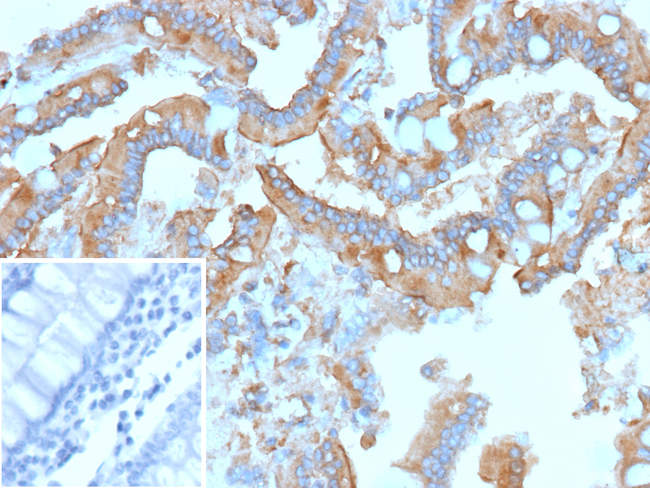
图: 1 / 3
RET Proto-oncogene (Medullary Thyroid Carcinoma Marker) Antibody (5979-MSM19-P1) in IHC (P)
Formalin-fixed, paraffin-embedded human colon carcinoma stained with RET Proto-oncogene Recombinant Mouse Monoclonal Antibody (r3F8). Inset: PBS instead of primary antibody; secondary only negative control.
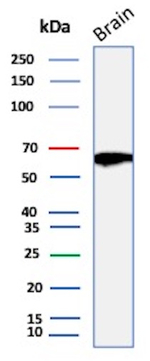
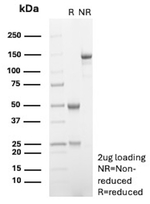
Please note: We are reviewing Western blot images included in the antibody testing data in our catalog, including those provided by third parties. Unless expressly labeled or annotated as “raw-unedited”, Western blot images included in the antibody testing data in our catalog may have been edited, optimized or otherwise adjusted for presentation.


产品信息
5979-MSM19-P1
产品规格
种属反应
Human
宿主/亚型
Mouse
/ IgG1, kappa
Expression System
CHO cells
分类
Recombinant Monoclonal
类型
Antibody
克隆号
r3F8
抗原
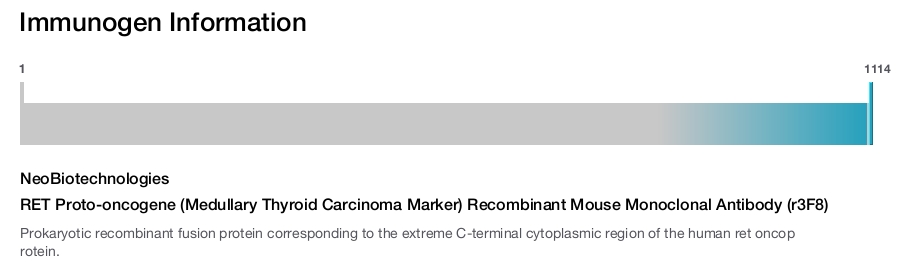
Prokaryotic recombinant fusion protein corresponding to the extreme C-terminal cytoplasmic region of the human ret oncoprotein.
偶联物
Unconjugated
Unconjugated
Unconjugated
形式
Liquid
浓度
200 µg/mL
规格
100 µg
纯化类型
Protein G
保存液
PBS with 0.05% BSA
内含物
0.05% sodium azide
保存条件
4°C
运输条件
Ambient (domestic); Wet ice (international)
产品详细信息
Product cellular localization: Apical cell membrane, Cell membrane, Cell projection, Cilium, Cytoplasm, Secreted.
Positive control: Kidney: Cells of proximal tubuli should show a moderate to strong ACE2 immunostaining with accentuation of the staining at the apical membrane.
Tissue specificity: Expressed in endothelial cells from small and large arteries, and in arterial smooth muscle cells (at protein level) (PubMed:15141377). Expressed in enterocytes of the small intestine, Leydig cells and Sertoli cells (at protein level) (PubMed:15141377). Expressed in the renal proximal tubule and the small intestine (at protein level) (PubMed:18424768). Expressed in heart, kidney, testis, and gastrointestinal system (at protein level) (PubMed:10969042, PubMed:10924499, PubMed:15231706, PubMed:12459472, PubMed:15671045, PubMed:32715618, PubMed:32170560). In lung, expressed at low levels in some alveolar type 2 cells, the expression seems to be individual-specific (at protein level) (PubMed:32425701, PubMed:15141377, PubMed:32715618, PubMed:32170560, PubMed:33432184). Expressed in nasal epithelial cells (at protein level) (PubMed:33432184, PubMed:32333915). Coexpressed with TMPRSS2 within some lung alveolar type 2 cells, ileal absorptive enterocytes, intestinal epithelial cells, cornea, gallbladder and nasal goblet secretory cells (PubMed:32413319, PubMed:32327758, PubMed:32358202). Coexpressed with TMPRSS4 within mature enterocytes (PubMed:32404436). Expressed in nasal and bronchial epithelial cells (at protein level).
靶标信息
The receptor tyrosine kinase RET is a member of the cadherin superfamily. RET plays a crucial role in neural crest development, and can undergo oncogenic activation by cytogenetic rearrangement. RET transduce signals for cell growth and differentiation. Mutations in the RET gene are associated with the disorders multiple endocrine neoplasia, type IIA, multiple endocrine neoplasia, type IIB, Hirschsprung disease, and medullary thyroid carcinoma. Two transcript variants encoding different isoforms have been found for the RET gene. Additional transcript variants have been described for RET but their biological validity has not been confirmed.
仅用于科研。不用于诊断过程。未经明确授权不得转售。
篇参考文献 (0)
您是否在文献中引用过该产品?请点击下方按钮邮件告知我们。
生物信息学
蛋白别名: cadherin family member 12; Cadherin family member 12 (CDHF12); Cadherin related family member 16 (CDHR16); cadherin-related family member 16; EC 2.7.10.1; ELKS; Hydroxyaryl protein kinase; kinase Ret; Multiple endocrine neoplasia and medullary thyroid carcinoma 1; Oncogene RET; OTTHUMP00000216967; proto-oncogene c-Ret; rearranged during transfection; ret; RET ELE1; ret proto-oncogene (multiple endocrine neoplasia and medullary thyroid carcinoma 1, Hirschsprung disease); RET receptor tyrosine kinase; unnamed protein product
基因别名: CDHF12; CDHR16; HSCR1; MEN2A; MEN2B; MTC1; PTC; RET-ELE1
UniProt ID: (Human) P07949
Entrez Gene ID: (Human) 5979
homophilic cell adhesion via plasma membrane adhesion molecules
neuron cell-cell adhesion
signal transduction
transmembrane receptor protein tyrosine kinase signaling pathway
nervous system development
axon guidance
posterior midgut development
positive regulation of neuron projection development
regulation of cell adhesion
positive regulation of cell migration
membrane protein proteolysis
positive regulation of cell adhesion mediated by integrin
glial cell-derived neurotrophic factor receptor signaling pathway
positive regulation of MAPK cascade
positive regulation of transcription, DNA-templated
response to pain
positive regulation of protein kinase B signaling
Peyer's patch morphogenesis
cellular response to retinoic acid
positive regulation of metanephric glomerulus development
lymphocyte migration into lymphoid organs
GDF15-GFRAL signaling pathway
positive regulation of extrinsic apoptotic signaling pathway in absence of ligand
Disclaimer

Clicking the images or links will redirect you to a website hosted by BenchSci that provides third-party scientific content. Neither the content nor the BenchSci technology and processes for selection have been evaluated by us; we are providing them as-is and without warranty of any kind, including for use or application of the Thermo Fisher Scientific products presented.

