Search
Abnova
RGS4 Monoclonal Antibody (2B2)
{{$productOrderCtrl.translations['antibody.pdp.commerceCard.promotion.promotions']}}
{{$productOrderCtrl.translations['antibody.pdp.commerceCard.promotion.promocode']}}: {{promo.promoCode}} {{promo.promoTitle}} {{promo.promoDescription}}. {{$productOrderCtrl.translations['antibody.pdp.commerceCard.promotion.learnmore']}}
{{$ctrl.translations['antibody.pdp.skuNotes.additionalInformation']}}:
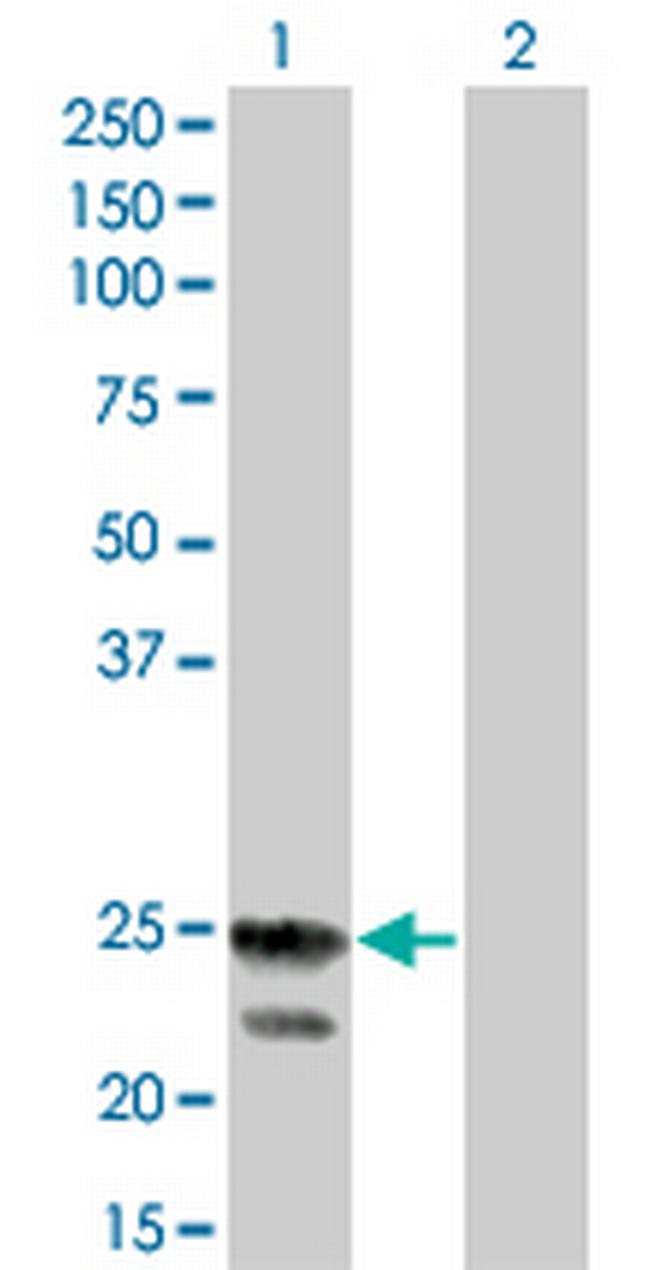
Please note: We are reviewing Western blot images included in the antibody testing data in our catalog, including those provided by third parties. Unless expressly labeled or annotated as “raw-unedited”, Western blot images included in the antibody testing data in our catalog may have been edited, optimized or otherwise adjusted for presentation.

产品信息
H00005999-M01
产品规格
种属反应
Human
宿主/亚型
Mouse
/ IgG2b, kappa
分类
Monoclonal
类型
Antibody
克隆号
2B2
抗原
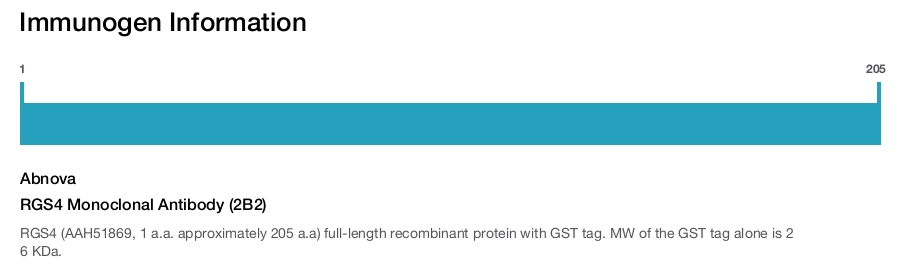
RGS4 (AAH51869, 1 a.a. approximately 205 a.a) full-length recombinant protein with GST tag. MW of the GST tag alone is 26 KDa.
偶联物
Unconjugated
Unconjugated
Unconjugated
形式
Liquid
浓度
1 mg/mL
规格
100 µg
纯化类型
Protein A
保存液
PBS, pH 7.4
内含物
no preservative
保存条件
-20°C, Avoid Freeze/Thaw Cycles
运输条件
Ambient (domestic); Wet ice (international)
产品详细信息
Product may be used with Western Blot (Transfected lysate).
Immunogen sequence: MCKGLAGLPA SCLRSAKDMK HRLGFLLQKS DSCEHNSSHN KKDKVVICQR VSQEEVKKWA ESLENLISHE CGLAAFKAFL KSEYSEENID FWISCEEYKK IKSPSKLSPK AKKIYNEFIS VQATKEVNLD SCTREETSRN MLEPTITCFD EAQKKIFNLM EKDSYRRFLK SRFYLDLVNP SSCGAEKQKG AKSSADCASL VPQCA
靶标信息
Regulator of G protein signaling (RGS) family members are regulatory molecules that act as GTPase activating proteins (GAPs) for G alpha subunits of heterotrimeric G proteins. RGS proteins are able to deactivate G protein subunits of the Gi alpha, Go alpha and Gq alpha subtypes. They drive G proteins into their inactive GDP-bound forms. Regulator of G protein signaling 4 belongs to this family. All RGS proteins share a conserved 120-amino acid sequence termed the RGS domain. Regulator of G protein signaling 4 protein is 37% identical to RGS1 and 97% identical to rat Rgs4. This protein negatively regulate signaling upstream or at the level of the heterotrimeric G protein and is localized in the cytoplasm. Alternatively spliced transcript variants have been found for this gene.
仅用于科研。不用于诊断过程。未经明确授权不得转售。
篇参考文献 (0)
您是否在文献中引用过该产品?请点击下方按钮邮件告知我们。
生物信息学
蛋白别名: alternatively spliced; MGC2124; MGC60244; RP11-430G6.1; schizophrenia disorder 9; unnamed protein product
基因别名: RGP4; SCZD9
UniProt ID: (Human) P49798
Entrez Gene ID: (Human) 5999
response to amphetamine
G-protein coupled receptor signaling pathway
regulation of G-protein coupled receptor protein signaling pathway
positive regulation of heart rate
response to cocaine
response to ethanol
negative regulation of G-protein coupled receptor protein signaling pathway
regulation of calcium ion transport
negative regulation of dopamine receptor signaling pathway
negative regulation of cell growth involved in cardiac muscle cell development
regulation of actin filament organization
negative regulation of glycine import across plasma membrane
regulation of potassium ion transmembrane transport
negative regulation of potassium ion transmembrane transport
dorsal root ganglion development
positive regulation of excitatory postsynaptic potential
Disclaimer

Clicking the images or links will redirect you to a website hosted by BenchSci that provides third-party scientific content. Neither the content nor the BenchSci technology and processes for selection have been evaluated by us; we are providing them as-is and without warranty of any kind, including for use or application of the Thermo Fisher Scientific products presented.

