Search
Invitrogen
RIG-I Polyclonal Antibody
{{$productOrderCtrl.translations['antibody.pdp.commerceCard.promotion.promotions']}}
{{$productOrderCtrl.translations['antibody.pdp.commerceCard.promotion.promocode']}}: {{promo.promoCode}} {{promo.promoTitle}} {{promo.promoDescription}}. {{$productOrderCtrl.translations['antibody.pdp.commerceCard.promotion.learnmore']}}
{{$ctrl.translations['antibody.pdp.skuNotes.additionalInformation']}}:
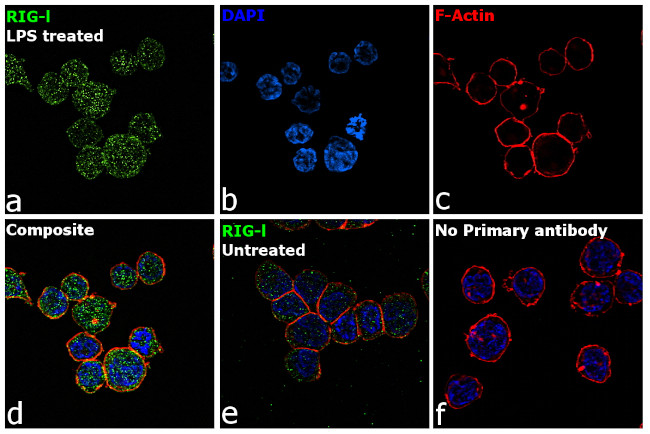
图: 1 / 9
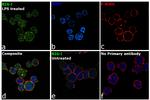
RIG-I Antibody (PA5-23497) in ICC/IF
Immunofluorescence analysis of RIG-I was performed using 70% confluent log phase THP-1 cells and THP-1 cells treated with 1 µg of LPS for 18 hr. The cells were fixed with 4% paraformaldehyde for 10 minutes, permeabilized with 0.1% Triton™ X-100 for 15 minutes, and blocked with 2% BSA for 1 hour at room temperature. The cells were labeled with RIG-I Polyclonal Antibody (Product # PA5-23497) at 5 µg/mL in 0.1% BSA, incubated at 4 degree celsius overnight and then with Goat anti-Rabbit IgG (H+L) Highly Cross-Adsorbed Secondary Antibody, Alex... View More
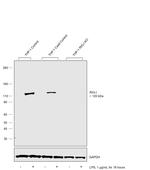
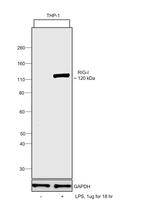
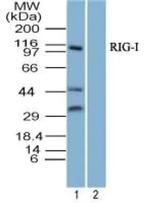

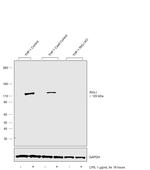
Please note: We are reviewing Western blot images included in the antibody testing data in our catalog, including those provided by third parties. Unless expressly labeled or annotated as “raw-unedited”, Western blot images included in the antibody testing data in our catalog may have been edited, optimized or otherwise adjusted for presentation.


产品信息
PA5-23497
产品规格
种属反应
Human,
Non-human primate
宿主/亚型
Rabbit
/ IgG
分类
Polyclonal
类型
Antibody
抗原
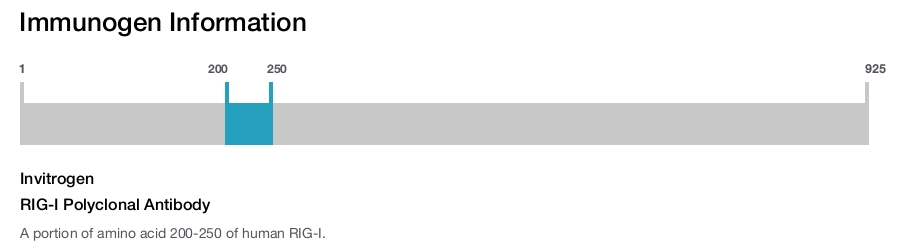
A portion of amino acid 200-250 of human RIG-I.
偶联物
Unconjugated
Unconjugated
Unconjugated
形式
Liquid
浓度
1.0 mg/mL
规格
100 µg
纯化类型
Antigen affinity chromatography
保存液
PBS
内含物
0.02% sodium azide
保存条件
Store at 4°C short term. For long term storage, store at -20°C, avoiding freeze/thaw cycles.
RRID
产品详细信息
The amino acid sequence used as immunogen for the RIG-I antibody is 82% homologous in Rat.
靶标信息
Retinoic acid-inducible gene I, RIG-I is a pattern recognition receptor (PRR) involved in the recognition of viral dsRNA. Along with MDA5, RIG-I detects viral dsRNA and activates the innate immune response. Both MDA5 and RIG-I are RNA helicases and they perform overlapping as well as distinct roles. RIG-I is activated by dsRNAs without a 5'-triphosphate end and short dsRNAs, whereas MDA5 is activated by long dsRNAs. Once activated, both proteins signal through IPS-1 activating transcription factors NF-kappaB and IRF-3 (1) and ultimately activating apoptosis, cytokine signaling, and inflammation. RIG-I is essential for signaling by influenza A, influenza B, human respiratory syncytial virus (3), paromyxoviruses, Japanese encephalitis virus, and West Nile virus. MicroRNA-146a has been implicated in feedback inhibition of RIG-I-dependant antiviral response by negatively regulating RIG-I targets TRAF6, IRAK1, and IRAK2. Recent evidence has implicated RIG-I in the detection of cytosolic DNA through RNA polymerase III activity.
仅用于科研。不用于诊断过程。未经明确授权不得转售。
篇参考文献 (0)
您是否在文献中引用过该产品?请点击下方按钮邮件告知我们。
生物信息学
蛋白别名: ATP-dependent RNA helicase DDX58; DEAD (Asp-Glu-Ala-Asp) box polypeptide 58; DEAD box protein 58; DEAD/H (Asp-Glu-Ala-Asp/His) box polypeptide; DExD/H-box helicase 58; probable ATP-dependent RNA helicase DDX58; retinoic acid-inducible gene 1 protein; retinoic acid-inducible gene I protein; RIG-I; RNA helicase RIG-I; unnamed protein product
基因别名: DDX58; RIG-I; RIG1; RLR-1; SGMRT2
UniProt ID: (Human) O95786
Entrez Gene ID: (Human) 23586
positive regulation of defense response to virus by host
positive regulation of immune system process
positive regulation of myeloid dendritic cell cytokine production
cytoplasmic pattern recognition receptor signaling pathway
detection of virus
response to virus
gene expression
positive regulation of gene expression
regulation of cell migration
positive regulation of granulocyte macrophage colony-stimulating factor production
positive regulation of interferon-alpha production
positive regulation of interferon-beta production
positive regulation of interleukin-6 production
positive regulation of interleukin-8 production
positive regulation of tumor necrosis factor production
regulation of type III interferon production
RIG-I signaling pathway
response to exogenous dsRNA
innate immune response
positive regulation of transcription from RNA polymerase II promoter
defense response to virus
positive regulation of response to cytokine stimulus
cellular response to exogenous dsRNA
antiviral innate immune response
Disclaimer

Clicking the images or links will redirect you to a website hosted by BenchSci that provides third-party scientific content. Neither the content nor the BenchSci technology and processes for selection have been evaluated by us; we are providing them as-is and without warranty of any kind, including for use or application of the Thermo Fisher Scientific products presented.

