Search
Invitrogen
SAA4 Recombinant Rabbit Monoclonal Antibody (014)
{{$productOrderCtrl.translations['antibody.pdp.commerceCard.promotion.promotions']}}
{{$productOrderCtrl.translations['antibody.pdp.commerceCard.promotion.promocode']}}: {{promo.promoCode}} {{promo.promoTitle}} {{promo.promoDescription}}. {{$productOrderCtrl.translations['antibody.pdp.commerceCard.promotion.learnmore']}}
{{$ctrl.translations['antibody.pdp.skuNotes.additionalInformation']}}:
产品信息
MA5-30833
产品规格
种属反应
Human
宿主/亚型
Rabbit
/ IgG
Expression System
HEK293 cells
分类
Recombinant Monoclonal
类型
Antibody
克隆号
014
抗原
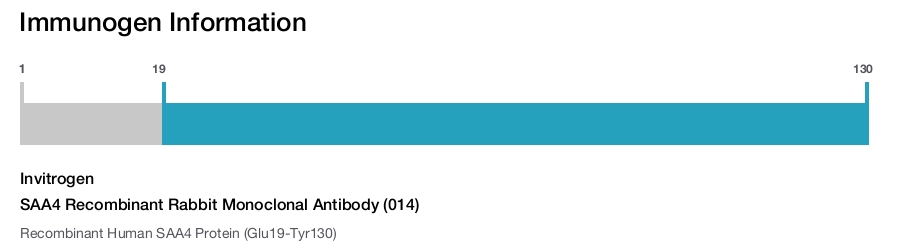
Recombinant Human SAA4 Protein (Glu19-Tyr130)
偶联物
Unconjugated
Unconjugated
Unconjugated
形式
Liquid
浓度
1 mg/mL
规格
100 µg
纯化类型
Protein A
保存液
PBS
内含物
no preservative
保存条件
Store at 4°C short term. For long term storage, store at -20°C, avoiding freeze/thaw cycles.
运输条件
Ambient (domestic); Wet ice (international)
RRID
产品详细信息
This product is preservative free. It is recommended to add sodium azide to avoid contamination (final concentration 0.05%-0.1%).
Recombinant rabbit monoclonal antibodies are produced using in vitro expression systems. The expression systems are developed by cloning in the specific antibody DNA sequences from immunoreactive rabbits. Then, individual clones are screened to select the best candidates for production. The advantages of using recombinant rabbit monoclonal antibodies include: better specificity and sensitivity, lot-to-lot consistency, animal origin-free formulations, and broader immunoreactivity to diverse targets due to larger rabbit immune repertoire.
This antibody has specificity for Human SAA4.
靶标信息
Serum Amyloid A4 (SAA4) is a gene that encodes one of the constitutively expressed serum amyloid proteins. Located on chromosome 11, SAA4 is part of the serum amyloid A (SAA) superfamily, which includes other highly homologous genes like SAA1, SAA2, and SAA3. Unlike its counterparts, SAA4 is not an acute-phase reactant but is persistently expressed across different tissues, including plasma, where it associates with high-density lipoprotein (HDL). SAA4 is involved in lipid metabolism and inflammatory responses, albeit not directly induced by inflammatory stimuli like other SAA proteins. It appears as multiple isoforms, some of which may be glycosylated. Recent studies have shown that SAA4 expression encompasses a broad spectrum of physiological conditions and may serve as a marker in diseases involving chronic inflammation and persistent pathological states such as neovascular age-related macular degeneration. The gene's constitutive expression pattern suggests its fundamental role in maintaining homeostasis rather than responding dynamically to acute inflammatory challenges.
仅用于科研。不用于诊断过程。未经明确授权不得转售。
篇参考文献 (0)
您是否在文献中引用过该产品?请点击下方按钮邮件告知我们。
生物信息学
蛋白别名: constitutively expressed serum amyloid A protein; SAA4; unnamed protein product
基因别名: C-SAA; CSAA
UniProt ID: (Human) P35542
Entrez Gene ID: (Human) 6291
Disclaimer

Clicking the images or links will redirect you to a website hosted by BenchSci that provides third-party scientific content. Neither the content nor the BenchSci technology and processes for selection have been evaluated by us; we are providing them as-is and without warranty of any kind, including for use or application of the Thermo Fisher Scientific products presented.

