Search
Invitrogen
SIAH2 Monoclonal Antibody (24E6H3)
{{$productOrderCtrl.translations['antibody.pdp.commerceCard.promotion.promotions']}}
{{$productOrderCtrl.translations['antibody.pdp.commerceCard.promotion.promocode']}}: {{promo.promoCode}} {{promo.promoTitle}} {{promo.promoDescription}}. {{$productOrderCtrl.translations['antibody.pdp.commerceCard.promotion.learnmore']}}
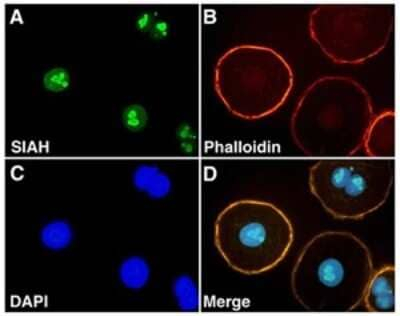
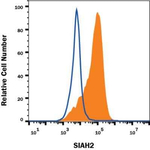
Please note: We are reviewing Western blot images included in the antibody testing data in our catalog, including those provided by third parties. Unless expressly labeled or annotated as “raw-unedited”, Western blot images included in the antibody testing data in our catalog may have been edited, optimized or otherwise adjusted for presentation.


产品信息
MA5-24780
应用
建议稀释比
已发表文章
产品规格
种属反应
Fruit fly,
Human,
Mouse,
Pig
宿主/亚型
Mouse
/ IgG1
分类
Monoclonal
类型
Antibody
克隆号
24E6H3
抗原
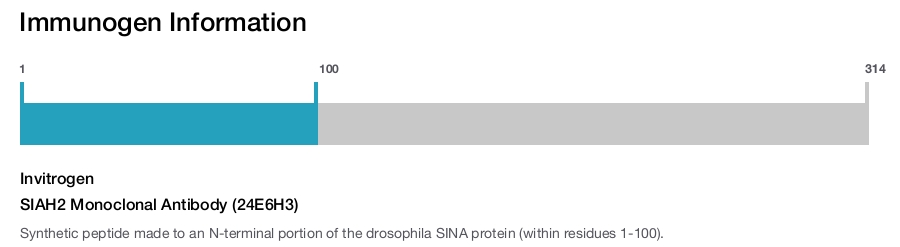
Synthetic peptide made to an N-terminal portion of the drosophila SINA protein (within residues 1-100).
偶联物
Unconjugated
Unconjugated
Unconjugated
形式
Liquid
浓度
Conc. Not Determined
保存液
tissue culture supernatant
内含物
0.1% sodium azide
保存条件
4°C, do not freeze
运输条件
Ambient (domestic); Wet ice (international)
RRID
产品详细信息
This is specific for human SIAH2 and Drosophila SINA in proliferating cells and stem cells. This does not detect Drosophila SINAH or normal, nondividing cells.
靶标信息
SIAH-2 (seven in absentia homolog 2) is an E3 ligase that catalyzes ubiquitination and proteasome-mediated degradation of protein substrates. SIAH-2 encodes a 324 amino acid protein that shares 77% identity with human SIAH-1 and 68% identity with the Drosophila sina (seven in absentia) gene, on which development of the Drosophila R7 photoreceptor is dependent. SIAH-2 targets TRAF2 (which regulates cell responses to stress and cytokines through the regulation of key stress-signaling cascades) for degradation under stress conditions such as hypoxia. It targets HIF-1 alpha prolyl hydroxylase 3 (PHD3) for degradation upon exposure to hypoxic conditions, which coincides with an increase in SIAH-2 transcription. SIAH-2 can decrease TNF-alpha-dependent induction of JNK activity and transcriptional activation of NFkB. SIAH-2 null mice subjected to hypoxia display an impaired respiratory response and reduced levels of hemoglobin.
仅用于科研。不用于诊断过程。未经明确授权不得转售。
篇参考文献 (0)
您是否在文献中引用过该产品?请点击下方按钮邮件告知我们。
生物信息学
蛋白别名: anon-fast-evolving-2H7; CG9949-PA; CG9949-PB; CG9949-PC; EC 6.3.2; HL08111p; mSiah2; RING-type E3 ubiquitin transferase SIAH2; seven in absenti; seven in absentia 2; seven in absentia homolog 2; seven-in-absentia; siah-2; sina-PA; sina-PB; sina-PC; unnamed protein product
基因别名: anon-EST:fe2H7; CG9949; Dmel\CG9949; Dmel_CG9949; hSiah2; sia; SINA; Sinh2
UniProt ID: (Human) O43255, (Mouse) Q06986, (Fruit fly) P21461
Entrez Gene ID: (Human) 6478, (Pig) 100622531, (Mouse) 20439, (Fruit fly) 39884
ubiquitin-dependent protein catabolic process
small GTPase mediated signal transduction
protein ubiquitination
regulation of protein ubiquitination
regulation of circadian rhythm
negative regulation of apoptotic process
proteasome-mediated ubiquitin-dependent protein catabolic process
negative regulation of transcription, DNA-templated
canonical Wnt signaling pathway
negative regulation of canonical Wnt signaling pathway
amyloid fibril formation
regulation of apoptotic signaling pathway
negative regulation of extrinsic apoptotic signaling pathway
protein catabolic process
sensory organ development
R7 cell fate commitment
proteasomal protein catabolic process
positive regulation of proteasomal ubiquitin-dependent protein catabolic process
enteroendocrine cell differentiation
sevenless signaling pathway
regulation of R7 cell differentiation
Disclaimer

Clicking the images or links will redirect you to a website hosted by BenchSci that provides third-party scientific content. Neither the content nor the BenchSci technology and processes for selection have been evaluated by us; we are providing them as-is and without warranty of any kind, including for use or application of the Thermo Fisher Scientific products presented.

