Search
GenScript
TAP-tag Polyclonal Antibody, HRP
{{$productOrderCtrl.translations['antibody.pdp.commerceCard.promotion.promotions']}}
{{$productOrderCtrl.translations['antibody.pdp.commerceCard.promotion.viewpromo']}}
{{$productOrderCtrl.translations['antibody.pdp.commerceCard.promotion.promocode']}}: {{promo.promoCode}} {{promo.promoTitle}} {{promo.promoDescription}}. {{$productOrderCtrl.translations['antibody.pdp.commerceCard.promotion.learnmore']}}
Additional Information:
{{banner.description}}

产品信息
A01435-40
应用
建议稀释比
已发表文章
产品规格
宿主/亚型
Rabbit
/ IgG
分类
Polyclonal
类型
Antibody
抗原
Synthetic peptide CSSGALDYDIPTTASENLYFQ conjugated to KLH.
偶联物
形式
Lyophilized
规格
40 µg
保存条件
-20°C or -80°C if preferred
运输条件
Wet ice
产品详细信息
Reconstitute the lyophilized powder with deionized water (or equivalent) to an antibody concentration of 0.5 mg/ml.
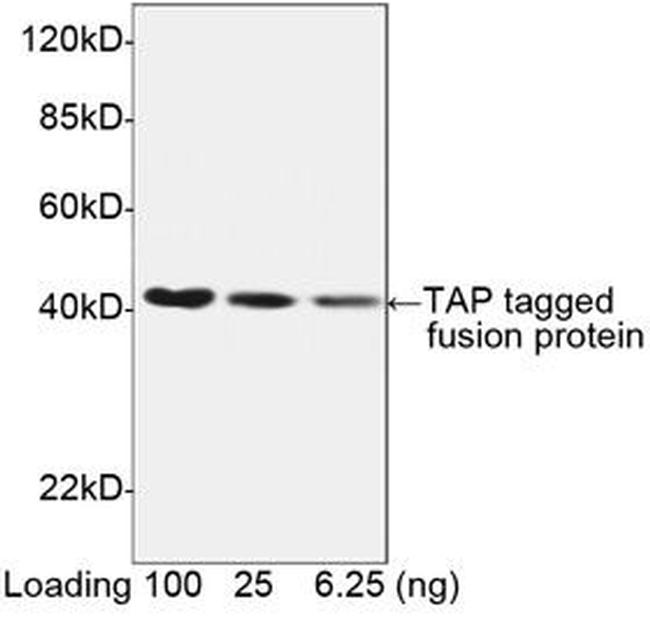
Well-characterized antibodies for epitope tags consisting of short sequences have been widely used in the study of protein expression in various systems.The TAP (tandem affinity purification) tag allows rapid purification of complexes from a relatively small number of cells without prior knowledge about the composition, activity, or function of the complex. Combined with mass spectrometry, the TAP strategy allows for the identification of proteins interacting with a given target protein. The Rabbit anti-TAP tag consists a 21 residue peptide, CSSGALDYDIPTTASENLYFQ, derived from c-terminal of the TAP construct after TEV cleavage.GenScript Rabbit Anti-TAP-tag [HRP] Polyclonal Antibody is highly purified from rabbit antiserum by immunoaffinity chromatography and then conjugated to horseradish peroxidase. The antibody is suitable for detecting fusion proteins that contain TAP tag.
靶标信息
Epitope tags provide a method to localize gene products in a variety of cell types, study the topology of proteins and protein complexes, identify associated proteins, and characterize newly identified, low abundance or poorly immunogenic proteins when protein specific antibodies are not available. Tandem affinity purification (TAP) is an affinity purification method for isolation of TAP-tagged proteins together with associated proteins. The protocol involves the fusion of the "TAP tag" (typically a calmodulin binding peptide (CBP), a tobacco etch virus protease (TEV protease) cleavage site and Protein A) to the protein of interest. The TAP technique is useful in analyzing in vivo interactions.
⚠WARNING: This product can expose you to chemicals including mercury, which is known to the State of California to cause birth defects or other reproductive harm. For more information go to www.P65Warnings.ca.gov.
仅用于科研。不用于诊断过程。未经明确授权不得转售。
Disclaimer

Clicking the images or links will redirect you to a website hosted by BenchSci that provides third-party scientific content. Neither the content nor the BenchSci technology and processes for selection have been evaluated by us; we are providing them as-is and without warranty of any kind, including for use or application of the Thermo Fisher Scientific products presented.

