Search
Invitrogen
TAS2R38 Polyclonal Antibody
{{$productOrderCtrl.translations['antibody.pdp.commerceCard.promotion.promotions']}}
{{$productOrderCtrl.translations['antibody.pdp.commerceCard.promotion.promocode']}}: {{promo.promoCode}} {{promo.promoTitle}} {{promo.promoDescription}}. {{$productOrderCtrl.translations['antibody.pdp.commerceCard.promotion.learnmore']}}
{{$ctrl.translations['antibody.pdp.skuNotes.additionalInformation']}}:
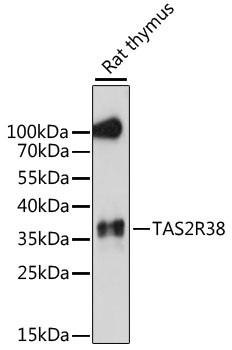
图: 1 / 1
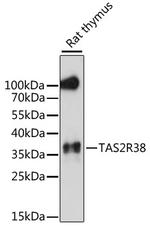
TAS2R38 Antibody (PA5-90212) in WB
Western blot analysis of TAS2R38 in extracts of Rat thymus. Samples were incubated with TAS2R38 Polyclonal antibody (Product # PA5-90212) using a dilution of 1:1,000, followed by HRP Goat Anti-Rabbit IgG (H+L) at a dilution of 1:10,000. Lysates/proteins: 25 µg per lane. Blocking buffer: 3% nonfat dry milk in TBST. Detection: ECL Enhanced Kit. Exposure time: 90s.
Please note: We are reviewing Western blot images included in the antibody testing data in our catalog, including those provided by third parties. Unless expressly labeled or annotated as “raw-unedited”, Western blot images included in the antibody testing data in our catalog may have been edited, optimized or otherwise adjusted for presentation.

产品信息
PA5-90212
产品规格
种属反应
Rat
宿主/亚型
Rabbit
/ IgG
分类
Polyclonal
类型
Antibody
抗原
Synthetic Peptide
偶联物
Unconjugated
Unconjugated
Unconjugated
形式
Liquid
浓度
0.87 mg/mL
规格
87 µg
纯化类型
Affinity Chromatography
保存液
PBS, pH 7.3, with 50% glycerol
内含物
0.01% thimerosal
保存条件
-20°C, Avoid Freeze/Thaw Cycles
运输条件
Ambient (domestic); Wet ice (international)
RRID
产品详细信息
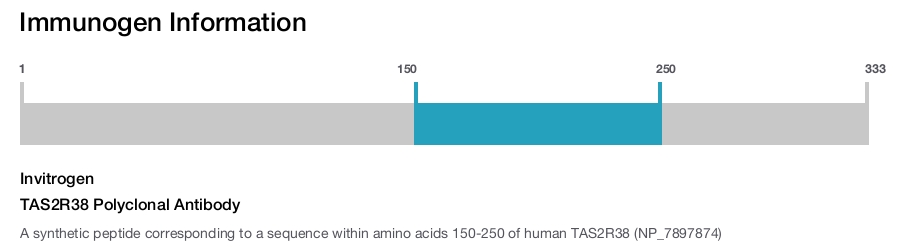
Immunogen sequence: CSCICTVLCV WCFFSRPHFT VTTVLFMNNN TRLNWQIKDL NLFYSFLFCY LWSVPPFLLF LVSSGMLTVS LGRHMRTMKV YTRNSRDPSL EAHIKALKSL V; Positive Samples: rat thymus; Cellular Location: Membrane, Multi-pass membrane protein
靶标信息
Receptor that may play a role in the perception of bitterness and is gustducin-linked. May play a role in sensing the chemical composition of the gastrointestinal content. The activity of this receptor may stimulate alpha gustducin, mediate PLC-beta-2 activation and lead to the gating of TRPM5. Expressed in subsets of taste receptor cells of the tongue and exclusively in gustducin-positive cells. Variations in TAS2R38 are associated with the ability to taste phenylthiocarbamide (PTC tasting); also called thiourea tasting. The ability to taste the substance PTC and a number of related substances is genetically controlled. Genetic studies have demonstrated complex inheritance for this trait. For some people (and some chimpanzees also), the chemical PTC tastes very bitter. For others, it is tasteless. Actually, substantial variation in taste sensitivity exists in human. Five haplotypes arising from three coding SNPs in the TAS2R38 gene are associated with distinct phenotypes of PTC taste sensitivity.
⚠WARNING: This product can expose you to chemicals including mercury, which is known to the State of California to cause birth defects or other reproductive harm. For more information go to www.P65Warnings.ca.gov.
仅用于科研。不用于诊断过程。未经明确授权不得转售。
篇参考文献 (0)
您是否在文献中引用过该产品?请点击下方按钮邮件告知我们。
生物信息学
蛋白别名: T2R26; taste receptor type 2 member 26; taste receptor, type 2, member 38
基因别名: T2R38; Tas2r38
UniProt ID: (Rat) Q4VHE7
Entrez Gene ID: (Rat) 500091
Disclaimer

Clicking the images or links will redirect you to a website hosted by BenchSci that provides third-party scientific content. Neither the content nor the BenchSci technology and processes for selection have been evaluated by us; we are providing them as-is and without warranty of any kind, including for use or application of the Thermo Fisher Scientific products presented.

