Search
Abnova
TBX21 Polyclonal Antibody, MaxPab™
{{$productOrderCtrl.translations['antibody.pdp.commerceCard.promotion.promotions']}}
{{$productOrderCtrl.translations['antibody.pdp.commerceCard.promotion.promocode']}}: {{promo.promoCode}} {{promo.promoTitle}} {{promo.promoDescription}}. {{$productOrderCtrl.translations['antibody.pdp.commerceCard.promotion.learnmore']}}
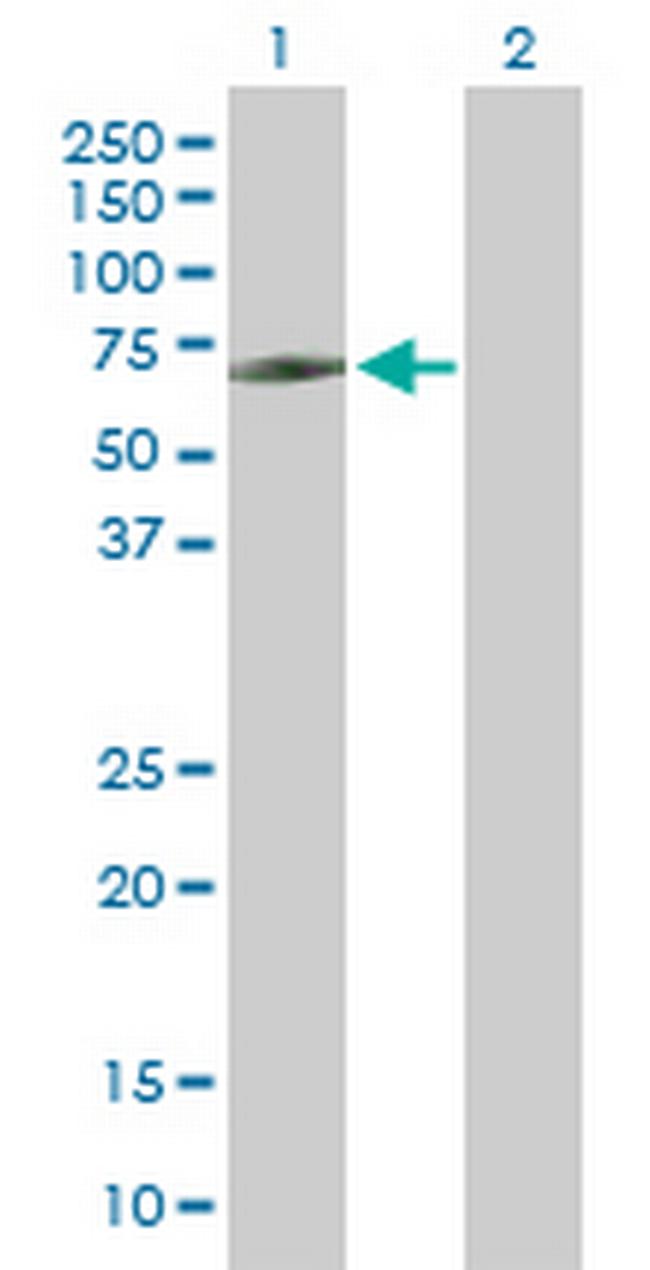
Please note: We are reviewing Western blot images included in the antibody testing data in our catalog, including those provided by third parties. Unless expressly labeled or annotated as “raw-unedited”, Western blot images included in the antibody testing data in our catalog may have been edited, optimized or otherwise adjusted for presentation.

产品信息
H00030009-B01P
产品规格
种属反应
Human
宿主/亚型
Mouse
/ IgG
分类
Polyclonal
类型
Antibody
抗原
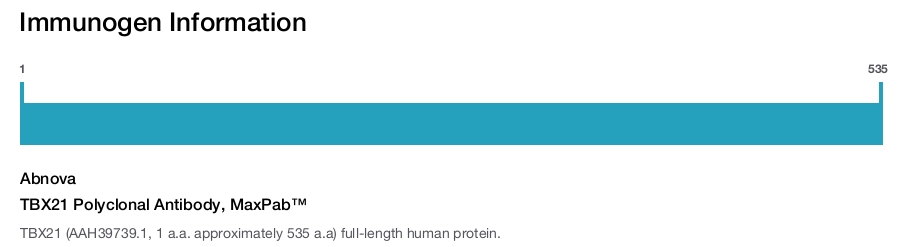
TBX21 (AAH39739.1, 1 a.a. approximately 535 a.a) full-length human protein.
偶联物
Unconjugated
Unconjugated
Unconjugated
形式
Liquid
浓度
0.5-1 mg/mL
规格
50 µg
纯化类型
Protein A
保存液
PBS, pH 7.4
内含物
no preservative
保存条件
-20°C, Avoid Freeze/Thaw Cycles
运输条件
Ambient (domestic); Wet ice (international)
产品详细信息
Product may be used with Western Blot (Transfected lysate).
The Isotype of this product is composed of an IgG Mixture.
Immunogen sequence: MGIVEPGCGD MLTGTEPMPG SDEGRAPGAD PQHRYFYPEP GAQDADERRG GGSLGSPYPG GALVPAPPSR FLGAYAYPPR PQAAGFPGAG ESFPPPADAE GYQPGEGYAA PDPRAGLYPG PREDYALPAG LEVSGKLRVA LNNHLLWSKF NQHQTEMIIT KQGRRMFPFL SFTVAGLEPT SHYRMFVDVV LVDQHHWRYQ SGKWVQCGKA EGSMPGNRLY VHPDSPNTGA HWMRQEVSFG KLKLTNNKGA SNNVTQMIVL QSLHKYQPRL HIVEVNDGEP EAACNASNTH IFTFQETQFI AVTAYQNAEI TQLKIDNNPF AKGFRENFES MYTSVDTSIP SPPGPNCQFL GGDHYSPLLP NQYPVPSRFY PDLPGQAKDV VPQAYWLGAP RDHSYEAEFR AVSMKPAFLP SAPGPTMSYY RGQEVLAPGA GWPVAPQYPP KMGPASWFRP MRTLPMEPGP GGSEGRGPED QGPPLVWTEI APIRPESSDS GLGEGDSKRR RVSPYPSSGD SSSPAGAPSP FDKEAEGQFY NYFPN
靶标信息
T-bet, also known as TBX21, is a T-cell specific transcription factor containing a single T-box DNA-binding domain. It controls the expression of the TH1 cytokine, interferon-gamma. Both Th1 and Th17 cells are crucial in immune regulation and autoimmune disease development. T-bet initiates Th1 lineage development from naive Th precursor cells and directs T cell differentiation to Th1 versus Th17. T-bet is cooperating with Stat4 (signal tranducer and activator of transcription 4) in programming chromatin architecture for Th1 gene expression. Genetic variations in T-bet are associated with susceptibility to aspirin-induced asthma and nasal polyps.
仅用于科研。不用于诊断过程。未经明确授权不得转售。
篇参考文献 (0)
您是否在文献中引用过该产品?请点击下方按钮邮件告知我们。
生物信息学
蛋白别名: HGNC:11599; T-box 21; T-box expressed in T cells; T-box protein 21; T-box transcription factor expressed in T cells; T-cell-specific T-box transcription factor T-bet; transcription factor TBLYM
基因别名: IMD88; T-bet; T-PET; TBET; TBLYM
UniProt ID: (Human) Q9UL17
Entrez Gene ID: (Human) 30009
transcription regulatory region sequence-specific DNA binding
RNA polymerase II core promoter proximal region sequence-specific DNA binding
RNA polymerase II transcription factor activity, sequence-specific DNA binding
transcriptional repressor activity, RNA polymerase II transcription regulatory region sequence-specific binding
transcriptional activator activity, RNA polymerase II transcription regulatory region sequence-specific binding
DNA binding
transcription factor activity, sequence-specific DNA binding
protein binding
sequence-specific DNA binding
sequence-specific double-stranded DNA binding
negative regulation of transcription from RNA polymerase II promoter
cell fate specification
T-helper 1 cell lineage commitment
leukocyte migration involved in inflammatory response
regulation of transcription, DNA-templated
regulation of transcription from RNA polymerase II promoter
response to virus
negative regulation of interleukin-2 production
proteasome-mediated ubiquitin-dependent protein catabolic process
regulation of T cell differentiation
negative regulation of transcription, DNA-templated
positive regulation of transcription, DNA-templated
positive regulation of transcription from RNA polymerase II promoter
response to dexamethasone
lymphocyte migration
negative regulation of T-helper 17 cell differentiation
negative regulation of T-helper 17 cell lineage commitment
negative regulation of T-helper 2 cell cytokine production
positive regulation of T-helper 1 cell cytokine production
Disclaimer

Clicking the images or links will redirect you to a website hosted by BenchSci that provides third-party scientific content. Neither the content nor the BenchSci technology and processes for selection have been evaluated by us; we are providing them as-is and without warranty of any kind, including for use or application of the Thermo Fisher Scientific products presented.

