Search
Proteintech
TFAP2B Polyclonal Antibody
{{$productOrderCtrl.translations['antibody.pdp.commerceCard.promotion.promotions']}}
{{$productOrderCtrl.translations['antibody.pdp.commerceCard.promotion.promocode']}}: {{promo.promoCode}} {{promo.promoTitle}} {{promo.promoDescription}}. {{$productOrderCtrl.translations['antibody.pdp.commerceCard.promotion.learnmore']}}
{{$ctrl.translations['antibody.pdp.skuNotes.additionalInformation']}}:
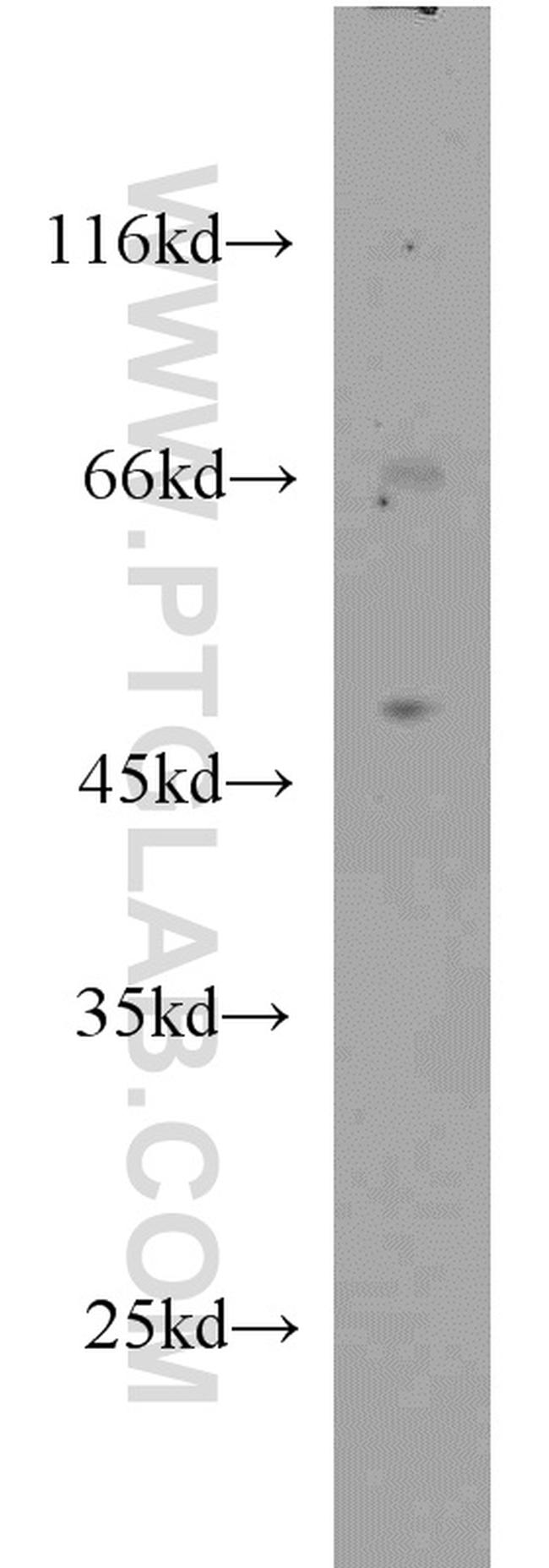
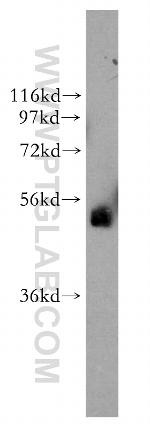
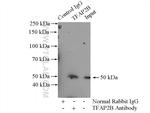
Please note: We are reviewing Western blot images included in the antibody testing data in our catalog, including those provided by third parties. Unless expressly labeled or annotated as “raw-unedited”, Western blot images included in the antibody testing data in our catalog may have been edited, optimized or otherwise adjusted for presentation.


产品信息
13183-1-AP
产品规格
种属反应
Human,
Mouse,
Rat
宿主/亚型
Rabbit
/ IgG
分类
Polyclonal
类型
Antibody
抗原
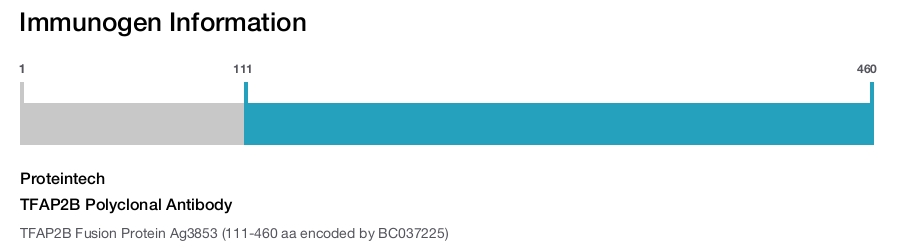
TFAP2B Fusion Protein Ag3853 (111-460 aa encoded by BC037225)
偶联物
Unconjugated
Unconjugated
Unconjugated
形式
Liquid
浓度
0.18 mg/mL
规格
27 µg
纯化类型
Antigen affinity chromatography
保存液
PBS, pH 7.3, with 50% glycerol
内含物
0.02% sodium azide
保存条件
-20°C
运输条件
Wet ice (domestic); Dry ice (international)
产品详细信息
Immunogen sequence: RQEVGSEAG SLLPQPRAAL PQLSGLDPRR DYHSVRRPDV LLHSAHHGLD AGMGDSLSLH GLGHPGMEDV QSVEDANNSG MNLLDQSVIK KVPVPPKSVT SLMMNKDGFL GGMSVNTGEV FCSVPGRLSL LSSTSKYKVT VGEVQRRLSP PECLNASLLG GVLRRAKSKN GGRSLRERLE KIGLNLPAGR RKAANVTLLT SLVEGEAVHL ARDFGYICET EFPAKAVSEY LNRQHTDPSD LHSRKNMLLA TKQLCKEFTD LLAQDRTPIG NSRPSPILEP GIQSCLTHFS LITHGFGAPA ICAALTALQN YLTEALKGMD KMFLNNTTTN RHTSGEGPGS KTGDKEEKHR K (111-460 aa encoded by BC037225)
靶标信息
This gene encodes a member of the AP-2 family of transcription factors. AP-2 proteins form homo- or hetero-dimers with other AP-2 family members and bind specific DNA sequences. They are thought to stimulate cell proliferation and suppress terminal differentiation of specific cell types during embryonic development. Specific AP-2 family members differ in their expression patterns and binding affinity for different promoters. This protein functions as both a transcriptional activator and repressor. Mutations in this gene result in autosomal dominant Char syndrome, suggesting that this gene functions in the differentiation of neural crest cell derivatives.
仅用于科研。不用于诊断过程。未经明确授权不得转售。
生物信息学
蛋白别名: activating enhancer binding protein 2 beta; activating enhancer-binding protein 2 beta; AP-2 beta; AP2-beta; unnamed protein product
基因别名: AP-2(beta); AP-2B; AP-2beta; AP2-B; AP2-beta; E130018K07Rik; PDA2; Tcfap2b
UniProt ID: (Human) Q92481, (Mouse) Q61313
Entrez Gene ID: (Human) 7021, (Rat) 301285, (Mouse) 21419
RNA polymerase II regulatory region sequence-specific DNA binding
RNA polymerase II core promoter proximal region sequence-specific DNA binding
RNA polymerase II transcription factor activity, sequence-specific DNA binding
core promoter proximal region sequence-specific DNA binding
transcriptional activator activity, RNA polymerase II transcription regulatory region sequence-specific binding
DNA binding
transcription factor activity, sequence-specific DNA binding
protein binding
protein homodimerization activity
sequence-specific DNA binding
protein heterodimerization activity
sequence-specific double-stranded DNA binding
chromatin binding
negative regulation of transcription from RNA polymerase II promoter
kidney development
glucose metabolic process
regulation of transcription, DNA-templated
regulation of transcription from RNA polymerase II promoter
nervous system development
sensory organ development
positive regulation of cell proliferation
negative regulation of cell proliferation
gene expression
retina layer formation
regulation of BMP signaling pathway
forelimb morphogenesis
hindlimb morphogenesis
aorta morphogenesis
regulation of cell proliferation
negative regulation of apoptotic process
positive regulation of neuron apoptotic process
skin development
fat cell differentiation
regulation of cell differentiation
negative regulation of transcription, DNA-templated
positive regulation of transcription, DNA-templated
positive regulation of transcription from RNA polymerase II promoter
sympathetic nervous system development
smooth muscle tissue development
regulation of insulin secretion
distal tubule development
collecting duct development
metanephric nephron development
ductus arteriosus closure
response to xenobiotic stimulus
negative regulation of neuron apoptotic process
Disclaimer

Clicking the images or links will redirect you to a website hosted by BenchSci that provides third-party scientific content. Neither the content nor the BenchSci technology and processes for selection have been evaluated by us; we are providing them as-is and without warranty of any kind, including for use or application of the Thermo Fisher Scientific products presented.

