Search
Invitrogen
THRB Polyclonal Antibody
{{$productOrderCtrl.translations['antibody.pdp.commerceCard.promotion.promotions']}}
{{$productOrderCtrl.translations['antibody.pdp.commerceCard.promotion.viewpromo']}}
{{$productOrderCtrl.translations['antibody.pdp.commerceCard.promotion.promocode']}}: {{promo.promoCode}} {{promo.promoTitle}} {{promo.promoDescription}}. {{$productOrderCtrl.translations['antibody.pdp.commerceCard.promotion.learnmore']}}
Additional Information:
{{banner.description}}
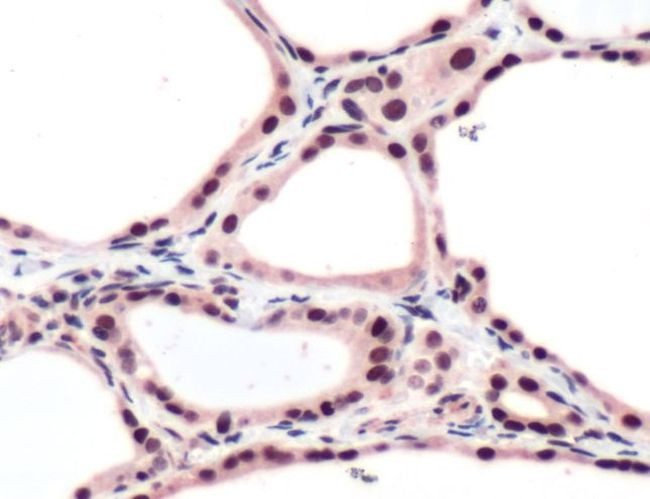
图: 1 / 2
THRB Antibody (PA1-38763) in IHC
Immunohistochemical analysis of Thyroid Hormone Receptor beta using anti-Thyroid Hormone Receptor beta Polyclonal Antibody (Product # PA5-32616) in Thyroid Cancer Tissue. The recommened dilution for this antibody in immunohistochemistry applications is 1:100.


产品信息
PA1-38763
产品规格
已发表种属
Human
宿主/亚型
Rabbit
/ IgG
分类
Polyclonal
类型
Antibody
抗原
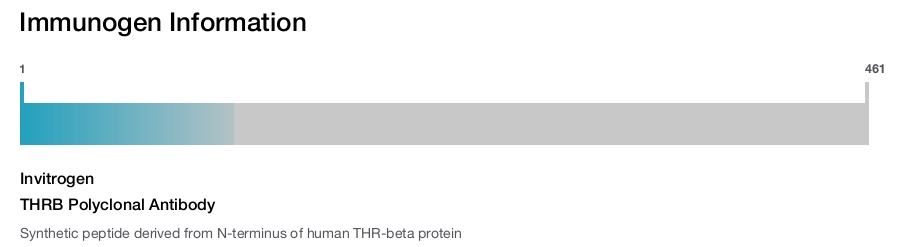
Synthetic peptide derived from N-terminus of human THR-beta protein
偶联物
Unconjugated
Unconjugated
Unconjugated
形式
Liquid
保存条件
Store at 4°C short term. For long term storage, store at -20°C, avoiding freeze/thaw cycles.
运输条件
Wet ice
RRID
产品详细信息
This antibody is predicted to react with canine, mouse, porcine and rabbit based on sequence homology.
Heat-mediated antigen retrieval is recommended prior to staining, using a 10mM citrate buffer, pH 6.0, for 10 minutes followed by cooling at room temperature for 20 min. Following antigen retrieval, incubate samples with primary antibody for 10 min at room temperature. A suggested positive control is thyroid tissue.
靶标信息
Thyroid hormone receptors (TR), also known as c-erbA-2, are ligand-dependent, intracellular proteins that stimulate transcription of specific genes by binding to specific DNA sequences called hormone response elements following activation by the appropriate hormone. Thyroid hormones, through their interaction with TR, effect metabolic processes, growth and development in many tissues by regulating the expression of genes for growth hormone, malic enzyme and several hepatic proteins. There are two forms of TR; TR alpha (on chromosome 17) and TR beta (on chromosome 3). Each of these isoforms also has two isoforms; TR alpha-1 and TRv alpha-2, and TR beta-1 and TR beta-2 respectively. TR alpha-1 and 2 are identical through amino acid 370 where their sequences diverge. TRv alpha-2, which does not bind T3 and is a strong negative regulator of the functional TR, is 80 amino acids longer than TR alpha-1. The corresponding gene for the thyroid hormone receptor beta-1 is NR1A2.
仅用于科研。不用于诊断过程。未经明确授权不得转售。
Disclaimer

Clicking the images or links will redirect you to a website hosted by BenchSci that provides third-party scientific content. Neither the content nor the BenchSci technology and processes for selection have been evaluated by us; we are providing them as-is and without warranty of any kind, including for use or application of the Thermo Fisher Scientific products presented.

