Search
Proteintech
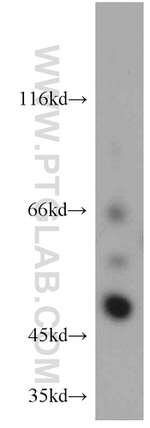
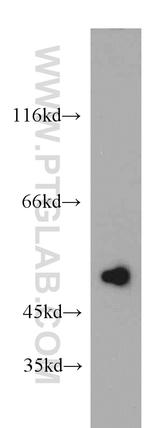
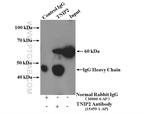
TNIP2 Polyclonal Antibody
{{$productOrderCtrl.translations['antibody.pdp.commerceCard.promotion.promotions']}}
{{$productOrderCtrl.translations['antibody.pdp.commerceCard.promotion.viewpromo']}}
{{$productOrderCtrl.translations['antibody.pdp.commerceCard.promotion.promocode']}}: {{promo.promoCode}} {{promo.promoTitle}} {{promo.promoDescription}}. {{$productOrderCtrl.translations['antibody.pdp.commerceCard.promotion.learnmore']}}
Additional Information:
{{banner.description}}
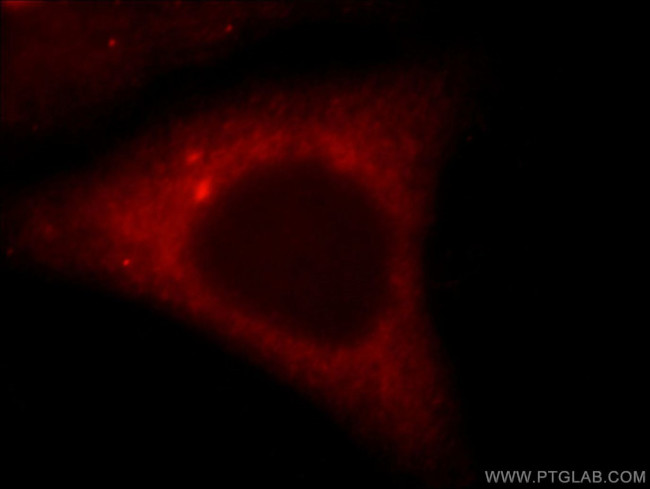


产品信息
15459-1-AP
应用
建议稀释比
已发表文章
产品规格
种属反应
Human,
Mouse,
Rat
已发表种属
Human,
Mouse
宿主/亚型
Rabbit
/ IgG
分类
Polyclonal
类型
Antibody
抗原
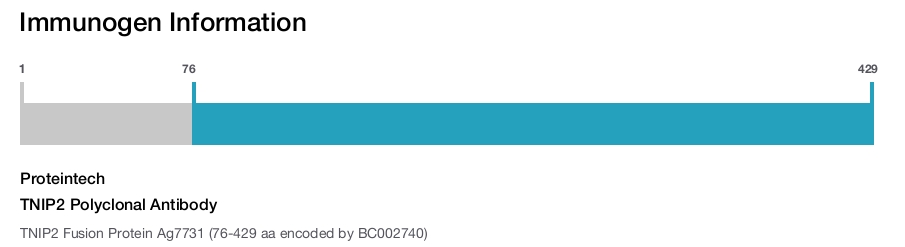
TNIP2 Fusion Protein Ag7731 (76-429 aa encoded by BC002740)
偶联物
形式
Liquid
浓度
0.2 mg/mL
规格
30 µg
纯化类型
Antigen affinity chromatography
保存液
PBS, pH 7.3, with 50% glycerol
内含物
0.02% sodium azide
保存条件
-20°C
运输条件
Wet ice (domestic); Dry ice (international)
产品详细信息
Immunogen sequence: EQLRRQEGG AAEAQMRQEI ERLTERLEEK EREMQQLLSQ PQHEREKEVV LLRRSMAEGE RARAASDVLC RSLANETHQL RRTLTATAHM CQHLAKCLDE RQHAQRNVGE RSPDQSEHTD GHTSVQSVIE KLQEENRLLK QKVTHVEDLN AKWQRYNASR DEYVRGLHAQ LRGLQIPHEP ELMRKEISRL NRQLEEKIND CAEVKQELAA SRTARDAALE RVQMLEQQIL AYKDDFMSER ADRERAQSRI QELEEKVASL LHQVSWRQDS REPDAGRIHA GSKTAKYLAA DALELMVPGG WRPGTGSQQP EPPAEGGHPG AVQRGQGDLQ CPHCLQCFSD EQGEELLRHV AECCQ (76-429 aa encoded by B C002740)
靶标信息
TNFAIP3, also known as A20, is located in chromosome band 6q23, a region that is often deleted in B cell lymphomas. Recently, it was identified as a tumor suppressor gene in Hodgkin lymphoma and several subtypes of non-Hodgkin lymphomas. TNFAIP3 was initially identified as a zinc-finger protein that is rapidly and transiently induced by TNF-a, inhibiting NF-kappa-B-dependent gene expression, and protecting cells from TNF-a-cytotoxicity. Overexpression of TNFAIP3 also inhibits the TLR2- and TLR4-mediated interleukin-8 synthesis in airway epithelial cells, suggesting that TNFAIP3 also acts as a negative regulator of TLR-mediated inflammatory responses, thereby protecting the host against harmful over-responses to pathogens. At least two isoforms of TNFAIP3 are known to exist.
仅用于科研。不用于诊断过程。未经明确授权不得转售。
生物信息学
蛋白别名: A20 binding inhibitor of NF-kappaB activation-2; A20-binding inhibitor of NF-kappa-B activation 2; A20-binding inhibitor of NF-kappaB activation-2; ABIN-2; Fetal liver LKB1-interacting protein; KLIP; TNFAIP3-interacting protein 2; tnip2; unnamed protein product
基因别名: 1810020H16Rik; ABIN-2; ABIN2; AI428870; FLIP1; KLIP; TNIP2
UniProt ID: (Human) Q8NFZ5, (Mouse) Q99JG7
Entrez Gene ID: (Human) 79155, (Mouse) 231130, (Rat) 305451
transcription, DNA-templated
regulation of transcription, DNA-templated
apoptotic process
inflammatory response
I-kappaB kinase/NF-kappaB signaling
CD40 signaling pathway
toll-like receptor 2 signaling pathway
toll-like receptor 3 signaling pathway
toll-like receptor 9 signaling pathway
positive regulation of macrophage activation
positive regulation of I-kappaB kinase/NF-kappaB signaling
positive regulation of transcription from RNA polymerase II promoter
protein stabilization
positive regulation of B cell activation
interleukin-1-mediated signaling pathway
cellular response to lipopolysaccharide
negative regulation of endothelial cell apoptotic process
regulation of transcription from RNA polymerase II promoter
regulation of I-kappaB kinase/NF-kappaB signaling
negative regulation of I-kappaB kinase/NF-kappaB signaling
Disclaimer

Clicking the images or links will redirect you to a website hosted by BenchSci that provides third-party scientific content. Neither the content nor the BenchSci technology and processes for selection have been evaluated by us; we are providing them as-is and without warranty of any kind, including for use or application of the Thermo Fisher Scientific products presented.

