Search
Invitrogen
TSLP Monoclonal Antibody (eBio28F12 (28F12)), Functional Grade, eBioscience™
{{$productOrderCtrl.translations['antibody.pdp.commerceCard.promotion.promotions']}}
{{$productOrderCtrl.translations['antibody.pdp.commerceCard.promotion.viewpromo']}}
{{$productOrderCtrl.translations['antibody.pdp.commerceCard.promotion.promocode']}}: {{promo.promoCode}} {{promo.promoTitle}} {{promo.promoDescription}}. {{$productOrderCtrl.translations['antibody.pdp.commerceCard.promotion.learnmore']}}
Additional Information:
{{banner.description}}


产品信息
16-5491-025
应用
建议稀释比
已发表文章
产品规格
已发表种属
Mouse
宿主/亚型
Rat
/ IgG2a, kappa
分类
Monoclonal
类型
Antibody
克隆号
eBio28F12 (28F12)
偶联物
Functional Grade
Functional Grade
Functional Grade
形式
Liquid
浓度
1 mg/mL
规格
25 mg
保存条件
4°C
运输条件
Wet ice
RRID
产品详细信息
Description: The monoclonal antibody eBio28F12 reacts with and inhibits the bioactivity of mouse TSLP. Thymic Stromal-Derived Lymphopoetin (TSLP) was first identified in the tissue culture supernatant of a thymic stromal cell line as a growth factor capable of inducing proliferation and differentiation of pre-B cells. It was later found to be closely related to another stromal cytokine, IL-7, with which it shares overlapping functions. Along with its proliferative effects on B cells, TSLP induces dendritic cells to support the differentiation of naive T cells towards the Th2 lineage and may also be involved in the development of CD4^+CD25^+ regulatory T cells. The receptor for TSLP is heterodimeric and shares one subunit, IL-7Ralpha, with IL-7 and other members of the family, while the TSLPR subunit is unique to TSLP.
TSLP expression can be induced by a variety of inflammatory cytokines and TLR ligands. Expression is regulated by NF-kappaB and has been detected in epithelial cells, stromal cells, and basophils. Elevated levels of TSLP are associated with asthma and atopic dermatitis, which are both Th2-mediated inflammatory conditions. It is believed that chronic overexpression of TSLP may result in increased sensitivity to allergens, resulting in susceptibility to these conditions.
Applications Reported: The monoclonal antibody eBio28F12 reacts with and inhibits the bioactivity of mouse TSLP.
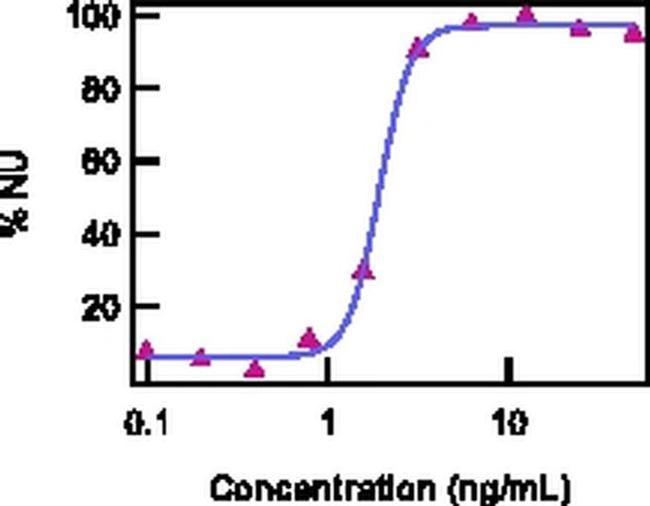
Applications Tested: The ND50 of eBio28F12, as determined by the neutralization of recombinant mouse TSLP-induced proliferation of the Nag8/7 cell line, is 1-3 ng/mL in the presence of 0.5 ng/mL mTSLP. The neutralization dose of this antibody will vary depending on cell type, assay method, and cytokine concentration.
Storage and handling: Use in a sterile environment.
Filtration: 0.2 µm post-manufacturing filtered.
Purity: Greater than 90%, as determined by SDS-PAGE.
Endotoxin Level: Less than 0.001 ng/µg antibody, as determined by LAL assay.
Aggregation: Less than 10%, as determined by HPLC.
靶标信息
TSLP is a 159 amino acid four helix-bundle hemopoietic cytokine that signals through a heterodimeric receptor complex consisting of the human TSLP receptor and the IL-7R alpha-chain. It impacts myeloid cells and induces the release of T cell-attracting chemokines from monocytes, enhances the maturation of CD11c (+) dendritic cells, naive CD4 (+), and CD8 (+) T cells into proallergic effectors, and primes dendritic cells to produce large amounts of IL-12 after CD40 ligand stimulation. TSLP influences the regulation of the positive selection of regulatory T cells and maintenance of peripheral CD4 (+) T cell homeostasis. It induces allergic inflammation by directly activating mast cells and may be involved in the pathophysiology of inflammatory arthritis. It is expressed in heart, liver and prostate.
仅用于科研。不用于诊断过程。未经明确授权不得转售。
Disclaimer

Clicking the images or links will redirect you to a website hosted by BenchSci that provides third-party scientific content. Neither the content nor the BenchSci technology and processes for selection have been evaluated by us; we are providing them as-is and without warranty of any kind, including for use or application of the Thermo Fisher Scientific products presented.

