Search
Invitrogen
Tick-Borne Encephalitis Virus NS3 Recombinant Rabbit Monoclonal Antibody (HL4154)
{{$productOrderCtrl.translations['antibody.pdp.commerceCard.promotion.promotions']}}
{{$productOrderCtrl.translations['antibody.pdp.commerceCard.promotion.promocode']}}: {{promo.promoCode}} {{promo.promoTitle}} {{promo.promoDescription}}. {{$productOrderCtrl.translations['antibody.pdp.commerceCard.promotion.learnmore']}}
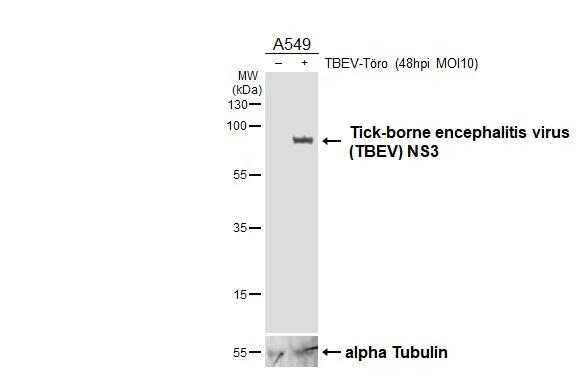
图: 1 / 1
Tick-Borne Encephalitis Virus NS3 Antibody (MA568423) in WB
Western blot analysis of Tick-Borne Encephalitis Virus NS3 in Non-infected (–) and infected (+) A549 whole cell extracts. Samples were incubated with Tick-Borne Encephalitis Virus NS3 recombinant monoclonal antibody (Product # MA568423) using a dilution of 1:1,000. The HRP-conjugated anti-rabbit IgG antibody was used to detect the primary antibody.
Please note: We are reviewing Western blot images included in the antibody testing data in our catalog, including those provided by third parties. Unless expressly labeled or annotated as “raw-unedited”, Western blot images included in the antibody testing data in our catalog may have been edited, optimized or otherwise adjusted for presentation.

产品信息
MA568423
产品规格
种属反应
Virus
宿主/亚型
Rabbit
/ IgG
Expression System
HEK293 cells
分类
Recombinant Monoclonal
类型
Antibody
克隆号
HL4154
抗原
Recombinant fragment of Tick-borne encephalitis virus (TBEV) NS3.
偶联物
Unconjugated
Unconjugated
Unconjugated
形式
Liquid
浓度
1 mg/mL
规格
100 µg
纯化类型
Protein A
保存液
PBS
内含物
no preservative
保存条件
Store at 4°C short term. For long term storage, store at -20°C, avoiding freeze/thaw cycles.
运输条件
Ambient (domestic); Wet ice (international)
靶标信息
Tick-Borne Encephalitis Virus (TBEV) non-structural protein 3 (NS3) is a multifunctional enzyme that is crucial for the virus replication and maturation processes. NS3 comprises two primary domains: an N-terminal protease domain and a C-terminal helicase domain. The protease domain, in combination with the NS2B protein, forms the NS2B-NS3 protease complex, which is essential for cleaving the viral polyprotein into functional proteins, facilitating viral replication. The helicase domain is responsible for unwinding viral RNA during replication, ensuring the efficient synthesis of viral RNA. NS3's dual role in proteolysis and RNA unwinding makes it a critical target for antiviral drug development. Structural elucidation of NS3 has provided insights into its mechanism, highlighting its importance in the viral life cycle. Efforts to develop inhibitors targeting NS3's protease and helicase activities are ongoing, aiming to disrupt the replication of TBEV and other flaviviruses. Understanding the biochemical properties and interactions of NS3 remains vital for devising effective therapeutic strategies against TBEV infections.
仅用于科研。不用于诊断过程。未经明确授权不得转售。
篇参考文献 (0)
您是否在文献中引用过该产品?请点击下方按钮邮件告知我们。
生物信息学
蛋白别名: TBEV NS3
Disclaimer

Clicking the images or links will redirect you to a website hosted by BenchSci that provides third-party scientific content. Neither the content nor the BenchSci technology and processes for selection have been evaluated by us; we are providing them as-is and without warranty of any kind, including for use or application of the Thermo Fisher Scientific products presented.

