Search
Disclaimer

Clicking the images or links will redirect you to a website hosted by BenchSci that provides third-party scientific content. Neither the content nor the BenchSci technology and processes for selection have been evaluated by us; we are providing them as-is and without warranty of any kind, including for use or application of the Thermo Fisher Scientific products presented.
Invitrogen
Trabikibart Recombinant Human Monoclonal Antibody
{{$productOrderCtrl.translations['antibody.pdp.commerceCard.promotion.promotions']}}
{{$productOrderCtrl.translations['antibody.pdp.commerceCard.promotion.viewpromo']}}
{{$productOrderCtrl.translations['antibody.pdp.commerceCard.promotion.promocode']}}: {{promo.promoCode}} {{promo.promoTitle}} {{promo.promoDescription}}. {{$productOrderCtrl.translations['antibody.pdp.commerceCard.promotion.learnmore']}}
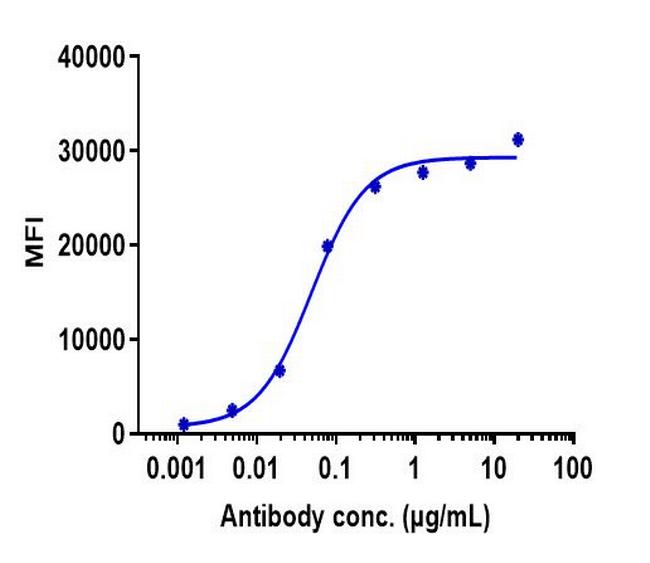
图: 1 / 4
Trabikibart Antibody (MA5-58863) in Flow
Flow cytometry analysis of Trabikibart Recombinant monoclonal antibody (Product # MA5-58863). Human CSF2RB HEK293 cells were stained with (CSL311) and negative control protein respectively, washed and then followed by PE and analyzed with FACS, EC50=0.049 µg/mL.


产品信息
MA5-58863
应用
建议稀释比
已发表文章
产品规格
种属反应
Human
宿主/亚型
Human
/ IgG4SP
Expression System
CHO cells
分类
Recombinant Monoclonal
类型
Antibody
偶联物
形式
Lyophilized
浓度
1 mg/mL
纯化类型
Protein A
保存液
25mM histidine, pH 6.2, with 0.01% Tween 80, 8% sucrose
内含物
no preservative
保存条件
-20°C, Avoid Freeze/Thaw Cycles
运输条件
Ambient (domestic); Dry ice (international)
RRID
产品详细信息
For reconstitution, add sterile, distilled water to achieve a final antibody concentration of 1 mg/mL. Gently shake to solubilize the protein completely. Do not vortex. Reconstituted products should be stored at -80 °.
靶标信息
Trabikibart, also known as CSL311, is a fully human monoclonal antibody that targets the common beta chain (beta c) receptor, shared by the interleukin-3 (IL-3), granulocyte-macrophage colony-stimulating factor (GM-CSF), and interleukin-5 (IL-5) cytokines. Colony stimulating factor 2 receptor subunit beta (CSF2RB), also known as CD131, is a critical component of the cytokine receptor family involved in hematopoiesis and immune response regulation. Located on chromosome 22q13.1, the CSF2RB gene encodes the common beta-subunit that pairs with the alpha-subunits of receptors for granulocyte-macrophage colony-stimulating factor (GM-CSF), interleukin-3 (IL-3), and interleukin-5 (IL-5). Structurally, the beta-subunit contributes to the formation of high-affinity receptor complexes essential for signal transduction. Functionally, upon ligand binding, CSF2RB stimulates various intracellular signaling cascades that mediate cellular proliferation, differentiation, and survival, particularly of hematopoietic progenitor cells and immune cells. Aberrations in CSF2RB expression or function can lead to immune dysfunctions and are associated with diseases such as asthma and leukemia. Recent studies have highlighted the importance of the CSF2RB in regulatory T cells, underscoring its role in autoimmune disease prevention.
仅用于科研。不用于诊断过程。未经明确授权不得转售。
篇参考文献 (0)
您是否在文献中引用过该产品?请点击下方按钮邮件告知我们。

