Search
Invitrogen
UBE2A/UBE2B Recombinant Rabbit Monoclonal Antibody (K01_4N84)
{{$productOrderCtrl.translations['antibody.pdp.commerceCard.promotion.promotions']}}
{{$productOrderCtrl.translations['antibody.pdp.commerceCard.promotion.promocode']}}: {{promo.promoCode}} {{promo.promoTitle}} {{promo.promoDescription}}. {{$productOrderCtrl.translations['antibody.pdp.commerceCard.promotion.learnmore']}}
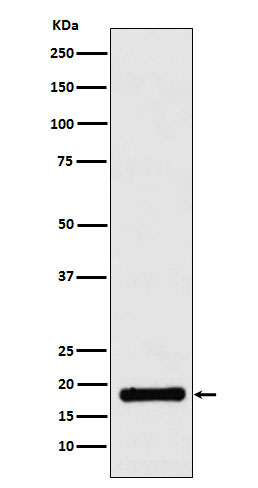
Please note: We are reviewing Western blot images included in the antibody testing data in our catalog, including those provided by third parties. Unless expressly labeled or annotated as “raw-unedited”, Western blot images included in the antibody testing data in our catalog may have been edited, optimized or otherwise adjusted for presentation.

产品信息
MA567492
产品规格
种属反应
Human
宿主/亚型
Rabbit
/ IgG
Expression System
HEK293F
分类
Recombinant Monoclonal
类型
Antibody
克隆号
K01_4N84
抗原
A synthesized peptide derived from UBE2B.
偶联物
Unconjugated
Unconjugated
Unconjugated
形式
Liquid
浓度
1 mg/mL
规格
100 µg
纯化类型
Protein A/G
保存液
PBS, pH 7.4, with 150mM NaCl, 50% glycerol, 0.05% BSA
内含物
0.02% sodium azide
保存条件
Store at 4°C short term. For long term storage, store at -20°C, avoiding freeze/thaw cycles.
运输条件
Ambient (domestic); Wet ice (international)
靶标信息
The modification of proteins with ubiquitin is an important cellular mechanism for targeting abnormal or short-lived proteins for degradation. Ubiquitination involves at least three classes of enzymes: ubiquitin-activating enzymes, or E1s, ubiquitin-conjugating enzymes, or E2s, and ubiquitin-protein ligases, or E3s. This gene encodes a member of the E2 ubiquitin-conjugating enzyme family. This enzyme is required for post-replicative DNA damage repair. Its protein sequence is 100% identical to the mouse, rat, and rabbit homologs, which indicates that this enzyme is highly conserved in eukaryotic evolution.
仅用于科研。不用于诊断过程。未经明确授权不得转售。
篇参考文献 (0)
您是否在文献中引用过该产品?请点击下方按钮邮件告知我们。
生物信息学
蛋白别名: E2 protein; E2 ubiquitin-conjugating enzyme A; E2 ubiquitin-conjugating enzyme B; HHR6A (Human homologue of yeast RAD 6); putative; HHR6B (Human homologue of yeast RAD 6); putative; RAD6 homolog A; RAD6 homolog B; UBE2B; ubiquitin carrier protein A; ubiquitin carrier protein B; ubiquitin conjugating enzyme E2B; ubiquitin-conjugating enzyme E2-17 kDa; ubiquitin-conjugating enzyme E2A; ubiquitin-conjugating enzyme E2B (RAD6 homolog); ubiquitin-protein ligase A; ubiquitin-protein ligase B; unnamed protein product
基因别名: E2-17kDa; HHR6A; HHR6B; HR6B; MRXS30; MRXSN; RAD6A; RAD6B; UBC2
UniProt ID: (Human) P49459, (Human) P63146
Entrez Gene ID: (Human) 7319, (Human) 7320
G2/M transition of mitotic cell cycle
protein polyubiquitination
DNA repair
postreplication repair
chromatin remodeling
ubiquitin-dependent protein catabolic process
response to UV
protein ubiquitination
proteasome-mediated ubiquitin-dependent protein catabolic process
protein K48-linked ubiquitination
protein K11-linked ubiquitination
positive regulation of mitophagy
cellular response to DNA damage stimulus
spermatogenesis
response to xenobiotic stimulus
protein stabilization
protein autoubiquitination
protein K63-linked ubiquitination
positive regulation of canonical Wnt signaling pathway
Disclaimer

Clicking the images or links will redirect you to a website hosted by BenchSci that provides third-party scientific content. Neither the content nor the BenchSci technology and processes for selection have been evaluated by us; we are providing them as-is and without warranty of any kind, including for use or application of the Thermo Fisher Scientific products presented.

