Search
Disclaimer

Clicking the images or links will redirect you to a website hosted by BenchSci that provides third-party scientific content. Neither the content nor the BenchSci technology and processes for selection have been evaluated by us; we are providing them as-is and without warranty of any kind, including for use or application of the Thermo Fisher Scientific products presented.
OriGene
UBE3B Monoclonal Antibody (OTI3F10), TrueMAB™
{{$productOrderCtrl.translations['antibody.pdp.commerceCard.promotion.promotions']}}
{{$productOrderCtrl.translations['antibody.pdp.commerceCard.promotion.viewpromo']}}
{{$productOrderCtrl.translations['antibody.pdp.commerceCard.promotion.promocode']}}: {{promo.promoCode}} {{promo.promoTitle}} {{promo.promoDescription}}. {{$productOrderCtrl.translations['antibody.pdp.commerceCard.promotion.learnmore']}}
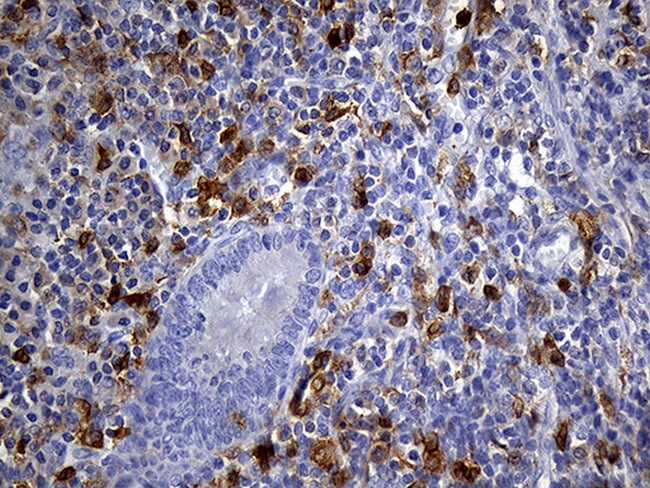


产品信息
CF806725
产品规格
种属反应
Human
宿主/亚型
Mouse
/ IgG2a
分类
Monoclonal
类型
Antibody
克隆号
OTI3F10
抗原
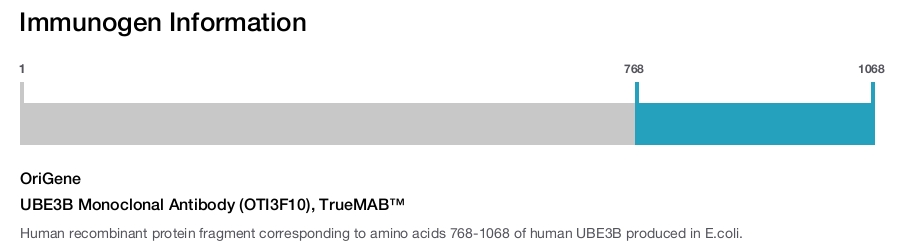
Human recombinant protein fragment corresponding to amino acids 768-1068 of human UBE3B produced in E.coli.
偶联物
形式
Lyophilized
浓度
1 mg/mL
纯化类型
Affinity chromatography
保存液
PBS, pH 7.3, with 8% trehalose
内含物
no preservative
保存条件
-20°C, Avoid Freeze/Thaw Cycles
运输条件
Ambient (domestic); Wet ice (international)
产品详细信息
For reconstitution, we recommend adding 100 µL distilled water to a final antibody concentration of about 1 mg/mL. To use this carrier-free antibody for conjugation experiments, we strongly recommend performing another round of desalting. (Zeba Spin Desalting Columns, 7KMWCO, 0.5 mL, Product # 89882)
靶标信息
The modification of proteins with ubiquitin is an important cellular mechanism for targeting abnormal or short-lived proteins for degradation. Ubiquitination involves at least three classes of enzymes: E1 ubiquitin-activating enzymes, E2 ubiquitin-conjugating enzymes, and E3 ubiquitin-protein ligases. This gene encodes a member of the E3 ubiquitin-conjugating enzyme family which accepts ubiquitin from an E2 ubiquitin-conjugating enzyme and transfers the ubiquitin to the targeted substrates. A HECT (homology to E6-AP C-terminus) domain in the C-terminus of the longer isoform of this protein is the catalytic site of ubiquitin transfer and forms a complex with E2 conjugases. Shorter isoforms of this protein which lack the C-terminal HECT domain are therefore unlikely to bind E2 enzymes. Alternatively spliced transcript variants encoding distinct isoforms have been identified for this gene.
仅用于科研。不用于诊断过程。未经明确授权不得转售。
篇参考文献 (0)
您是否在文献中引用过该产品?请点击下方按钮邮件告知我们。
生物信息学
蛋白别名: HECT-type ubiquitin transferase E3B; UBE3B_v2; Ubiquitin-protein ligase E3B
基因别名: BPIDS; KOS; UBE3B
UniProt ID: (Human) Q7Z3V4
Entrez Gene ID: (Human) 89910

