Search
Proteintech
UBQLN3 Polyclonal Antibody
{{$productOrderCtrl.translations['antibody.pdp.commerceCard.promotion.promotions']}}
{{$productOrderCtrl.translations['antibody.pdp.commerceCard.promotion.promocode']}}: {{promo.promoCode}} {{promo.promoTitle}} {{promo.promoDescription}}. {{$productOrderCtrl.translations['antibody.pdp.commerceCard.promotion.learnmore']}}
{{$ctrl.translations['antibody.pdp.skuNotes.additionalInformation']}}:
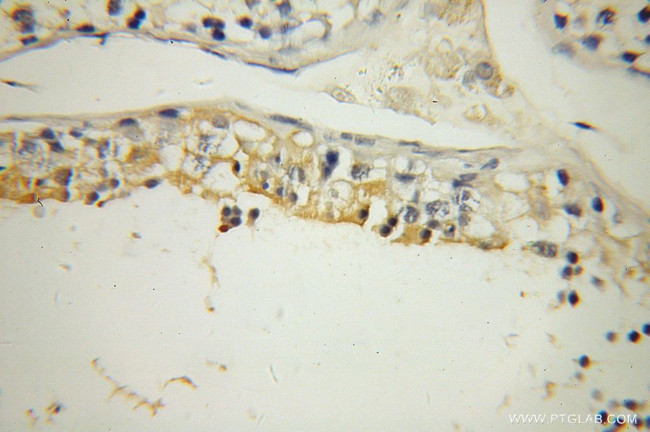
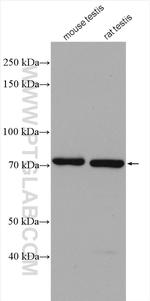
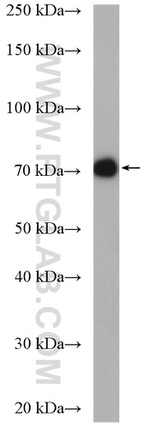
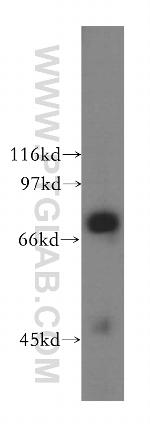
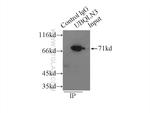
Please note: We are reviewing Western blot images included in the antibody testing data in our catalog, including those provided by third parties. Unless expressly labeled or annotated as “raw-unedited”, Western blot images included in the antibody testing data in our catalog may have been edited, optimized or otherwise adjusted for presentation.


产品信息
13568-1-AP
应用
建议稀释比
已发表文章
产品规格
种属反应
Human,
Mouse,
Rat
已发表种属
Human,
Mouse
宿主/亚型
Rabbit
/ IgG
分类
Polyclonal
类型
Antibody
抗原
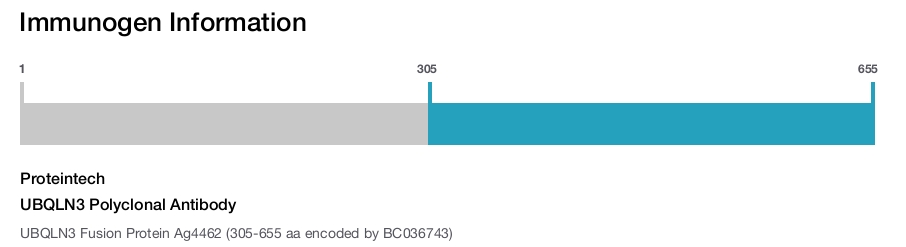
UBQLN3 Fusion Protein Ag4462 (305-655 aa encoded by BC036743)
偶联物
Unconjugated
Unconjugated
Unconjugated
形式
Liquid
浓度
0.39 mg/mL
规格
58.5 µg
纯化类型
Antigen affinity chromatography
保存液
PBS, pH 7.3, with 50% glycerol
内含物
0.02% sodium azide
保存条件
-20°C
运输条件
Wet ice (domestic); Dry ice (international)
产品详细信息
Immunogen sequence: PWTSTHGGS GSRQGRQDGD QDAPDIRNRF PNFLGIIRLY DYLQQLHENP QSLGTYLQGT ASALSQSQEP PPSVNRVPPS SPSSQEPGSG QPLPEESVAI KGRSSCPAFL RYPTENSTGQ GGDQDGAGKS STGHSTNLPD LVSGLGDSAN RVPFAPLSFS PTAAIPGIPE PPWLPSPAYP RSLRPDGMNP APQLQDEIQP QLPLLMHLQA AMANPRALQA LRQIEQGLQV LATEAPRLLL WFMPCLAGTG SVAGGIESRE DPLMSEDPLP NPPPEVFPAL DSAELGFLSP PFLHMLQDLV STNPQQLQPE AHFQVQLEQL RSMGFLNREA NLQALIATGG DVDAAVEKLR QS (305-655 aa encoded by BC036743)
靶标信息
This gene encodes an ubiquitin-like protein (ubiquilin) that shares high degree of similarity with related products in yeast, rat and frog. Ubiquilins contain a N-terminal ubiquitin-like domain and a C-terminal ubiquitin-associated domain. They physically associate with both proteasomes and ubiquitin ligases, and thus thought to functionally link the ubiquitination machinery to the proteasome to affect in vivo protein degradation. This gene is specifically expressed in the testis, and proposed to regulate cell-cycle progression during spermatogenesis.
仅用于科研。不用于诊断过程。未经明确授权不得转售。
生物信息学
蛋白别名: testicular tissue protein Li 220; TUP-1; unnamed protein product
基因别名: 4933400K24Rik; TUP-1
UniProt ID: (Human) Q9H347, (Mouse) Q8C5U9
Entrez Gene ID: (Human) 50613, (Mouse) 244178, (Rat) 308905
Disclaimer

Clicking the images or links will redirect you to a website hosted by BenchSci that provides third-party scientific content. Neither the content nor the BenchSci technology and processes for selection have been evaluated by us; we are providing them as-is and without warranty of any kind, including for use or application of the Thermo Fisher Scientific products presented.

