Search
Proteintech
UIMC1 Polyclonal Antibody
{{$productOrderCtrl.translations['antibody.pdp.commerceCard.promotion.promotions']}}
{{$productOrderCtrl.translations['antibody.pdp.commerceCard.promotion.viewpromo']}}
{{$productOrderCtrl.translations['antibody.pdp.commerceCard.promotion.promocode']}}: {{promo.promoCode}} {{promo.promoTitle}} {{promo.promoDescription}}. {{$productOrderCtrl.translations['antibody.pdp.commerceCard.promotion.learnmore']}}
Additional Information:
{{banner.description}}
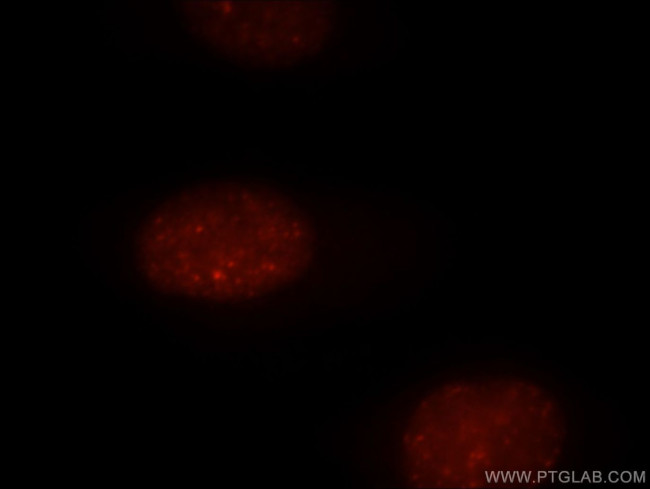
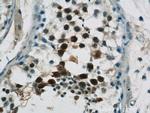
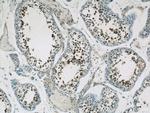
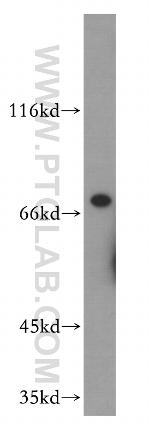
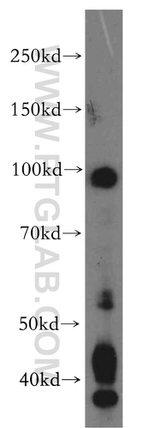
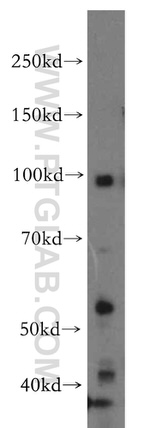
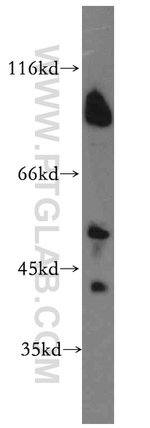
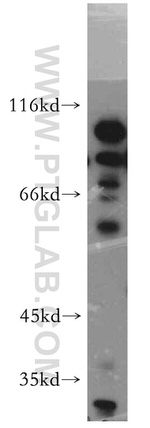
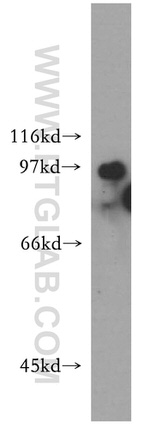


产品信息
13642-1-AP
应用
建议稀释比
已发表文章
产品规格
种属反应
Human,
Mouse
宿主/亚型
Rabbit
/ IgG
分类
Polyclonal
类型
Antibody
抗原
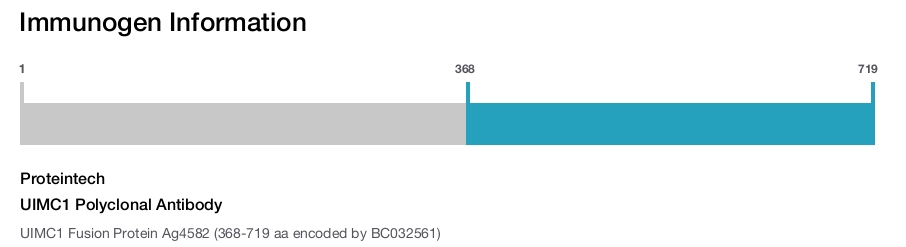
UIMC1 Fusion Protein Ag4582 (368-719 aa encoded by BC032561)
偶联物
形式
Liquid
浓度
0.22 mg/mL
规格
33 µg
纯化类型
Antigen affinity chromatography
保存液
PBS, pH 7.3, with 50% glycerol
内含物
0.02% sodium azide
保存条件
-20°C
运输条件
Wet ice (domestic); Dry ice (international)
产品详细信息
Immunogen sequence: DQSSQPVFE NVNVKSFDRC TGHSAEHTQC GKPQSSQGIV EETSEEGNSV PASQSVAALT SKRSLVLMPE SSAEEITVCP ETQLSSSETF DLEREVSPGS RDILDGVRII MADKEVGNKE DAEKEVAIST FSSSNQVSCP LCDQCFPPTK IERHAMYCNG LMEEDTVLTR RQKEAKTKSD SGTAAQTSLD IDKNEKCYLC KSLVPFREYQ CHVDSCLQLA KADQGDGPEG SGRACSTVEG KWQQRLKNPK EKGHSEGRLL SFLEQSEHKT SDADIKSSET GAFRVPSPGM EEAGCSREMQ SSFTRRDLNE SPVKSFVSIS EATDCLVDFK KQVTVQPGSR TRTKAGRGRR RKF (368-719 aa encoded by BC032561)
靶标信息
RAP80 was initially identified as zinc-finger containing nuclear protein that is highly expressed in testis and interacts with the retinoid-related testis-associated receptor (RTR). Later experiments revealed that RAP80 is recruited by the Coiled-coil domain 98 (CCDC98) protein to the breast cancer-1 protein BRCA1, allowing the formation of BRCA1 foci in response to DNA damage caused by ionizing radiation. Both RAP80 and CCDC98 are required for DNA damage resistance, G2-M checkpoint control, and DNA repair. Cells depleted of either RAP80 or CCDC98 exhibited increased sensitivity to ionizing radiation, although not as much as in BRCA1-depleted cells, suggesting that RAP80 and CCDC98 control only part of the DNA damage response role of BRCA1. At least four isoforms of RAP80 are known to exist.
仅用于科研。不用于诊断过程。未经明确授权不得转售。
篇参考文献 (0)
您是否在文献中引用过该产品?请点击下方按钮邮件告知我们。
生物信息学
蛋白别名: BRCA1-A complex subunit RAP80; Receptor-associated protein 80; retinoid X receptor interacting protein 110; Retinoid X receptor-interacting protein 110; RIP110; Ubiquitin interaction motif-containing protein 1; unnamed protein product
基因别名: 9430016E08Rik; D330018D10Rik; D630032M02Rik; RAP80; RIP110; RXRIP110; UIMC1; X2HRIP110
UniProt ID: (Human) Q96RL1, (Mouse) Q5U5Q9
Entrez Gene ID: (Human) 51720, (Mouse) 20184
DNA repair
regulation of DNA repair
double-strand break repair
chromatin organization
cellular response to DNA damage stimulus
mitotic G2 DNA damage checkpoint
response to ionizing radiation
mitotic G2/M transition checkpoint
positive regulation of DNA repair
negative regulation of transcription, DNA-templated
DNA repair-dependent chromatin remodeling
transcription, DNA-templated
regulation of transcription, DNA-templated
chromatin modification
G2 DNA damage checkpoint
histone H2A K63-linked deubiquitination
Disclaimer

Clicking the images or links will redirect you to a website hosted by BenchSci that provides third-party scientific content. Neither the content nor the BenchSci technology and processes for selection have been evaluated by us; we are providing them as-is and without warranty of any kind, including for use or application of the Thermo Fisher Scientific products presented.

