Search
Invitrogen
VAMP2 Polyclonal Antibody
{{$productOrderCtrl.translations['antibody.pdp.commerceCard.promotion.promotions']}}
{{$productOrderCtrl.translations['antibody.pdp.commerceCard.promotion.viewpromo']}}
{{$productOrderCtrl.translations['antibody.pdp.commerceCard.promotion.promocode']}}: {{promo.promoCode}} {{promo.promoTitle}} {{promo.promoDescription}}. {{$productOrderCtrl.translations['antibody.pdp.commerceCard.promotion.learnmore']}}
Additional Information:
{{banner.description}}
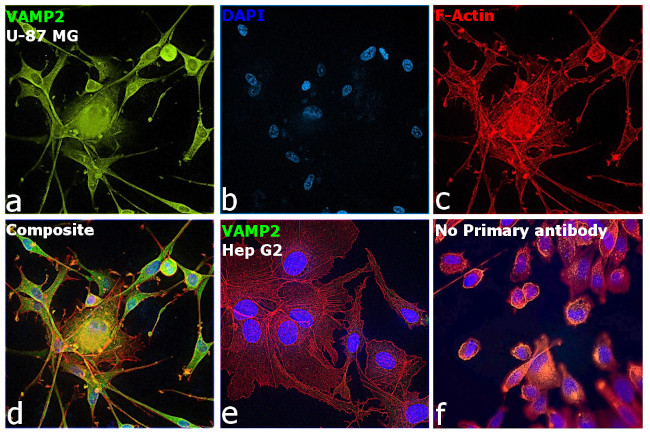
图: 1 / 4
VAMP2 Antibody (OSS00035W) in ICC/IF
Immunofluorescence analysis of Vesicle-associated membrane protein 2 was performed using 70% confluent log phase U-87 MG and Hep G2 cells. The cells were fixed with 4% paraformaldehyde for 10 minutes, permeabilized with 0.1% Triton™ X-100 for 15 minutes, and blocked with 2% BSA for 1 hour at room temperature. The cells were labeled with VAMP2 Polyclonal Antibody (Product # OSS00035W), at 1:100 in 0.1% BSA, incubated at 4 degree celsius overnight and then labeled with Donkey anti-Rabbit IgG (H+L) Highly Cross-Adsorbed Secondary Antibody, Al... View More


产品信息
OSS00035W
产品规格
已发表种属
Dog
宿主/亚型
Rabbit
/ IgG
分类
Polyclonal
类型
Antibody
抗原
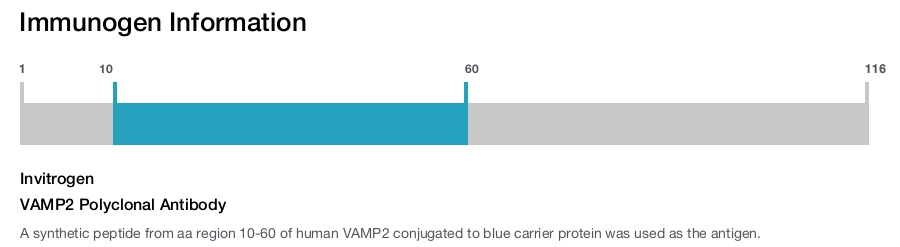
A synthetic peptide from aa region 10-60 of human VAMP2 conjugated to blue carrier protein was used as the antigen.
偶联物
形式
Lyophilized
浓度
Conc. Not Determined
保存条件
Store at 4°C short term. For long term storage, store at -20°C, avoiding freeze/thaw cycles. Glycerol (1:1) may be added for added stability.
运输条件
Ambient (domestic); Wet ice (international)
RRID
产品详细信息
Glycerol (1:1) may be added for additional stability.
Reconstitute in 100 µL of sterile water.
The VAMP2 peptide shares 93% shared identity with VAMP1. The peptide is homologous in many other species including rat, mouse and xenopus.
靶标信息
The vesicle associated membrane proteins (VAMP) or synaptobrevins are calcium binding proteins specific to eukaryotes. VAMPs, along with synaptosomal associated protein of 25 kDa (SNAP-25) and syntaxin, form the core complex of soluble NSF attachment protein receptor (SNARE) proteins that interact with the soluble proteins N-ethylmaleimide-sensitive factor (NSF) and alpha-SNAP. These membrane associated proteins play a key role in the regulation of vesicle membrane fusion with the plasma membrane. The Clostridium tetani neurotoxin is a metalloprotease with specificity for VAMP. In Alzheimer's disease, VAMP levels of all isoforms appear to be significantly lowered. It is suggested that VAMP-2 is a resident protein of the insulin-sensitive glucose transporter type 4 (GLUT4) compartment and that it is required for GLUT4 vesicle incorporation into the cell surface in response to insulin.
仅用于科研。不用于诊断过程。未经明确授权不得转售。
Disclaimer

Clicking the images or links will redirect you to a website hosted by BenchSci that provides third-party scientific content. Neither the content nor the BenchSci technology and processes for selection have been evaluated by us; we are providing them as-is and without warranty of any kind, including for use or application of the Thermo Fisher Scientific products presented.

