Search
Osenses
VDP Polyclonal Antibody
{{$productOrderCtrl.translations['antibody.pdp.commerceCard.promotion.promotions']}}
{{$productOrderCtrl.translations['antibody.pdp.commerceCard.promotion.viewpromo']}}
{{$productOrderCtrl.translations['antibody.pdp.commerceCard.promotion.promocode']}}: {{promo.promoCode}} {{promo.promoTitle}} {{promo.promoDescription}}. {{$productOrderCtrl.translations['antibody.pdp.commerceCard.promotion.learnmore']}}
Additional Information:
{{banner.description}}
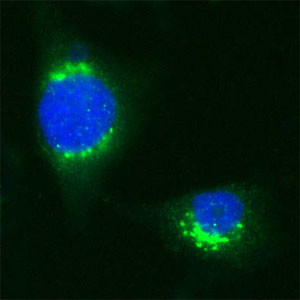
图: 1 / 4
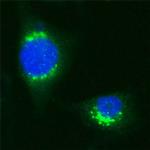
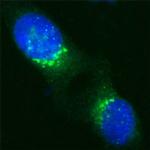
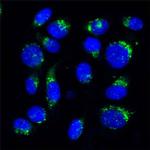
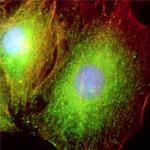
VDP Antibody (OSV00018W-100UL) in ICC/IF
Human Melanoma cell line C32 was cultured overnight on round cover slides placed in a 24 well tissue culture plate. Culture media removed and washed twice with PBS before fixing with 2% formalin for 10 minutes. Cells were then washed three times with PBS and incubated with Tris 0.01M containing Triton X 0.005% for 15 minutes. Cells were washed and incubated with 100 µL of Rabbit antibody to internal region of Vesicle docking protein (VDP, USO1, TAP, Transcytosis-associated protein): whole serum (OSV00018W) diluted 1:100 in the blocking buf... View More
Please note: We are reviewing Western blot images included in the antibody testing data in our catalog, including those provided by third parties. Unless expressly labeled or annotated as “raw-unedited”, Western blot images included in the antibody testing data in our catalog may have been edited, optimized or otherwise adjusted for presentation.


产品信息
OSV00018W-100UL
应用
建议稀释比
已发表文章
产品规格
种属反应
Human,
Mouse,
Rat
宿主/亚型
Rabbit
/ Ig
分类
Polyclonal
类型
Antibody
抗原
A synthetic peptide from the internal region of human VDP115 conjugated to blue carrier protein was used as the antigen
偶联物
Unconjugated
Unconjugated
Unconjugated
形式
Lyophilized
浓度
Conc. Not Determined
保存液
whole serum
内含物
no preservative
保存条件
Store at 4°C short term. For long term storage, store at -20°C, avoiding freeze/thaw cycles. Glycerol (1:1) may be added for added stability.
运输条件
Ambient (domestic); Wet ice (international)
产品详细信息
Reconstitute in 100 µL of sterile water. Centrifuge to remove any insoluble material.
The antigen is homologous in rat and moue.
Specificity of this antibody: VDP.
靶标信息
The protein encoded by this gene is a peripheral membrane protein which recycles between the cytosol and the Golgi apparatus during interphase. It is regulated by phosphorylation: dephosphorylated protein associates with the Golgi membrane and dissociates from the membrane upon phosphorylation. Ras-associated protein 1 recruits this protein to coat protein complex II (COPII) vesicles during budding from the endoplasmic reticulum, where it interacts with a set of COPII vesicle-associated SNAREs to form a cis-SNARE complex that promotes targeting to the Golgi apparatus. Transport from the ER to the cis/medial Golgi compartments requires the action of this gene product, GM130 and giantin in a sequential manner.
仅用于科研。不用于诊断过程。未经明确授权不得转售。
生物信息学
蛋白别名: General vesicular transport factor p115; Protein USO1 homolog; TAP; transcytosis associated protein; transcytosis associated protein p115; Transcytosis-associated protein; USO1 homolog, vesicle docking protein; VDP p115; vesicle docking protein, 115 kDa; Vesicle-docking protein
基因别名: 115kDa; TAP; USO1; VDP
UniProt ID: (Mouse) Q9Z1Z0, (Rat) P41542
Entrez Gene ID: (Mouse) 56041, (Rat) 56042
Disclaimer

Clicking the images or links will redirect you to a website hosted by BenchSci that provides third-party scientific content. Neither the content nor the BenchSci technology and processes for selection have been evaluated by us; we are providing them as-is and without warranty of any kind, including for use or application of the Thermo Fisher Scientific products presented.

