Search
Bioss
VEGFB167 Polyclonal Antibody
{{$productOrderCtrl.translations['antibody.pdp.commerceCard.promotion.promotions']}}
{{$productOrderCtrl.translations['antibody.pdp.commerceCard.promotion.viewpromo']}}
{{$productOrderCtrl.translations['antibody.pdp.commerceCard.promotion.promocode']}}: {{promo.promoCode}} {{promo.promoTitle}} {{promo.promoDescription}}. {{$productOrderCtrl.translations['antibody.pdp.commerceCard.promotion.learnmore']}}
Additional Information:
{{banner.description}}
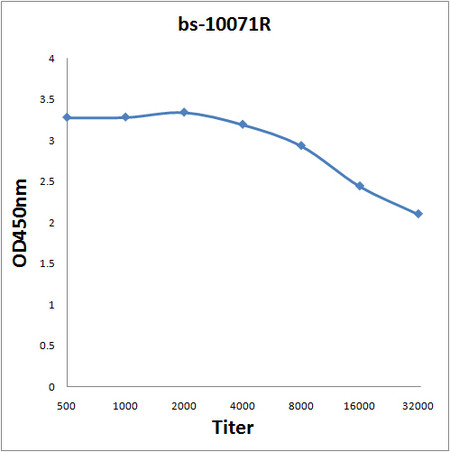

产品信息
BS-10071R
产品规格
种属反应
Human,
Mouse,
Rat
宿主/亚型
Rabbit
/ IgG
分类
Polyclonal
类型
Antibody
抗原
KLH conjugated synthetic peptide derived from human VEGFB167, amino acids 121-188.
偶联物
形式
Liquid
浓度
1 mg/mL
规格
100 µg
纯化类型
Protein A
保存液
0.01M TBS, pH 7.4, with 50% glycerol, 1% BSA
内含物
0.02% ProClin 300
保存条件
-20°C
运输条件
Ambient (domestic); Wet ice (international)
靶标信息
The onset of angiogenesis is believed to be an early event in tumorigenesis and may facilitate tumor progression and metastasis. Several growth factors with angiogenic activity have been described and include fibroblast growth factor (FGF), platelet derived growth factor (PDGF) and vascular endothelial growth factors (VEGFs). The VEGF protein family is comprised of VEGF, VEGF-B, VEGF-C and VEGF-D, all of which may exhibit angiogenic function in vivo. VEGF-B, which exists as two alternatively spliced isoforms known as VEGF-B167 and VEGF-B186, is abundantly expressed in heart and skeletal muscle and is frequently co-expressed with VEGF. VEGF-C binds to and specifically activates Flt-4 and Flk-1.
仅用于科研。不用于诊断过程。未经明确授权不得转售。
篇参考文献 (0)
您是否在文献中引用过该产品?请点击下方按钮邮件告知我们。
生物信息学
蛋白别名: prepro-neuropeptide Y; Pro-neuropeptide Y; pro-neuropeptide Y-like; unnamed protein product
基因别名: 0710005A05Rik; NPY; NPY02; PYY4; RATNPY; RATNPY02
UniProt ID: (Human) P01303, (Mouse) P57774, (Rat) P07808
Entrez Gene ID: (Rat) 100912228, (Human) 4852, (Mouse) 109648, (Rat) 24604
neuropeptide signaling pathway
cell-cell signaling
feeding behavior
regulation of appetite
response to yeast
negative regulation of acute inflammatory response to antigenic stimulus
G-protein coupled receptor signaling pathway, coupled to cyclic nucleotide second messenger
chemical synaptic transmission
regulation of blood pressure
positive regulation of cell proliferation
adult feeding behavior
positive regulation of cell-substrate adhesion
antibacterial humoral response
antifungal humoral response
central nervous system neuron development
cerebral cortex development
neuron projection development
positive regulation of appetite
regulation of nerve growth factor production
monocyte activation
innate immune response
negative regulation of blood pressure
positive regulation of dopamine metabolic process
short-day photoperiodism
defense response to Gram-negative bacterium
defense response to Gram-positive bacterium
intestinal epithelial cell differentiation
antimicrobial humoral immune response mediated by antimicrobial peptide
positive regulation of ERK1 and ERK2 cascade
regulation of presynaptic cytosolic calcium ion concentration
synaptic signaling via neuropeptide
positive regulation of eating behavior
positive regulation of nitric oxide metabolic process
regulation of synaptic vesicle exocytosis
sensory perception of taste
Disclaimer

Clicking the images or links will redirect you to a website hosted by BenchSci that provides third-party scientific content. Neither the content nor the BenchSci technology and processes for selection have been evaluated by us; we are providing them as-is and without warranty of any kind, including for use or application of the Thermo Fisher Scientific products presented.

