Search
Invitrogen
VMA2 Monoclonal Antibody (13D11B2)
{{$productOrderCtrl.translations['antibody.pdp.commerceCard.promotion.promotions']}}
{{$productOrderCtrl.translations['antibody.pdp.commerceCard.promotion.promocode']}}: {{promo.promoCode}} {{promo.promoTitle}} {{promo.promoDescription}}. {{$productOrderCtrl.translations['antibody.pdp.commerceCard.promotion.learnmore']}}
{{$ctrl.translations['antibody.pdp.skuNotes.additionalInformation']}}:
Please note: We are reviewing Western blot images included in the antibody testing data in our catalog, including those provided by third parties. Unless expressly labeled or annotated as “raw-unedited”, Western blot images included in the antibody testing data in our catalog may have been edited, optimized or otherwise adjusted for presentation.


产品信息
A-6427
应用
建议稀释比
已发表文章
产品规格
种属反应
Yeast
已发表种属
Yeast
宿主/亚型
Mouse
/ IgG1
分类
Monoclonal
类型
Antibody
克隆号
13D11B2
抗原
Purified S. cerevisiae vacuole membranes
偶联物
Unconjugated
Unconjugated
Unconjugated
形式
Liquid
浓度
1 mg/mL
规格
250 µg
纯化类型
purified
保存液
HEPES buffered saline
内含物
0.02% sodium azide
保存条件
4°C
运输条件
Ambient (domestic); Wet ice (international)
RRID
产品详细信息
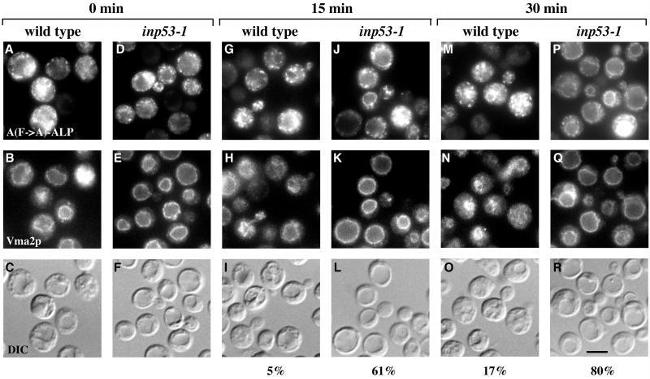
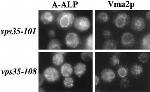
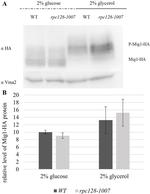
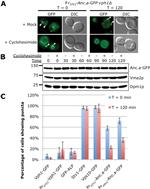
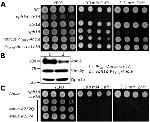
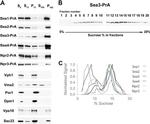
This clone recognizes the 60 kDa subunit 1 (B-subunit, the product of the VMA2 or VAT2 gene) of S. cerevisiae. By Western blot, this can be used to identify organelles during subcellular fractionation of yeast membranes.
靶标信息
Vacuolar-type H+-ATPase (V-ATPase) is a multisubunit enzyme responsible for acidification of eukaryotic intracellular organelles. V-ATPases pump protons against an electrochemical gradient, while F-ATPases reverse the process, thereby synthesizing ATP. A peripheral V1 domain, which is responsible for ATP hydrolysis, and a integral V0 domain, which is responsible for proton translocation, compose V-ATPase. Nine subunits (A-H) make up the V1 domain and five subunits (a, d, c, c' and c") make up the V0 domain. Like F-ATPase, V-ATPase most likely operates through a rotary mechanism. The V-ATPase V1 B subunit exists as two isoforms. In the inner ear, the V-ATPase B1 isoform functions in proton secretion and is required to maintain proper endolymph pH and normal auditory function. The gene encoding the human V-ATPase B1 isoform maps to chromosome 2cen-q13. Mutations in this gene cause distal renal tubular acidosis associated with sensorineural deafness. The V-ATPase B2 isoform is expressed in kidney and is the only B isoform expressed in osteoclasts.
仅用于科研。不用于诊断过程。未经明确授权不得转售。
生物信息学
蛋白别名: V-ATPase B1
Disclaimer

Clicking the images or links will redirect you to a website hosted by BenchSci that provides third-party scientific content. Neither the content nor the BenchSci technology and processes for selection have been evaluated by us; we are providing them as-is and without warranty of any kind, including for use or application of the Thermo Fisher Scientific products presented.

