Search
Abnova
WISP3 Polyclonal Antibody, MaxPab™
{{$productOrderCtrl.translations['antibody.pdp.commerceCard.promotion.promotions']}}
{{$productOrderCtrl.translations['antibody.pdp.commerceCard.promotion.promocode']}}: {{promo.promoCode}} {{promo.promoTitle}} {{promo.promoDescription}}. {{$productOrderCtrl.translations['antibody.pdp.commerceCard.promotion.learnmore']}}
{{$ctrl.translations['antibody.pdp.skuNotes.additionalInformation']}}:
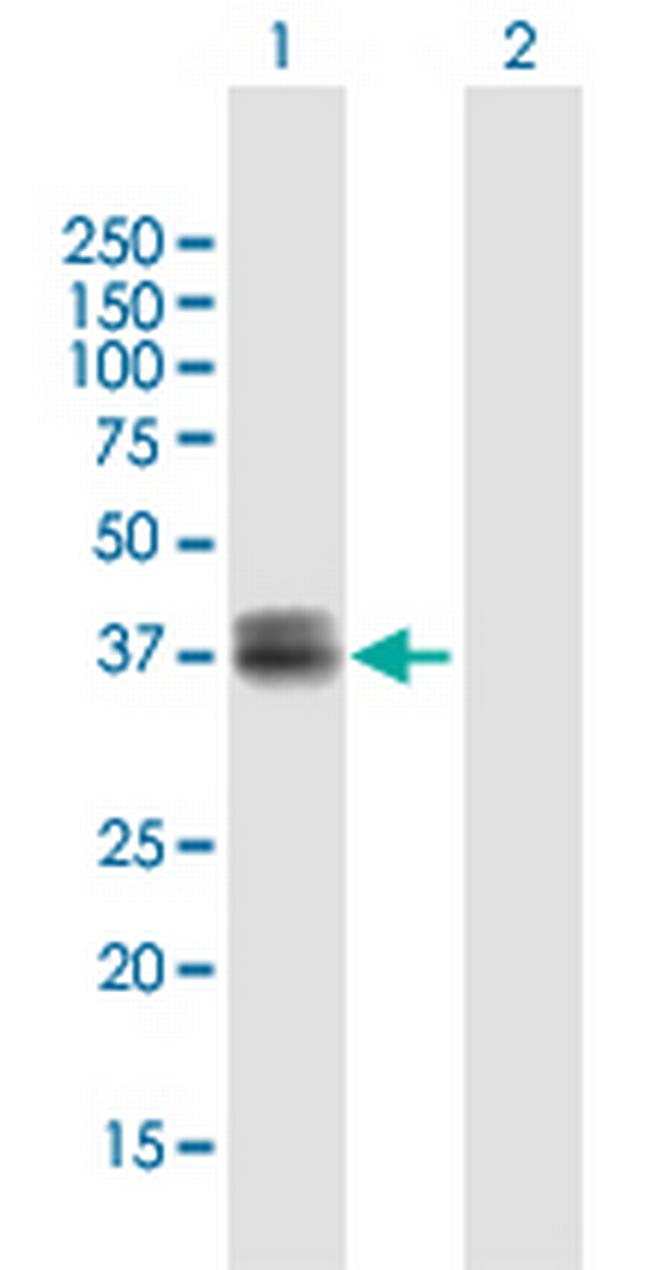
Please note: We are reviewing Western blot images included in the antibody testing data in our catalog, including those provided by third parties. Unless expressly labeled or annotated as “raw-unedited”, Western blot images included in the antibody testing data in our catalog may have been edited, optimized or otherwise adjusted for presentation.

产品信息
H00008838-B01P
产品规格
种属反应
Human
宿主/亚型
Mouse
/ IgG
分类
Polyclonal
类型
Antibody
抗原
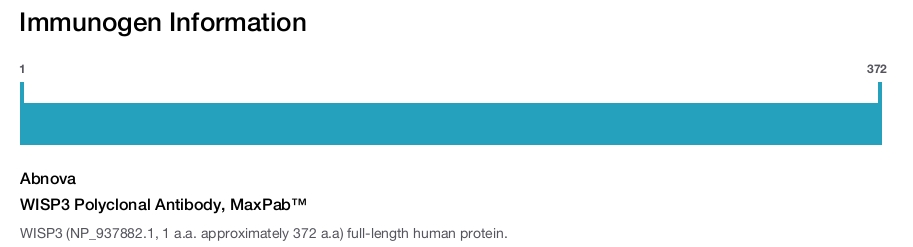
WISP3 (NP_937882.1, 1 a.a. approximately 372 a.a) full-length human protein.
偶联物
Unconjugated
Unconjugated
Unconjugated
形式
Liquid
浓度
1 mg/mL
规格
50 µg
纯化类型
Protein A
保存液
PBS, pH 7.4
内含物
no preservative
保存条件
-20°C, Avoid Freeze/Thaw Cycles
运输条件
Ambient (domestic); Wet ice (international)
产品详细信息
Product may be used with Western Blot (Transfected lysate).
The Isotype of this product is composed of an IgG Mixture.
Immunogen sequence: MNKRRLLYPS GWLHGPSDMQ GLLFSTLLLA GLAQFCCRVQ GTGPLDTTPE GRPGEVSDAP QRKQFCHWPC KCPQQKPRCP PGVSLVRDGC GCCKICAKQP GEICNEADLC DPHKGLYCDY SVDRPRYETG VCAYLVAVGC EFNQVHYHNG QVFQPNPLFS CLCVSGAIGC TPLFIPKLAG SHCSGAKGGK KSDQSNCSLE PLLQQLSTSY KTMPAYRNLP LIWKKKCLVQ ATKWTPCSRT CGMGISNRVT NENSNCEMRK EKRLCYIQPC DSNILKTIKI PKGKTCQPTF QLSKAEKFVF SGCSSTQSYK PTFCGICLDK RCCIPNKSKM ITIQFDCPNE GSFKWKMLWI TSCVCQRNCR EPGDIFSELK IL
靶标信息
WISP3 is a member of the WNT1 inducible signaling pathway (WISP) protein subfamily, which belongs to the connective tissue growth factor (CTGF) family. WNT1 is a member of a family of cysteine-rich, glycosylated signaling proteins that mediate diverse developmental processes. The CTGF family members are characterized by four conserved cysteine-rich domains: insulin-like growth factor-binding domain, von Willebrand factor type C module, thrombospondin domain and C-terminal cystine knot-like domain. WISP3 is overexpressed in colon tumors. It may be downstream in the WNT1 signaling pathway that is relevant to malignant transformation. Mutations of the WISP3 gene are associated with progressive pseudorheumatoid dysplasia, an autosomal recessive skeletal disorder, indicating that the gene is essential for normal postnatal skeletal growth and cartilage homeostasis.
仅用于科研。不用于诊断过程。未经明确授权不得转售。
篇参考文献 (0)
您是否在文献中引用过该产品?请点击下方按钮邮件告知我们。
生物信息学
蛋白别名: CCN family member 6; epididymis secretory sperm binding protein; putative IGF-binding protein; WNT1 inducible signaling pathway protein 3
基因别名: LIBC; PPAC; PPD; PPRD; WISP-3; WISP3
UniProt ID: (Human) O95389
Entrez Gene ID: (Human) 8838
cell adhesion
signal transduction
cell-cell signaling
negative regulation of cell proliferation
negative regulation of angiogenesis
positive regulation of cell differentiation
regulation of developmental process
regulation of mitochondrial membrane potential
regulation of reactive oxygen species biosynthetic process
Disclaimer

Clicking the images or links will redirect you to a website hosted by BenchSci that provides third-party scientific content. Neither the content nor the BenchSci technology and processes for selection have been evaluated by us; we are providing them as-is and without warranty of any kind, including for use or application of the Thermo Fisher Scientific products presented.

