Search
Invitrogen
ZNRF1 Polyclonal Antibody
{{$productOrderCtrl.translations['antibody.pdp.commerceCard.promotion.promotions']}}
{{$productOrderCtrl.translations['antibody.pdp.commerceCard.promotion.promocode']}}: {{promo.promoCode}} {{promo.promoTitle}} {{promo.promoDescription}}. {{$productOrderCtrl.translations['antibody.pdp.commerceCard.promotion.learnmore']}}
{{$ctrl.translations['antibody.pdp.skuNotes.additionalInformation']}}:
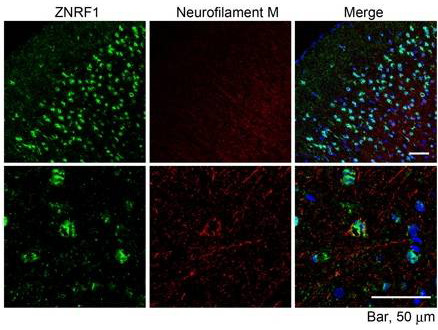
图: 1 / 4
ZNRF1 Antibody (PA5-37982) in IHC (P)
Immunohistochemical analysis of ZNRF1 in paraffin embedded mouse cerebral cortex using a ZNRF1 polyclonal antibody (Product #PA5-37982) at a concentration of 1:100. Microwaved antigen retrieval was performed with pH 6 buffered citrate. Samples were then stained with streptavidfine-Alexa 488 after biotinylation with an anti-goat secondary antibody. The Neurofilament M was labeled with a different antibody.
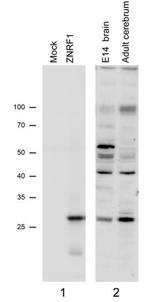
Please note: We are reviewing Western blot images included in the antibody testing data in our catalog, including those provided by third parties. Unless expressly labeled or annotated as “raw-unedited”, Western blot images included in the antibody testing data in our catalog may have been edited, optimized or otherwise adjusted for presentation.


产品信息
PA5-37982
产品规格
种属反应
Human,
Mouse
宿主/亚型
Goat
/ IgG
分类
Polyclonal
类型
Antibody
抗原
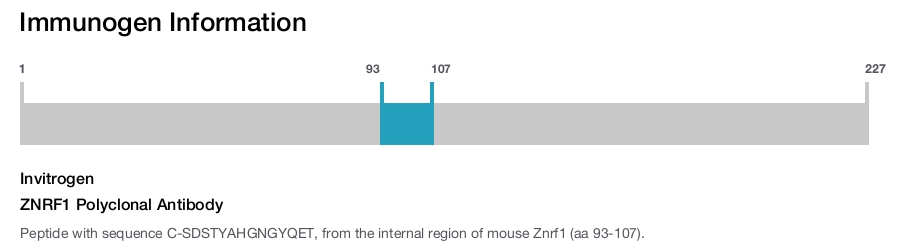
Peptide with sequence C-SDSTYAHGNGYQET, from the internal region of mouse Znrf1 (aa 93-107).
偶联物
Unconjugated
Unconjugated
Unconjugated
形式
Liquid
浓度
0.5 mg/mL
规格
100 µg
纯化类型
Ammonium sulfate precipitation
保存液
TBS, pH 7.3, with 0.5% BSA
内含物
0.02% sodium azide
保存条件
-20°C, Avoid Freeze/Thaw Cycles
运输条件
Ambient (domestic); Wet ice (international)
RRID
产品详细信息
This antibody is predicted to react with human, rat, dog, pig and cow based on sequence homology.
This antibody is tested in Peptide ELISA: antibody detection limit dilution 32,000.
靶标信息
E3 ubiquitin-protein ligase that mediates the ubiquitination of AKT1 and GLUL, thereby playing a role in neuron cells differentiation. Plays a role in the establishment and maintenance of neuronal transmission and plasticity. Regulates Schwann cells differentiation by mediating ubiquitination of GLUL. Promotes neurodegeneration by mediating 'Lys-48'-linked polyubiquitination and subsequent degradation of AKT1 in axons: degradation of AKT1 prevents AKT1-mediated phosphorylation of GSK3B, leading to GSK3B activation and phosphorylation of DPYSL2/CRMP2 followed by destabilization of microtubule assembly in axons (Probable).
仅用于科研。不用于诊断过程。未经明确授权不得转售。
篇参考文献 (0)
您是否在文献中引用过该产品?请点击下方按钮邮件告知我们。
生物信息学
蛋白别名: MGC101991; nerve injury gene 283; nerve injury-induced gene 283 protein; peripheral nerve injury protein nin283; ring finger protein 42; RING-type E3 ubiquitin transferase ZNRF1; unnamed protein product; zinc and ring finger 1, E3 ubiquitin protein ligase; zinc and ring finger protein 1; zinc ring finger protein 1; zinc/RING finger protein 1
基因别名: B830022L21Rik; NIN283; Rnf42; Zrfp1
UniProt ID: (Human) Q8ND25, (Mouse) Q91V17
Entrez Gene ID: (Human) 84937, (Mouse) 170737
protein ubiquitination
positive regulation of toll-like receptor 4 signaling pathway
proteasome-mediated ubiquitin-dependent protein catabolic process
protein K48-linked ubiquitination
positive regulation of autophagosome-lysosome fusion
cytoskeleton organization
toll-like receptor 3 signaling pathway
regulation of toll-like receptor 3 signaling pathway
toll-like receptor 4 signaling pathway
regulation of toll-like receptor 4 signaling pathway
Disclaimer

Clicking the images or links will redirect you to a website hosted by BenchSci that provides third-party scientific content. Neither the content nor the BenchSci technology and processes for selection have been evaluated by us; we are providing them as-is and without warranty of any kind, including for use or application of the Thermo Fisher Scientific products presented.

