Search
Invitrogen
ZNRF3 Polyclonal Antibody
{{$productOrderCtrl.translations['antibody.pdp.commerceCard.promotion.promotions']}}
{{$productOrderCtrl.translations['antibody.pdp.commerceCard.promotion.viewpromo']}}
{{$productOrderCtrl.translations['antibody.pdp.commerceCard.promotion.promocode']}}: {{promo.promoCode}} {{promo.promoTitle}} {{promo.promoDescription}}. {{$productOrderCtrl.translations['antibody.pdp.commerceCard.promotion.learnmore']}}
Additional Information:
{{banner.description}}
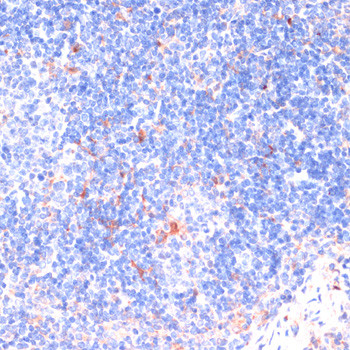
图: 1 / 4
ZNRF3 Antibody (PA5-120417) in IHC (P)
Immunohistochemistry analysis of ZNRF3 in paraffin-embedded mouse spleen. Samples were incubated with ZNRF3 Polyclonal antibody (Product # PA5-120417) using a dilution of 1:100 (40x lens). Perform microwave antigen retrieval with 10 mM PBS buffer pH 7.2 before commencing with IHC staining protocol.

Please note: We are reviewing Western blot images included in the antibody testing data in our catalog, including those provided by third parties. Unless expressly labeled or annotated as “raw-unedited”, Western blot images included in the antibody testing data in our catalog may have been edited, optimized or otherwise adjusted for presentation.


产品信息
PA5-120417
应用
建议稀释比
已发表文章
产品规格
种属反应
Human,
Mouse,
Rat
宿主/亚型
Rabbit
/ IgG
分类
Polyclonal
类型
Antibody
抗原
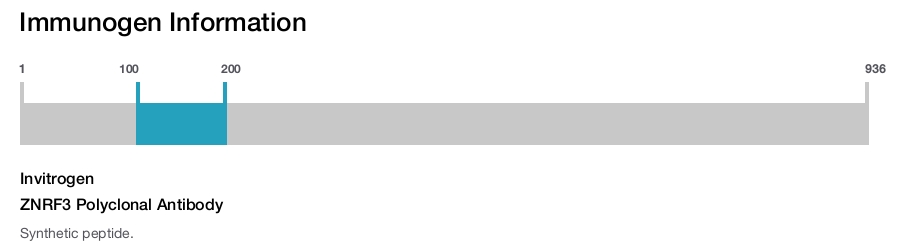
Synthetic peptide.
偶联物
Unconjugated
Unconjugated
Unconjugated
形式
Liquid
浓度
1.76 mg/mL
规格
176 µg
纯化类型
Affinity Chromatography
保存液
PBS, pH 7.3, with 50% glycerol
内含物
0.09% sodium azide
保存条件
-20°C, Avoid Freeze/Thaw Cycles
运输条件
Ambient (domestic); Wet ice (international)
RRID
产品详细信息
Positive test controls include: A-549.
Immunogen sequence: MHPLGLCNNN DEEDLYEYGW VGVVKLEQPE LDPKPCLTVL GKAKRAVQRG ATAVIFDVSE NPEAIDQLNQ GSEDPLKRPV VYVKGADAIK LMNIVNKQKV A
靶标信息
The ZNRF3 gene encodes a transmembrane E3 ubiquitin ligase that plays a critical role in regulating the Wnt signaling pathway, which is essential for various biological processes, including embryonic development and cell proliferation. ZNRF3 functions by negatively regulating this pathway through ubiquitination and degradation of Frizzled receptors, thereby suppressing the Wnt signaling. Located on chromosome 22, ZNRF3 acts as a tumor suppressor gene by inhibiting oncogenic Wnt signaling and has been implicated in the formation and progression of several cancers, particularly colorectal cancer. Moreover, ZNRF3 interacts with R-spondin proteins which are known to augment Wnt signaling by targeting ZNRF3 for degradation, thus facilitating cell differentiation and proliferation. Alterations in ZNRF3 expression or mutations can lead to aberrant Wnt signaling, contributing to tumorigenesis. Additionally, ZNRF3's role extends to its participation in lipid metabolism and maintenance of bone homeostasis. It has been studied as a potential therapeutic target due to its central involvement in these regulatory pathways.
仅用于科研。不用于诊断过程。未经明确授权不得转售。
篇参考文献 (0)
您是否在文献中引用过该产品?请点击下方按钮邮件告知我们。
生物信息学
蛋白别名: E3 ubiquitin-protein ligase ZNRF3; rCG35969-like; RING finger protein 203; RING-type E3 ubiquitin transferase ZNRF3; zinc and ring finger 3; Zinc/RING finger protein 3
基因别名: Gm1167; KIAA1133; RNF203; ZNRF3
UniProt ID: (Mouse) Q5SSZ7
Entrez Gene ID: (Rat) 685487, (Mouse) 407821
molecular_function
ubiquitin-protein transferase activity
frizzled binding
zinc ion binding
UDP-N-acetylmuramoylalanyl-D-glutamyl-2,6-diaminopimelate-D-alanyl-D-alanine ligase activity
ligase activity
ribosomal S6-glutamic acid ligase activity
coenzyme F420-0 gamma-glutamyl ligase activity
coenzyme F420-2 alpha-glutamyl ligase activity
metal ion binding
protein-glycine ligase activity
protein-glycine ligase activity, initiating
protein-glycine ligase activity, elongating
tubulin-glycine ligase activity
protein-glutamic acid ligase activity
tubulin-glutamic acid ligase activity
ubiquitin-dependent protein catabolic process
biological_process
protein ubiquitination
negative regulation of Wnt signaling pathway
Wnt receptor catabolic process
canonical Wnt signaling pathway
Wnt signaling pathway, planar cell polarity pathway
stem cell proliferation
negative regulation of canonical Wnt signaling pathway
negative regulation of non-canonical Wnt signaling pathway
Wnt signaling pathway
Disclaimer

Clicking the images or links will redirect you to a website hosted by BenchSci that provides third-party scientific content. Neither the content nor the BenchSci technology and processes for selection have been evaluated by us; we are providing them as-is and without warranty of any kind, including for use or application of the Thermo Fisher Scientific products presented.

